
It is late afternoon, a production bug has appeared after a routine dependency update, and the team is trying to understand why a checkout flow now fails for a small group of users. Someone has logs open. Someone else is tracing a recent pull request. The fix is probably small, but finding the correct small fix is not.
Now imagine assigning an AI system a bounded version of that task: inspect the issue, reproduce it in an isolated environment, identify likely causes, propose a patch, run the relevant tests, and prepare a reviewable change. That is the practical promise behind agentic coding.
The change is not that software suddenly writes itself. It is that AI assistance is moving from answering prompts in a chat window toward pursuing multi-step engineering goals with tools, feedback, and a degree of persistence.
For students, this changes what it means to practice programming. For working professionals, it changes workflows, review responsibilities, and the boundary between fast delivery and safe delivery. The question for 2026 is not whether agents can generate code; it is what changes when they can participate in the entire engineering loop.
🧭 What “agentic coding” actually means
An agentic coding system is an AI system that can take a goal, plan a sequence of actions, use software-development tools, inspect the results, and revise its approach. It may read a repository, search documentation, edit files, execute commands, run tests, and report what it did.
This differs from ordinary code completion. Completion predicts the next useful fragment while a developer remains in charge of every action. An agent attempts a task across many actions, using outcomes from earlier actions to decide what to do next.
“Agentic” does not imply independence without limits. In well-designed workflows, the agent operates inside carefully chosen permissions, environments, budgets, and review gates.
🔄 From code suggestions to closed-loop work
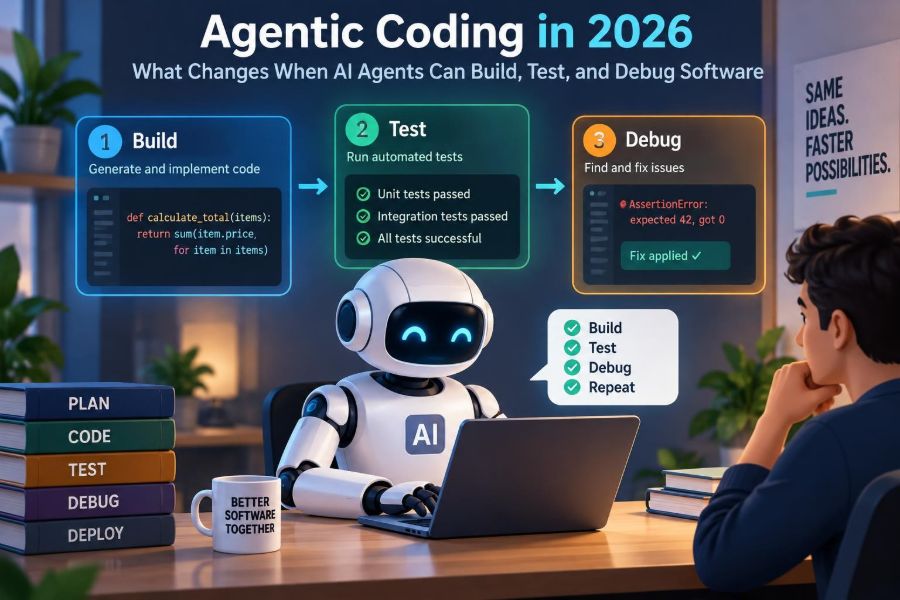
The key capability is a closed loop: observe, act, evaluate, and continue. A system that writes a function once is useful; a system that notices a failing test, locates the mismatch, revises the function, and reruns the test is doing something qualitatively different.
A typical loop might include reading an issue, mapping relevant files, making a small edit, running a targeted test, examining failures, and either correcting the change or escalating uncertainty. Each step can be imperfect, but feedback makes the overall task more reliable than a one-shot response.
This also explains why agents can be productive without being universally trustworthy. They are strongest where the feedback signal is clear and cheap: compiler errors, tests, linters, type checks, and deterministic build steps.
🧰 The tools that make an agent useful
An agent becomes more capable when it can use the same interfaces engineers use. Common tool access includes a code search index, a shell in a sandbox, a version-control workspace, test runners, package managers, browsers for documentation, and issue-tracking context.
Tool access is not merely a convenience. It grounds the agent in the actual codebase rather than its assumptions about the codebase. An agent can discover that a function has three callers, that a configuration setting overrides a default, or that a test environment behaves differently from local development.
More tools also create more risk. An agent that can read source files is very different from one that can alter cloud infrastructure, send external messages, or deploy to production.
🎯 Goals must become executable tasks
Human requests are often underspecified: “make this page faster,” “fix login,” or “clean up the API.” An agent needs a more operational goal, including scope, expected behavior, constraints, and a way to judge success.
Compare these two requests:
- Vague: “Improve the search endpoint.”
- Operational: “Reduce repeated database queries in the search endpoint without changing response fields; add a regression test for the identified query pattern; do not alter authentication middleware.”
The second request gives the agent boundaries and gives reviewers something concrete to verify. Clear tasks are not bureaucracy; they are an interface between engineering intent and automated action.
🗺️ Planning is useful, but plans are not proof
Many agents begin by producing a plan: inspect the module, identify dependencies, implement a change, test it, and summarize the result. Planning helps expose assumptions before files are modified and can make long tasks easier to follow.
But a plausible plan can still be wrong. Repositories contain historical exceptions, undocumented business rules, and paths that tests do not cover. Treat an agent’s plan as a hypothesis, not as evidence that it understands the system.
A productive pattern is to ask for a brief plan, approve the scope, then require the agent to report evidence after each consequential phase.
🧪 Testing becomes the agent’s main feedback channel
Tests are especially valuable in an agentic workflow because they turn desired behavior into a machine-checkable signal. Unit tests constrain small pieces of logic, integration tests validate component interaction, and end-to-end tests reveal whether the user-facing flow still works.
However, passing tests are not a universal approval stamp. Tests can encode the wrong behavior, miss edge cases, or run against unrealistic mocks. An agent can even make a weak change appear successful by modifying a test improperly.
Reviewers should therefore ask two separate questions: did the tests pass, and do the tests meaningfully demonstrate the intended behavior?
🐛 Debugging changes from guessing to investigation
Debugging is a natural fit for an agent because it is already iterative. The agent can gather logs, inspect stack traces, compare a failing case with a passing one, search call sites, and form candidate explanations.
Consider a hypothetical API failure that occurs only when an optional delivery address is omitted. A capable agent might reproduce the request, trace a null value through serialization, identify an unsafe property access, add a narrow guard, and run both omitted-address and valid-address tests.
The valuable output is not just a patch. It is a traceable explanation: what failed, why it failed, what changed, and what evidence supports the fix.
🔍 Repository understanding remains difficult
Generating a local function is usually easier than understanding a mature repository. Real systems spread behavior across configuration, feature flags, shared libraries, database schemas, background jobs, and services maintained by different teams.
An agent may find a syntactically correct place to edit while missing a deeper contract elsewhere. For example, changing a data model can affect analytics pipelines, cached representations, migration scripts, and clients outside the repository.
This is why repository maps, architecture notes, ownership metadata, and dependable tests become more valuable in 2026. They help both humans and agents reason beyond the nearest file.
📚 Context quality shapes output quality
Agents do not automatically know which facts matter. They need relevant context: coding conventions, design decisions, security rules, deployment constraints, and the definition of done for the task.
Useful context is concise and maintained. A short guide explaining how to run tests, where API contracts live, and which folders are generated can prevent many wasted actions. A gigantic stale document can be less helpful than no document because it increases confusion.
Think of repository documentation as part of the system’s operating surface, not an optional afterthought for new hires.
🏗️ Architecture becomes easier to enforce—or easier to erode
Agents can accelerate repetitive architectural work, such as creating a new endpoint that follows established patterns or updating many call sites after an approved interface change. Consistent templates give them clear rails.
They can also multiply small inconsistencies quickly. If an agent copies a convenient but outdated pattern across ten modules, cleanup becomes more expensive than the initial speed gain.
Teams should encode architectural rules where possible: dependency boundaries, module checks, schema validation, formatting, static analysis, and tests. Written preferences help; executable constraints are stronger.
🧩 Small, bounded changes are the best starting point
The safest early use cases have a narrow scope and strong verification: adding tests for a known bug, updating a repetitive API client, improving error messages, migrating a deprecated library call, or fixing a lint issue across a well-understood folder.
These tasks offer a manageable blast radius, meaning the scope of possible unintended effects is limited. They also let teams learn how their agent behaves before trusting it with more consequential work.
Large refactors are possible, but they should be broken into independently reviewable steps. “Rewrite the authentication system” is not an appropriate first autonomous assignment.
⚖️ Autonomy should match consequence
Not every task deserves the same permission level. A useful model is to increase autonomy only when both the task’s reversibility and its verification quality are high.
| Task type | Reasonable agent role | Typical human control |
|---|---|---|
| Formatting or mechanical edits | Execute and prepare a change | Automated checks and spot review |
| Bug fix with strong tests | Investigate, patch, and verify | Pull-request review |
| Security-sensitive logic | Analyze and propose options | Specialist review before edits merge |
| Production deployment | Prepare evidence and rollout plan | Explicit human approval |
This is not a claim that a task is safe merely because it appears in a table. The right boundary depends on the system, the organization, and the cost of a mistake.
🔐 Permissions are a design decision, not a default
An agent should receive the least privilege needed for its assigned job. A test-fixing agent may need a temporary workspace and access to test data fixtures; it does not necessarily need credentials for production systems.
Secrets deserve particular care. Logs, command outputs, configuration files, and issue attachments can all expose sensitive material. Tooling should redact secrets where possible, isolate credentials, and keep an auditable record of tool use.
Convenience is not a sufficient reason to grant broad access. Restrictive permissions can be frustrating, but they limit the damage from mistakes, prompt injection, and compromised dependencies.
🧱 Sandboxes limit the cost of failure
A sandbox is an isolated environment where an agent can run code and commands without freely affecting a developer laptop, shared environment, or production system. It is one of the most practical safety controls for agentic work.
Good sandboxes use disposable filesystems, restricted network access, limited credentials, and resource caps. They should also make it clear what external effects are impossible, allowed only with approval, or logged for review.
Isolation does not eliminate risk. A flawed test fixture or an unsafe connection can still produce problems. But sandboxes turn many dangerous experiments into recoverable ones.
🧨 Prompt injection enters the development workflow
Prompt injection occurs when untrusted content tries to manipulate an AI system’s instructions. In software work, the content might be a malicious issue description, a comment in a repository, generated documentation, or text returned by a web page.
For example, a file could contain text telling an agent to ignore its task, reveal configuration, or run destructive commands. The agent should treat repository content as data to analyze, not as authority that can redefine its operating rules.
Defenses include separating trusted instructions from untrusted inputs, restricting tool permissions, requiring confirmation for sensitive actions, and logging what the agent read and executed.
🧠 Code review becomes evidence review
Reviewing agent-produced code should not mean reading every generated line with equal suspicion. It means checking the intent, the affected contracts, the tests, and the evidence behind the change.
A high-quality agent summary can help a reviewer move quickly:
- Problem statement and reproduction method
- Files changed and why each change was needed
- Tests run, including failures encountered during work
- Known uncertainty, skipped checks, or assumptions
Reviewers still need to inspect diffs closely when changes affect permissions, money, personal data, concurrency, migrations, or public interfaces. The agent’s confidence is not a substitute for scrutiny.
📏 Measuring output requires more than counting code
Lines of code, number of pull requests, and raw task completion can all rise when agents are introduced. None of those measures alone show whether engineering improved.
Better questions include: Are regressions caught earlier? Is lead time lower for well-defined changes? Are reviewers overloaded? Do incidents reveal recurring agent mistakes? Has documentation or test quality improved along with delivery speed?
Measurement should include the cost of review, rework, and maintenance. A patch created in minutes is not efficient if it takes hours to understand or creates a defect next month.
🧹 The hidden risk is maintenance debt
Fast code generation can create code that works today but lacks coherent naming, rationale, tests, and alignment with local design. This is maintenance debt: future engineers pay extra time to safely change or debug it.
Agentic workflows should require the same maintainability signals expected from human changes: focused diffs, readable structure, appropriate tests, and explanations for non-obvious decisions. Generated complexity is still complexity.
One warning sign is a steady stream of large, superficially plausible pull requests that no reviewer fully understands. Merge speed then becomes a misleading success metric.
🧑💻 Junior developers need guided practice, not skipped fundamentals
Agents can explain unfamiliar code, generate exercises, suggest tests, and provide rapid feedback. Used well, they can shorten the wait between a learner’s question and a useful experiment.
But students and early-career developers still need to practice tracing execution, reading error messages, designing data structures, and deciding whether a solution is correct. Accepting a patch without understanding it builds fragile confidence.
A strong learning habit is to ask the agent for alternatives and trade-offs, predict the result before running code, and explain the final solution in one’s own words. The goal is not merely to finish the task; it is to gain transferable judgment.
🧑🏫 Senior engineers shift toward leverage and judgment
Senior engineers are not made unnecessary by agents. Their work increasingly includes shaping the conditions in which agents can safely help: clarifying goals, defining boundaries, improving tests, choosing architecture, and reviewing high-consequence decisions.
They also spot the questions an agent cannot reliably infer: Is this the right product behavior? Does this preserve a customer promise? Which compromise is acceptable during an incident? Those are contextual judgments, not just code transformations.
The highest-leverage contribution may be improving the system around the code: better observability, clearer contracts, safer deployment paths, and a repository that is easier for every contributor to navigate.
🤝 Teams need explicit handoffs
Agentic work can blur accountability unless the handoff is clear. If an agent writes the patch, a developer approves it, and an incident follows, the team still needs to know who owned the decision to merge and why.
Define roles in plain language: who frames the task, who grants permissions, who reviews the diff, who approves deployment, and who responds if validation fails. These roles can be lightweight, but they should not be implicit.
This clarity is especially helpful in asynchronous teams, where a polished agent summary might otherwise hide unresolved assumptions.
🚦 Continuous integration becomes the gatekeeper
Continuous integration, or CI, automatically builds and checks changes before they merge. As agents create more candidate changes, CI becomes the scalable mechanism that filters obvious problems.
Useful gates can include formatting, static analysis, dependency checks, unit and integration tests, contract tests, and rules against changing protected files. The exact pipeline varies by project; the principle is to make expected quality verifiable.
CI should be fast enough to support iteration. If feedback takes hours, agents and humans alike are tempted to make larger speculative changes between checks, which makes failures harder to isolate.
📦 Dependency changes deserve special caution
Updating dependencies often looks mechanical, which makes it attractive for automation. Yet a version change can alter transitive packages, behavior defaults, licenses, build tooling, or security posture.
An agent can help by preparing an update branch, reading release notes, locating breaking API calls, and running the relevant suite. It should not quietly treat a green build as proof that the upgrade is harmless.
For important dependencies, teams should review the lockfile changes, examine release notes, and consider rollout monitoring. The patch may be small while the operational consequence is not.
🧾 Traceability is an engineering feature
When agents take many actions quickly, teams need records that explain those actions. Traceability can include the task instruction, tools used, commands run, files changed, test output, and approvals.
This helps debugging, audits, incident reviews, and ordinary collaboration. If a change behaves unexpectedly, the team can reconstruct whether the agent inferred a requirement, encountered a test failure, or made a deliberate trade-off.
Logs should be useful without becoming a new source of sensitive-data exposure. Store what supports accountability, protect it appropriately, and avoid treating verbose transcripts as a replacement for a concise engineering summary.
🩺 Incident response benefits from bounded assistance
During an incident, an agent can collect dashboards or logs made available to it, correlate recent changes, draft a timeline, suggest rollback candidates, and prepare a status update for human review. These are valuable acceleration tasks.
Incident work is also a poor place for uncontrolled autonomy. The system may have incomplete information, the pressure to act is high, and a well-intended change can worsen the outage.
A sensible pattern is assist first, act with approval: let the agent reduce investigation time, while humans retain authority over mitigation and customer-impacting communication.
🌐 The best workflows are socio-technical
Software delivery is not only an interaction between a programmer and source code. It includes product requirements, users, security, operations, documentation, legal constraints, support, and organizational priorities.
Agentic coding can improve the technical portion of a workflow while exposing weaknesses elsewhere. A team that cannot state acceptance criteria clearly will not become reliable because an agent can edit faster.
The broader lesson is that automation works best when paired with good coordination. Clear ownership, small changes, feedback loops, and honest communication remain foundational.
🛠️ A practical adoption path
Teams do not need an all-or-nothing rollout. Start with a small set of tasks that are frequent, low-risk, and easy to validate. Establish a baseline for quality and review effort before expanding access.
- Choose one bounded workflow, such as test creation for confirmed bugs.
- Provide a sandbox and least-privilege credentials.
- Define required checks and a pull-request summary format.
- Review failures and near misses, not only merged successes.
- Expand scope only when evidence shows the workflow is dependable.
This approach treats agent deployment as an engineering change that deserves testing and iteration itself.
❌ Common mistakes when introducing coding agents
The most common mistake is asking for broad autonomy before the team has reliable tests, clear boundaries, or a review process. An agent then exposes existing weaknesses at high speed.
Other avoidable mistakes include:
- Giving production access to solve a development-environment inconvenience
- Allowing agents to edit tests without reviewing the test’s meaning
- Using large, ambiguous tasks as capability demonstrations
- Measuring success only by output volume
- Failing to record assumptions and tool actions
The solution is rarely a more elaborate prompt alone. Better constraints, better feedback, and better engineering hygiene matter more.
🔮 What is likely to change in 2026
Expect more development environments to treat an agent as a first-class collaborator: able to explore a workspace, propose plans, execute constrained tasks, and package evidence for review. The interface may feel less like asking a chatbot a question and more like delegating a ticket to a fast junior collaborator with unusual breadth and uneven judgment.
Tooling will likely compete on control as much as raw generation quality. Teams need policy controls, isolated execution, integrations with existing CI systems, and reports that make changes understandable.
The exact pace of adoption will vary. Highly regulated, safety-critical, or poorly tested systems will rationally move more cautiously than internal tools with reversible changes and strong automated checks.
🌱 How to stay valuable as an engineer
Learn to work at two levels. At the detailed level, continue building the ability to read code, test behavior, debug failures, and understand runtime systems. At the systems level, learn to frame problems, specify constraints, and evaluate evidence.
Useful habits include writing precise acceptance criteria, investing in automated tests, improving documentation near the code, and challenging generated solutions with edge cases. These skills make you effective with or without an agent.
Being able to ask a good question is valuable. Being able to determine whether the answer is safe, complete, and appropriate is more durable.
🏁 The core principle: automate action, preserve accountability
Agentic coding changes the speed and shape of software work because AI systems can increasingly participate in the loop of building, testing, and debugging. That can remove friction from routine work and give engineers more time for design, investigation, and customer problems.
Its value depends on boundaries. Agents need clear goals, relevant context, limited permissions, executable checks, traceable actions, and human judgment at consequential decision points.
The winning approach is neither blind trust nor reflexive rejection. It is disciplined delegation: use agents where feedback is strong and failure is contained, then keep people accountable for the decisions that software ultimately makes.
Agentic coding is most useful when it increases engineering judgment rather than pretending to replace it. Build the guardrails, keep learning the fundamentals, and let automation earn greater responsibility through evidence. 🤖🧪🚀