
A customer taps “Place order” during a flash sale. The payment provider takes a little longer than usual to respond, inventory is being updated by another service, and the confirmation email system is temporarily busy. The customer expects one simple outcome: either the order worked or it did not.
Behind that button, however, a modern application may need to coordinate several independent systems. If each system calls every other system directly and waits for an immediate answer, a brief slowdown in one place can turn into a failed checkout everywhere.
Message queues offer a more resilient way to connect that work. They let one part of a system record a task for another part to handle, often without forcing both parts to be healthy, fast, and available at exactly the same moment.
They are not magic infrastructure, and they introduce real design responsibilities. But once their trade-offs are understood, queues become a practical tool for making payments, e-commerce flows, notifications, and distributed systems easier to scale and recover.
📬 What a Message Queue Actually Does
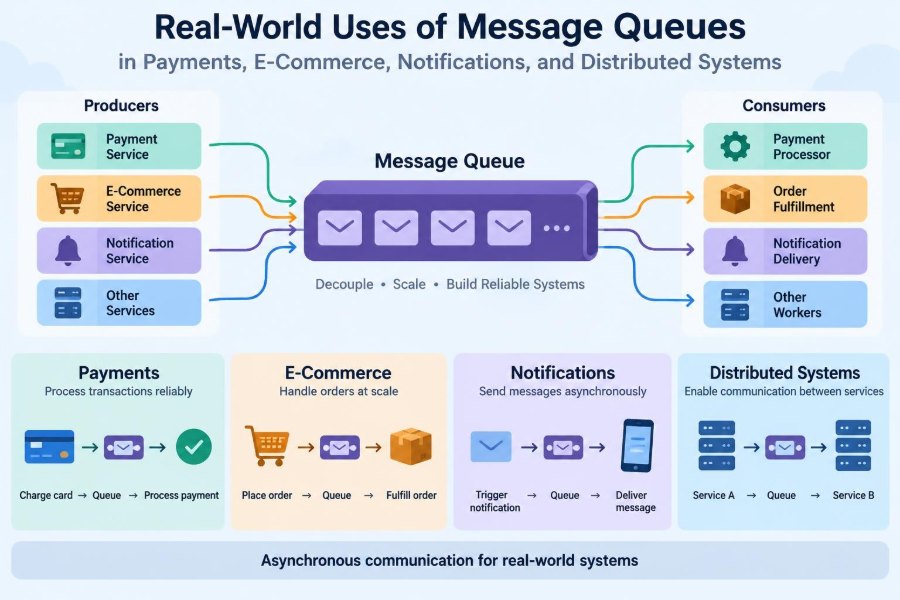
A message queue is a system that stores messages until a consumer can process them. A producer sends a message, such as order.created; a consumer receives it and performs work, such as reserving stock or sending a receipt.
The queue sits between them. This separation means the producer does not need to know whether the consumer is currently busy, restarting, or being deployed.
🔌 Why Direct Service Calls Become Fragile
In a synchronous request chain, the checkout service might call payments, inventory, fulfillment, email, analytics, and fraud screening before responding. Each dependency adds latency and another opportunity for a timeout.
Some decisions really must be synchronous, especially whether a payment authorization succeeded. Many follow-up actions do not. Moving non-critical work off the request path keeps the customer-facing action narrower and more predictable.
⏳ Decoupling Time, Not Just Code
Queues are often described as decoupling services, but their most useful effect is temporal decoupling. A producer can finish its immediate responsibility now, while a consumer performs secondary work seconds or minutes later.
That distinction matters during incidents. An email outage should not necessarily prevent a valid purchase from being recorded, and a reporting job should not delay a customer’s refund.
📦 Messages Are Contracts Between Systems
A message is data describing something that happened or work that should be done. Examples include an event such as payment.authorized and a command such as send-receipt.
Treat its structure as a contract. Include stable identifiers, timestamps when useful, a schema version, and only the information a consumer needs. A vague or constantly changing message format turns a queue into a hidden source of coupling.
🧾 The Checkout Workflow as a Running Example
Consider a hypothetical store. Its order service validates the basket, creates an order with a pending state, and requests payment authorization. Once that result is stored, it publishes an event indicating the next state.
Inventory, shipping, customer messaging, loyalty, and analytics can react independently. The customer sees the order result without waiting for every internal subscriber to finish.
💳 Keeping Payment Decisions Correct
Payments are a place to be careful with asynchronous design. A system should not tell a customer that money has been captured merely because it placed a message on a queue. The authoritative payment result must come from the payment processor or the system responsible for the ledger.
Queues are excellent for processing payment-related follow-up work, reconciling provider callbacks, and isolating downstream systems. They do not remove the need for clear payment states, auditing, and safe retry behavior.
🔁 Payment Webhooks Need Durable Handling
Payment providers commonly notify merchants through webhooks. A receiving endpoint can validate the notification, store the relevant event durably, and enqueue processing rather than attempting every business action inside the HTTP request.
This makes acknowledgement fast while allowing a worker to update the order later. The handler must still verify authenticity, identify duplicate provider events, and retain enough data to investigate mismatches.
🧮 Idempotency Prevents Duplicate Charges and Actions
In distributed systems, a message may be delivered more than once. A network interruption can occur after a worker completes work but before the broker records its acknowledgement. Retrying is sensible; blindly repeating the side effect is not.
Idempotency means processing the same request repeatedly produces the intended single result. For example, store a provider event ID or payment operation key and reject or safely return the prior result when it reappears.
🛒 Reserving Inventory Without Overselling
Inventory is shared state, so a queue alone does not solve overselling. If two workers reserve the last item simultaneously, the inventory service still needs an atomic database operation, lock, or conditional update.
A useful pattern is to create a temporary reservation after payment authorization, then confirm or release it as the order progresses. Messages coordinate the stages; the inventory authority enforces the actual quantity rule.
📮 Order Events Let Teams Move Independently
Publishing an order.confirmed event lets different capabilities evolve without adding more calls to checkout. A fulfillment service can create a pick task, a CRM system can record the purchase, and a data pipeline can update aggregates.
This is valuable organizationally as well as technically. Teams own consumers suited to their domain instead of modifying a central checkout service for every new downstream requirement.
📣 Notification Delivery Is Naturally Asynchronous
Email, SMS, push notifications, and chat messages are classic queue workloads. A user action can generate a notification task, and workers can send it while respecting provider limits and retrying temporary failures.
The application should record notification intent separately from delivery outcome. “Receipt requested,” “accepted by provider,” and “opened by recipient” are different facts and should not be treated as interchangeable.
🧰 One Notification Event, Several Channels
A delivery service can choose channels based on preferences and urgency. A shipping delay might create an email and an in-app notification, while a security-related message may have stricter channel rules.
Keep the business event distinct from channel-specific rendering. shipment.delayed describes the domain fact; an email template, push payload, and localization process are separate consumers or stages.
🚦 Queues Absorb Traffic Spikes
During a product launch, producers may create work faster than consumers can complete it. The queue provides a buffer, allowing workers to catch up rather than forcing the producer to fail immediately.
This is load leveling, not unlimited capacity. If the arrival rate remains higher than processing capacity, backlog grows. Monitoring queue depth and message age reveals whether the system is recovering or falling behind.
👷 Worker Pools Scale Background Work
Consumers usually run as worker processes. When a queue builds up, a platform may start more workers; when it is quiet, it may run fewer. This can be cheaper and safer than permanently scaling every web server for rare bursts.
Scaling has limits. Payment APIs, databases, and email providers may impose concurrency limits. More workers can worsen failures if they overwhelm the dependency they were meant to serve.
🧭 Ordering Is More Limited Than It Sounds
Many developers assume queues preserve a universal order. In practice, multiple consumers, retries, partitions, and delayed messages can change the order in which work completes.
If order matters for one customer or one order, use a partition or grouping key where the technology supports it, or make the consumer validate state transitions. Do not rely on broad “first in, first out” assumptions without checking the broker’s guarantees.
✅ Acknowledgements Mark Completed Work
After processing a message, a consumer acknowledges it. If the worker crashes first, the broker can make the message available again. This creates durability, but it also explains why duplicate delivery is normal rather than exceptional.
Acknowledge only after the required durable effect is complete. Acknowledging before a database update risks losing work; acknowledging far too late can needlessly hold messages and reduce throughput.
🧱 Delivery Guarantees Need Plain Language
Queue documentation may use terms such as at-most-once, at-least-once, and exactly-once. These labels describe delivery behavior, not a guarantee that every external side effect happened exactly one time.
| Approach | Typical trade-off |
|---|---|
| At-most-once | Can lose work, but avoids redelivery. |
| At-least-once | Retries improve completion, but consumers must handle duplicates. |
| Exactly-once claims | May apply only within defined boundaries; external APIs still need idempotency. |
For most business workflows, at-least-once delivery plus idempotent consumers is a practical and honest design.
🗃️ The Outbox Pattern Avoids a Dangerous Gap
A common failure occurs when an application writes an order to its database and then publishes an event. If it crashes between those operations, the order exists but no event is sent. Reversing the order creates the opposite inconsistency.
The outbox pattern stores the business change and an outgoing message record in the same database transaction. A separate publisher reads unsent outbox rows and delivers them, accepting that duplicates remain possible.
⚰️ Dead-Letter Queues Preserve Problem Messages
A malformed message or a permanent validation failure should not block normal processing forever. After a defined number of failed attempts, many systems route the message to a dead-letter queue (DLQ).
A DLQ is not a trash bin. It needs alerts, investigation procedures, and safe replay tooling. Otherwise, failed refunds, orders, or customer messages quietly become invisible operational debt.
🔄 Retries Need Backoff and Classification
Retrying a temporary network failure is reasonable. Retrying “customer email address is invalid” hundreds of times is wasteful. Consumers should distinguish transient faults from permanent business failures where possible.
Use delayed retries and exponential backoff to avoid hammering an unhealthy service. Add jitter—a small random delay—when many workers could retry at once and create a synchronized surge.
🔒 Secure Messages and Minimize Sensitive Data
Queues can contain personal information, order data, and operational instructions. Apply access controls so only intended producers and consumers can read or publish, and encrypt data in transit and at rest when the platform supports it.
Do not use messages as a casual store for secrets or unnecessary payment data. Prefer references to protected records when consumers can retrieve authorized details, and define retention policies for message payloads and DLQs.
🕵️ Trace One Order Across Many Services
Asynchronous systems are harder to follow because the work no longer appears in one request log. Put a correlation ID, such as an order ID or trace ID, in messages and include it in structured logs.
Useful operational views include queue depth, oldest-message age, processing latency, retry count, failure rate, and DLQ volume. Metrics tell operators where work is accumulating; correlated logs help explain why.
🧪 Test Failure Paths, Not Only Happy Paths
Testing a worker once with a valid message is not enough. Simulate duplicate delivery, consumer crashes, slow dependencies, invalid payloads, out-of-order events, and a broker that is temporarily unavailable.
For a payment flow, also test ambiguous outcomes: the provider received a request but the caller timed out. The correct response is often reconciliation using an idempotency key or provider-side status lookup, not a second charge attempt.
🧑💻 Consumer Deployments Must Be Compatible
Producers and consumers rarely deploy at the same instant. Additive schema changes—such as a new optional field—are generally safer than renaming or removing fields consumers may still expect.
Version messages deliberately when a breaking change is unavoidable. A consumer should validate inputs, tolerate unknown fields where appropriate, and fail visibly rather than silently interpreting a changed value incorrectly.
🧠 Commands and Events Should Not Be Blurred
A command requests an action from a particular owner: reserve-inventory. An event announces a fact that has already occurred: inventory.reserved. The difference affects ownership, retries, and expectations.
Using events as if they were commands can create accidental multiple handlers for an action that should happen once. Using commands for every notification can make systems unnecessarily centralized. Name messages for their meaning, not merely their transport.
🏗️ Event-Driven Does Not Mean Everything Needs a Queue
A queue adds operational components, monitoring, eventual consistency, and debugging complexity. A simple internal application with one database transaction may be clearer without one.
Use asynchronous messaging where independent work, burst handling, slow integrations, or resilience across service boundaries justify the cost. Keep a direct synchronous call when the caller genuinely needs the answer immediately and the dependency is part of the same decision.
⚠️ Common Designs That Cause Trouble
- Publishing before committing data: consumers may read an entity that does not yet exist.
- Assuming one delivery: duplicate emails, double fulfillment attempts, or repeated ledger entries follow.
- Putting huge payloads on queues: broker cost, latency, and retention risk increase.
- No ownership for failures: DLQs fill while business problems remain unresolved.
- Making every action asynchronous: users receive unclear outcomes for decisions that require immediate confirmation.
🗺️ A Practical Design Checklist
Before adding a queue, describe the business outcome and failure behavior in ordinary language. Ask what happens if the producer succeeds but the consumer is down, if the message is repeated, and if processing occurs tomorrow rather than now.
- Define the source of truth and state transitions.
- Choose an idempotency key for each side effect.
- Set retry, backoff, DLQ, and replay policies.
- Document ordering requirements explicitly.
- Instrument backlog, age, failures, and end-to-end latency.
🌐 The Core Principle: Durable Work Across Boundaries
The best use of a message queue is not “make everything asynchronous.” It is to make independent work durable across a boundary where timing, load, and availability cannot be assumed.
In payments, that means separating authoritative financial decisions from retriable follow-up processing. In e-commerce, it means coordinating orders, stock, fulfillment, and communication without a brittle chain of calls. In notifications, it means delivering reliably without holding up the action that triggered the message.
Queues succeed when paired with explicit state, idempotent consumers, observability, and a real plan for failures. They move complexity out of a single request path, but responsible engineering makes that complexity visible and manageable.
A message queue is most valuable when it turns uncertain timing into durable, observable, safely repeatable work. Used with clear ownership and careful failure handling, it helps distributed systems remain useful even when individual components are busy, slow, or temporarily unavailable. ⚙️📬🔁