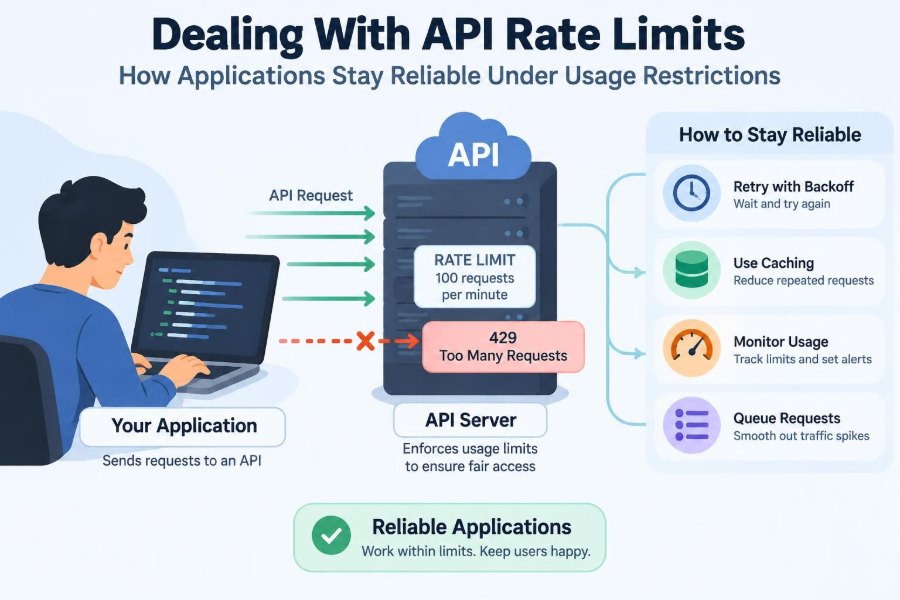

A product launch goes well until the dashboard suddenly fills with failed requests. Users refresh a page, a background job starts processing a backlog, and a popular third-party API begins returning HTTP 429: Too Many Requests.
This is not necessarily a sign that the external service is broken. The application may simply be asking for more than the service is prepared—or willing—to provide in a given period.
Rate limits are a normal part of building on APIs. They protect shared infrastructure, prevent abuse, and help providers give predictable service to many customers. But if an application treats them as unexpected errors, a brief burst can become slow screens, duplicated work, and frustrated users.
Reliable software does not try to defeat usage restrictions. It understands them, plans around them, and responds calmly when the boundary is reached.
🚦 What an API Rate Limit Actually Is
An API rate limit is a rule that controls how many requests a client may make over some interval. An API provider might limit requests per minute, per hour, per day, or according to a more flexible algorithm.
A “client” can mean an API key, an authenticated user, an IP address, an organization, an application, or a combination of these. That detail matters: a limit shared by an entire company behaves very differently from a limit assigned to each end user.
Rate limiting is about request volume, not necessarily how much data a request transfers. One endpoint may also have a separate limit because it performs expensive work, such as generating a report or searching a large dataset.
🛡️ Why Providers Put Limits in Place
APIs are shared systems. Without controls, a buggy integration, a scraper, or a sudden traffic spike could consume resources needed by everyone else.
Limits help providers manage several practical concerns:
- Protecting databases, CPUs, and downstream services from overload.
- Reducing abusive or accidental high-volume behavior.
- Making costs and capacity more predictable.
- Preserving fair access among customers and tenants.
- Giving operators room to recover from incidents without total collapse.
A limit is therefore a service contract as much as a restriction. It communicates the pace at which a consumer can safely use a shared capability.
📬 Recognizing a Rate-Limited Response
Many HTTP APIs use status code 429 Too Many Requests when a caller has exceeded a rate limit. Some APIs may use a different response format or return a domain-specific error code, so client code should follow the provider’s documentation rather than assume every limit looks identical.
Useful responses often include headers that describe the remaining allowance, the limit, or the time when the allowance resets. A Retry-After header can tell the client how long to wait before trying again.
Do not treat every 429 as a generic server failure. Record the endpoint, credential scope, response headers, request purpose, and timestamp. Those details turn a vague incident into something engineers can diagnose.
🧮 The Different Ways Limits Are Measured
“One hundred requests per minute” sounds clear, but real policies often have multiple dimensions. A request can be valid under one limit and rejected under another.
| Limit dimension | What it controls | Common consequence |
|---|---|---|
| Request count | Number of calls in a period | Polling too frequently triggers rejection. |
| Concurrent requests | Calls in flight at the same time | A wide worker pool overloads an endpoint. |
| Payload or cost units | Work, records, tokens, or bytes consumed | Large queries use the budget faster. |
| Per-user quota | Allowance for one user or tenant | One active user receives a localized error. |
| Global quota | Allowance shared by an app or account | One workflow affects everyone using the app. |
Design decisions should be based on the policy that actually applies, including any endpoint-specific rules.
🪣 Fixed Windows and Their Boundary Problem
A fixed-window limiter counts requests inside rigid blocks of time, such as each calendar minute. When the next window begins, the counter resets.
This method is simple, but it can allow a burst at a boundary. For example, a client could make its full allowance immediately before one minute ends and again immediately after the next begins. The two bursts are close together even though each technically falls in a separate window.
Clients should not rely on exploiting boundaries. A stable integration paces requests smoothly, because providers may change their implementation or apply other protections.
🪙 Sliding Windows, Tokens, and Leaky Buckets
A sliding window evaluates usage across a moving period, which reduces the sharp boundary effect. If the rule is 60 requests in the previous minute, each new request is assessed against the preceding 60 seconds.
Two useful mental models are the token bucket and the leaky bucket. In a token bucket, tokens arrive at a steady rate and each request spends one. Stored tokens allow a limited burst. In a leaky bucket, work exits at a controlled pace, smoothing bursts into a steadier flow.
Providers need not reveal their exact algorithm. For consumers, the operational lesson is the same: brief bursts may be allowed, but sustained pressure has a ceiling.
🏷️ Know Which Identity Is Being Limited
A service that limits per API key can be affected by every server, worker, and developer tool using that key. A per-user limit may instead be triggered by one unusually active account.
This distinction changes the remedy. If a global account quota is exhausted, retrying each user request independently can create a retry storm. If the quota is per user, isolating that user’s workload can protect the rest of the application.
Document credential ownership and quota scope. Shared production credentials, staging environments, scheduled jobs, and local testing can unintentionally compete for the same allowance.
🔍 Read Documentation as an Operational Contract
Rate-limit documentation should be read before a feature is built, not only after it fails. Look for default quotas, endpoint-specific restrictions, pagination guidance, batch operations, retry requirements, and whether limits vary by plan or authentication method.
Also identify what happens during a provider incident. Limits can be temporarily tightened, responses can be delayed, and a normally available endpoint can become unavailable. A client must distinguish a published quota rule from a broader service-health problem.
Where documentation is unclear, test conservatively in a non-production environment if possible. Avoid “probing” production limits by deliberately flooding an API.
📈 Measure Demand Before Choosing a Fix
Rate-limit failures are often symptoms of an unexamined demand pattern. A team may add retries when the real issue is that ten application servers all poll the same resource every few seconds.
Measure calls by endpoint, caller, tenant, result, and time bucket. Separate interactive traffic from background jobs. Then ask what creates demand: user actions, page loads, refreshes, webhooks, scheduled synchronization, retries, or internal fan-out.
A request budget becomes meaningful when it is compared with realistic peak behavior, not only average daily traffic. The busiest few minutes are usually where reliability decisions are tested.
🧠 Make Fewer Calls Through Better Product Design
The most reliable request is often the request never sent. Before tuning retry logic, inspect whether the user experience or service workflow generates unnecessary API calls.
For instance, a search box that calls a remote API on every keystroke can wait briefly for typing to pause. A dashboard can refresh only the data that changed instead of reloading every widget. A “sync now” button can show the latest completed sync rather than starting overlapping jobs.
Reducing demand improves latency and cost as well as quota usage. It also leaves more headroom for genuine spikes.
🗃️ Cache Data With an Explicit Freshness Rule
A cache stores a previously retrieved result so later requests can reuse it. It is especially effective for data that changes slowly, such as reference records, public metadata, configuration, or stable catalog information.
Every cache needs a freshness decision. A short time-to-live may preserve freshness but offer little protection during bursts. A long time-to-live saves calls but can display stale information. The right choice depends on the consequences of stale data.
Use cache keys carefully. If results differ by user, region, permission, or query parameters, a key that is too broad can expose the wrong data. Caching is a correctness concern, not only a performance optimization.
🧩 Coalesce Identical Work
Imagine 200 users opening a page that needs the same remote status value at nearly the same moment. Without coordination, the application may send 200 identical calls before its cache is populated.
Request coalescing, sometimes called single-flight behavior, lets the first caller perform the work while other callers wait for and reuse its result. This prevents a cache miss from becoming a sudden stampede.
Coalescing must include timeouts and failure handling. Waiting callers should not remain blocked indefinitely if the leading request hangs or fails.
📦 Batch Requests When the API Supports Them
Some APIs allow a client to request several records in one call or submit many independent operations as a batch. This can substantially reduce request count and connection overhead.
Batching is not automatically better. Very large batches can increase response time, make retries more complicated, and hit payload-size limits. A failed batch may require determining which individual items were processed.
Choose batch size based on documented limits, latency, memory use, and failure behavior. When possible, assign each item an idempotency key or stable identifier so partial processing can be handled safely.
📄 Paginate Instead of Asking for Everything
List endpoints commonly use pagination: results arrive in pages rather than one enormous response. Cursor-based pagination often provides a continuation token, while offset-based pagination specifies where to begin.
Fetch only the pages a user needs. A screen displaying the first page should not quietly retrieve every historical record “just in case.” Background exports may need full traversal, but they should be scheduled, paced, and resumable.
Cursor pagination is often more stable when records change during traversal, though behavior depends on the API. Follow the provider’s specified ordering and cursor rules.
🔔 Prefer Events Over Constant Polling
Polling repeatedly asks, “Has anything changed?” Webhooks, event streams, and provider notifications allow the provider to tell the application when something changes instead.
For example, an order-management system can receive an event when an order status changes rather than checking every order on a timer. This reduces empty requests and can improve how quickly meaningful updates arrive.
Events introduce responsibilities of their own: authenticate incoming messages, verify signatures when supported, handle duplicate delivery, and recover missed events through reconciliation. They reduce polling pressure; they do not remove the need for reliable processing.
⏳ Retry Only Failures That May Succeed Later
A retry is appropriate when a failure appears temporary, such as a 429 with a clear reset time, a network timeout, or a transient server error. It is usually wasteful for malformed requests, failed authentication, or validation errors.
Classify errors rather than placing all failures in one retry loop. The API’s documentation should guide which status codes are retryable and whether a response body gives a machine-readable reason.
Retries consume capacity too. A client that retries every rejected request immediately is not recovering; it is increasing the load that caused rejection.
🎲 Use Exponential Backoff With Jitter
Exponential backoff increases the delay after each failed attempt: perhaps a short pause, then a longer one, then longer again up to a defined maximum. It gives an overloaded system room to recover.
Jitter adds controlled randomness to the delay. Without it, many workers that fail together can retry at the same exact moments, causing synchronized spikes known as the thundering herd problem.
Honor Retry-After when it is supplied, unless documentation says otherwise. Set a maximum attempt count and an overall deadline. A background task that retries forever can silently consume a shared quota for days.
🧾 Idempotency Makes Retries Safer
An operation is idempotent if repeating it has the same intended effect as doing it once. Reading a record is usually naturally idempotent. Creating a payment, sending an email, or creating a support ticket may not be.
A timeout is ambiguous: the server may have completed the action even though the client never received the response. Retrying a non-idempotent request without protection can create duplicate charges, messages, or records.
When an API supports idempotency keys, reuse the same key for retries of the same logical operation. Otherwise, use application-level deduplication and reconciliation to determine what actually happened.
🚥 Control Concurrency, Not Just Request Rate
Rate limits describe how much work is allowed over time, but a client can cause trouble by sending too many requests simultaneously even when its average rate seems acceptable.
Use bounded worker pools, semaphores, or queues to cap in-flight requests. A concurrency limit protects local resources too: sockets, memory, database connections, and thread pools can all be exhausted while waiting for remote responses.
The correct value is context-dependent. Start conservatively, observe latency and error rates, and adjust with awareness of both provider rules and the application’s own capacity.
🧵 Put Background Work Behind a Queue
Queues decouple accepting work from performing it. Instead of calling a constrained API directly for every user action, an application can store a job and let workers process jobs at a controlled pace.
This is useful for imports, notifications, report generation, media processing, and synchronization. The user can receive a clear “scheduled” or “processing” status rather than waiting on a long chain of remote calls.
A queue needs operational design: durable job storage, visibility into retries, a dead-letter path for repeatedly failing jobs, and limits that prevent one tenant from monopolizing workers.
⚖️ Share a Global Budget Fairly
In distributed systems, each process may behave correctly by itself while the fleet exceeds a shared account limit together. Local counters are not enough when many replicas use the same credentials.
A centralized rate limiter, a shared token mechanism, or a dedicated outbound gateway can coordinate the global budget. These approaches add complexity, but they prevent independent workers from unknowingly racing each other.
Fairness matters too. Consider separate queues or quotas for interactive requests, scheduled jobs, and large tenants. Otherwise, a bulk import can consume the capacity needed for a user-facing workflow.
🧭 Prioritize Work When Capacity Is Scarce
Not all API calls have equal business value. When the budget is tight, an application should preserve the requests that matter most.
For a hypothetical commerce application, confirming a customer action may rank above refreshing analytics, while a nightly historical sync may safely wait. Define these priorities before an incident rather than improvising them under pressure.
- Serve essential interactive actions first.
- Delay refreshable or decorative data.
- Pause bulk jobs when error rates rise.
- Give users honest status instead of repeatedly attempting a doomed action.
Prioritization turns a hard quota into graceful degradation rather than an all-or-nothing outage.
🧱 Design Graceful Degradation
Graceful degradation means the product remains useful when a dependency is constrained. A screen might show cached information with a “last updated” time, temporarily disable a nonessential action, or offer an asynchronous completion notice.
It does not mean hiding failures. Users need clear language when an action is delayed or cannot yet be completed. Internal systems need enough context to retry appropriately without promising an immediate result.
Decide which features can use stale data, which can be queued, and which must fail fast. Those choices are product decisions informed by technical limits.
📊 Observe the Whole Request Lifecycle
Good monitoring shows more than the number of 429 responses. Track request rate, latency, success and error classes, retries, queue depth, cache hit rate, remaining quota when available, and work abandoned after retry limits are reached.
Tag metrics by endpoint and workload type. A single aggregate error rate can conceal a background job damaging one costly endpoint while ordinary user traffic remains healthy.
Logs and traces should make a request path visible across services. Correlation IDs help connect one user action to retries, queue jobs, cache decisions, and the final upstream response.
🚨 Alert on Trends, Not Only Total Failure
An alert that fires only when every request is rejected comes too late. Early signals include declining remaining quota, rising retry volume, a growing queue, repeated cache misses, and an unusual increase in a single endpoint’s traffic.
Alerts should be actionable. A useful alert identifies the affected credential or service, the time window, the primary endpoint, and a runbook step such as pausing a worker class or inspecting a recent deployment.
Avoid alert fatigue. A brief, automatically recovered 429 may be worth recording but not waking someone up for; sustained impact on an essential workflow is different.
🧪 Test Limits Before Production Traffic Finds Them
Test the client’s behavior with simulated 429 responses, delayed responses, missing headers, and partial batch failures. Verify that backoff occurs, retries stop at their configured limit, and users receive sensible outcomes.
Load testing should include realistic burst patterns, not only a smooth average rate. Also test distributed behavior: multiple workers, multiple deployments, and shared credentials often reveal coordination problems absent from local development.
Use a sandbox or mock server where available. Testing should validate resilience without violating a provider’s acceptable-use expectations.
🧰 Build a Reusable API Client Layer
Scattering HTTP calls throughout an application makes consistent rate-limit handling difficult. A shared client layer can centralize authentication, timeouts, response parsing, retry policy, telemetry, idempotency support, and rate-budget coordination.
Centralization should not become an opaque “retry everything” utility. The caller must still declare whether an operation is safe to retry, how long it may wait, and what result is acceptable if fresh data is unavailable.
Clear interfaces make policy visible. For example, an interactive read may have a short deadline, while a durable background job can wait and retry through a queue.
🧯 Avoid the Most Common Failure Patterns
Several tempting responses reliably make rate-limit incidents worse:
- Immediate retries: rejected requests are resent in a tight loop.
- Unlimited parallelism: every queued item starts at once.
- Blind polling: clients repeatedly request unchanged data.
- Retrying non-idempotent writes: ambiguous failures create duplicates.
- Ignoring shared scope: each service assumes it owns the full budget.
- Silent stale data: users act on old information without being told.
These failures often arise from treating the API as an infinitely available local function. It is a remote, shared dependency with its own capacity and rules.
🤝 Communicate With the Provider When Needed
If legitimate demand consistently exceeds a published quota, investigate product and architectural improvements first. Then, if appropriate, discuss the use case with the API provider. Some services offer higher quotas, different access tiers, bulk endpoints, or guidance for specific integration patterns.
Bring useful evidence: affected endpoints, typical and peak request patterns, why the calls are needed, existing caching or batching measures, and the operational impact. A request for more capacity is more credible when it reflects responsible client behavior.
Never assume a higher limit removes the need for backoff, observability, or graceful degradation. Capacity changes can shift the threshold, not eliminate failures.
🧭 A Practical Response Plan
When rate limiting begins affecting users, work through a calm sequence. First, identify the limit scope and affected endpoint. Next, stop behavior that multiplies demand, such as an aggressive retry loop or runaway job.
- Inspect 429 responses, headers, and recent traffic changes.
- Pause or slow low-priority background workloads.
- Honor retry timing and apply bounded backoff with jitter.
- Serve cached or delayed results where product rules allow.
- Check for duplicated workers, deployments, or shared-key consumers.
- After recovery, fix the demand pattern rather than merely raising thresholds.
This sequence protects users now while creating the evidence needed to prevent recurrence.
✅ The Core Principle: Treat Capacity as a Shared Resource
Reliable API integrations are built around a simple idea: external capacity is finite, variable, and shared. Rate limits make that reality visible.
The strongest design combines prevention and recovery. It avoids needless calls through caching, batching, events, and careful product choices; controls remaining work through queues and concurrency limits; and handles temporary rejection with informed retries, idempotency, and observability.
When applications cooperate with the services they depend on, they protect their users, their own infrastructure, and the wider ecosystem using the same API.
Applications stay reliable under API rate limits by budgeting requests deliberately, reducing avoidable demand, and recovering from rejection without creating more pressure. That discipline turns a quota from a surprise failure into a manageable engineering constraint. ⚙️📈🤝