
You transfer money from a savings account to a checking account. The app confirms the transfer, but a network interruption occurs halfway through. Did the money leave one account without reaching the other?
Or consider an online store selling its last concert ticket. Two customers press “buy” at nearly the same instant. Can both receive a confirmation for the same seat?
These are not edge cases created by dramatic demos. Systems that handle payments, inventory, bookings, medical records, and account permissions regularly face failures, retries, and simultaneous requests.
Database transactions give software a controlled way to treat several related database changes as one reliable unit of work. The familiar ACID properties describe the guarantees that make this possible.
🧩 What a Database Transaction Is
A transaction is a sequence of database operations that the database processes as a single logical action. The sequence either succeeds as a whole or does not take effect at all.
For example, a bank transfer may subtract an amount from one account, add it to another, and save an audit record. Those changes belong together. A partial transfer would leave the data in an invalid state.
Transactions are typically delimited by commands or API calls equivalent to BEGIN, COMMIT, and ROLLBACK. Exact syntax differs by database and framework.
🏪 Why Related Changes Must Travel Together
Many business actions are represented by more than one row, table, or document. An order may create an order record, reserve inventory, apply a discount, and record a payment authorization.
Without a transaction, an application could complete the first two writes and crash before the remaining writes. The database would contain evidence of an order whose inventory or payment state does not match reality.
A transaction lets developers state the intended boundary: “These operations represent one decision.” That boundary is as much a business concept as a technical one.
🔄 A Simple Transfer Example
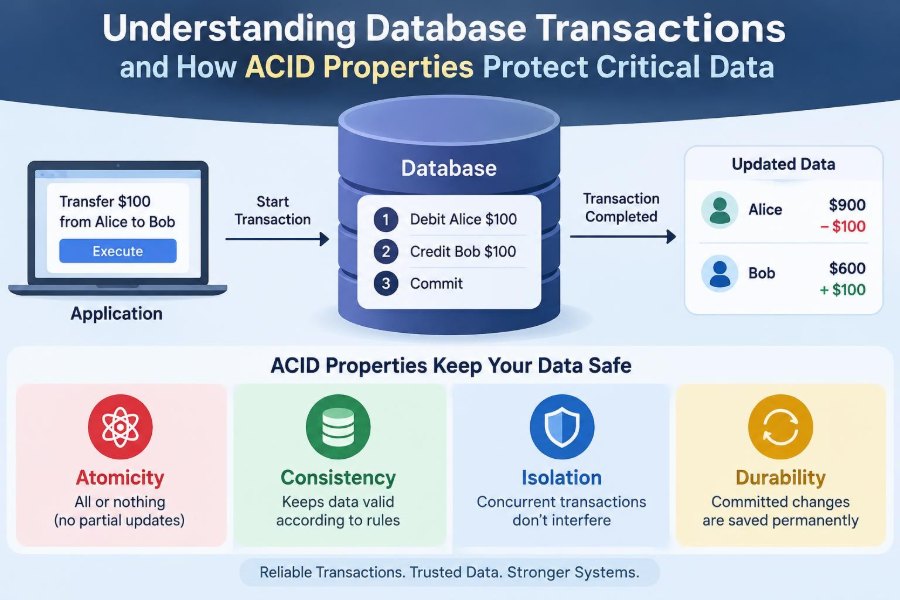
Imagine account A has 500 units and account B has 200. A customer transfers 100 units from A to B. A simplified transaction might look like this:
BEGIN;
UPDATE accounts SET balance = balance - 100 WHERE id = 'A';
UPDATE accounts SET balance = balance + 100 WHERE id = 'B';
INSERT INTO transfer_log (...) VALUES (...);
COMMIT;
If validation fails, a constraint is violated, or the application decides to abandon the action, it can issue ROLLBACK. The database undoes the transaction’s uncommitted work.
This example omits important real-world details, such as checking available funds and using integer minor currency units rather than floating-point values. But it shows why the statements must be grouped.
🧪 ACID Is a Set of Guarantees
ACID stands for Atomicity, Consistency, Isolation, and Durability. It is a useful model for reasoning about transactional systems, not a claim that every product implements every guarantee in identical ways.
Database engines expose different isolation levels, storage configurations, replication behaviors, and transaction features. A developer must understand the guarantees actually selected and configured.
| Property | Core question | Typical protection |
|---|---|---|
| Atomicity | Did all related work happen? | Prevents partial completion |
| Consistency | Does the result obey rules? | Preserves valid data states |
| Isolation | How do concurrent operations interact? | Controls interference |
| Durability | Will a committed result survive failure? | Protects acknowledged changes |
⚛️ Atomicity: All or Nothing
Atomicity means a transaction is indivisible from the perspective of success. If it commits, all of its intended changes become part of the database state. If it aborts, its changes are undone.
It does not mean every external effect can automatically be undone. If code sends an email, calls a shipping provider, or charges a third-party payment service during a transaction, rolling back the database cannot necessarily recall that action.
This distinction is critical: atomic database work is not the same as atomic distributed work.
🛑 How Rollbacks Prevent Partial Work
Databases may roll back because application code explicitly requests it, because a statement raises an error, because a deadlock victim is chosen, or because the connection ends before commit.
Inside application code, treat a failed transaction as a result that needs deliberate handling. Do not catch a database exception, log it, and continue as though the write succeeded.
Many libraries automatically roll back when a transaction block throws an error. That is helpful, but developers still need to verify their framework’s behavior and avoid swallowing exceptions prematurely.
✅ Consistency: Valid State Before and After
Consistency means a successful transaction takes the database from one state that obeys defined rules to another state that obeys those rules. It is about correctness constraints, not merely that replicas eventually contain the same bytes.
Those rules may include primary keys, foreign keys, uniqueness, required fields, check constraints, and application-level invariants. An invariant is a condition that should always hold, such as “a reserved seat cannot belong to two active reservations.”
Transactions provide a place to enforce coordinated changes, but they cannot infer every rule your business requires. The rules must be designed and represented.
🧱 Put Rules in the Database When Possible
Application validation improves usability, but it is not sufficient protection against concurrent requests, background jobs, admin tools, or future services that write to the same database.
Where a rule is fundamental, use database constraints when the data model permits it. A unique constraint can prevent duplicate email addresses; a foreign key can prevent a child record from pointing to a nonexistent parent.
Constraints complement transactions. A transaction coordinates a set of changes, while constraints reject states the database must never accept.
🔒 Isolation: Concurrent Work Without Chaos
Isolation governs what one transaction can observe about another transaction that is still running. It matters because production databases commonly process many requests at once.
If two sessions read the same available inventory and both independently decide it is available, each may try to reserve it. The database needs rules for ordering, blocking, detecting conflicts, or retrying work.
Perfectly hiding every concurrent detail can reduce throughput. Isolation is therefore often a deliberate trade-off between anomaly prevention and operational cost.
👀 The Problems Isolation Is Designed to Avoid
Concurrency anomalies have specific names. Knowing them makes design discussions clearer.
- Dirty read: one transaction reads another transaction’s uncommitted change, which may later be rolled back.
- Non-repeatable read: a transaction reads a row twice and gets different committed values because another transaction changed it between reads.
- Phantom read: repeating a query returns a different set of matching rows because another transaction inserted or removed qualifying data.
- Lost update: competing updates cause one valid change to overwrite another.
Not every engine permits every anomaly at every level. Documentation for the chosen database is the source of truth.
🎚️ Isolation Levels Are Practical Trade-Offs
SQL databases commonly offer named isolation levels, though exact semantics vary. Higher isolation generally prevents more concurrency anomalies, but it can lead to more locking, serialization failures, or retries.
| Level | General idea | Typical use consideration |
|---|---|---|
| Read committed | Reads committed data, with behavior varying by engine | Common default; still examine read-modify-write flows |
| Repeatable read | Provides a more stable view for a transaction | Useful when repeated reads drive a decision |
| Serializable | Aims to make concurrent execution behave like a serial order | Strong protection, but applications must handle retries |
Do not choose an isolation level by name alone. Test the exact business race you need to prevent.
🪑 Locks Coordinate Conflicting Access
Many databases use locks to coordinate access to rows, index entries, or other internal resources. A transaction updating a row may prevent another transaction from making a conflicting update until the first transaction ends.
Some systems support explicit locking reads, often expressed with syntax such as SELECT ... FOR UPDATE. This can be appropriate when a transaction must read a record and then safely make a decision based on it.
Locks are not a universal “make it safe” switch. Overly broad or long-held locks can make requests wait and reduce system responsiveness.
🔢 Optimistic Locking Detects Competing Edits
Optimistic locking assumes conflicts are uncommon. Instead of locking a row while a user thinks, the application stores a version number or timestamp and checks it during update.
UPDATE documents
SET content = ?, version = version + 1
WHERE id = ? AND version = ?;
If the update affects zero rows, someone changed the document first. The application can show a conflict, reload data, or ask the user to merge changes.
This approach is often suitable for user-edited records. It is less convenient when the operation must immediately reserve a scarce resource.
⚔️ Deadlocks Are Expected, Not Mysterious
A deadlock occurs when transactions wait on each other in a cycle. For example, one transaction locks account A and requests B while another locks B and requests A.
Databases detect such cycles and abort one transaction so the other can proceed. The aborted transaction receives an error and its application should usually retry the entire transaction when the operation is safe to retry.
Reduce deadlocks by keeping transactions short and acquiring resources in a consistent order. You cannot always eliminate them, so error handling remains necessary.
💾 Durability: Commit Must Mean Something
Durability means that once the database reports a successful commit, the committed change should survive a crash or restart according to the system’s configured guarantees.
Storage engines commonly use write-ahead logging: they record enough information in a log before treating associated data changes as committed. Recovery processes can use that record after an interruption.
Durability depends on more than a SQL statement. Hardware, filesystem behavior, cloud configuration, replication topology, and database settings can all affect the practical failure model.
📡 Replication Is Not the Same as Durability
Replication copies data from one database node to others for availability, read scaling, or disaster recovery. It is valuable, but it answers a different question from local transaction durability.
Some replication is asynchronous. In that design, a primary may acknowledge a commit before a replica receives it. A failure at the wrong moment can expose recovery trade-offs.
Teams handling critical data should understand acknowledgment rules, failover procedures, backup restoration, and acceptable loss windows rather than assuming “multiple servers” solves every failure mode.
🧾 Commit Is the Point of No Return
Before commit, a transaction can normally be rolled back. After commit, its changes are durable from the application’s perspective and should be treated as real.
That is why applications should perform validation before commit and avoid presenting success to a user before the commit outcome is known. A response sent too early can claim an action that later fails.
If a client loses its connection while committing, the outcome may be uncertain. The safest response is often to query a durable operation identifier rather than blindly submit the action again.
🔑 Idempotency Makes Retries Safer
An operation is idempotent when repeating it has the same intended effect as performing it once. This is essential because timeouts do not reveal whether a server completed work before the response was lost.
For a payment request, a client can send an idempotency key. The service stores that key with the completed result and returns the same outcome when it sees the key again.
Transactions protect writes within a database. Idempotency protects the boundary where unreliable networks and retried requests meet your application.
📬 External Side Effects Need a Different Pattern
Suppose an order transaction writes an order and then publishes a “send confirmation email” message. If the process crashes after commit but before publishing, the order exists but no message is sent.
The transactional outbox pattern addresses this by writing the business change and an outgoing event record in the same transaction. A separate worker reliably reads unsent outbox records and delivers them, with retries.
Consumers should also tolerate duplicate delivery. Exactly-once behavior across independent systems is difficult; carefully designed at-least-once delivery plus idempotent handling is often more realistic.
🛒 Inventory Reservations Reveal the Design Choices
Consider a hypothetical store with one remaining item. A naive process reads stock, sees one item, then later writes a new stock count. Two requests can both read one before either writes.
A safer approach may use a single conditional update:
UPDATE products
SET available = available - 1
WHERE id = ? AND available > 0;
If exactly one row is updated, the reservation succeeded. If no row is updated, stock was unavailable. This moves the critical condition into one atomic database statement.
🏦 Financial Data Requires More Than a Balance Column
A balance transfer example is useful, but production financial systems often retain immutable ledger entries as well as current balances. An audit trail helps explain how a balance was derived and supports correction through new entries rather than silent rewrites.
Transaction boundaries should include the ledger entries and any derived balance update that must remain aligned. Authorization, fraud controls, regulatory obligations, and settlement with outside institutions introduce additional requirements beyond ACID.
ACID is foundational, not a complete financial-system design.
🧰 Keep Transactions Small and Focused
Long transactions hold resources longer, increase contention, and make deadlocks more likely. Do not open a transaction, ask a user for input, call a slow remote API, or process a large file before committing unless there is a compelling reason.
Read and validate what you can first. Then open the transaction, perform the minimum coordinated database work, commit, and handle follow-up tasks asynchronously when appropriate.
Short does not mean carelessly fragmented. The goal is the smallest boundary that still preserves the business invariant.
🚫 Common Transaction Mistakes
- Assuming an ORM automatically makes several separate save calls one transaction.
- Using application-side “check then insert” logic without a unique constraint.
- Holding a transaction open during network calls or expensive computation.
- Retrying every database error without checking whether retrying is safe.
- Ignoring deadlock and serialization-failure handling.
- Treating a database rollback as though it reverses emails, payments, or messages already sent.
These mistakes are often invisible in local testing because they require timing, load, failures, or multiple workers to reveal themselves.
🧭 Choose Boundaries From Business Invariants
Start with the statement that must remain true. “Every confirmed reservation has a matching inventory decrement” is clearer than “put these repository calls in a transaction.”
Then identify the records that represent that invariant, the concurrent operations that can challenge it, and the database constraint or isolation behavior that protects it.
This approach avoids both extremes: transactions that are too narrow to preserve correctness and giant transactions that needlessly serialize unrelated work.
🧪 Test Races and Failure Paths Deliberately
Unit tests can confirm ordinary success and rollback paths, but concurrency bugs require more deliberate tests. Use separate connections or workers, synchronize them around key reads or writes, and observe which transactions succeed.
Test duplicate requests, connection loss around commit, constraint violations, deadlock retries, and recovery from worker failure. For critical workflows, run these tests against the same database technology and isolation settings used in deployment.
A test that merely checks a final happy-path record is not enough when correctness depends on ordering.
📊 Observe Transaction Health in Production
Operational visibility helps teams distinguish a design issue from a temporary load spike. Useful signals include transaction duration, lock waits, deadlock counts, rollback rates, failed conditional updates, and retry frequency.
Logs should include a request or operation identifier without exposing sensitive values. That identifier can connect an API request, a database transaction, an outbox event, and a support investigation.
Metrics do not replace correctness design, but they reveal when real traffic is testing its assumptions.
🧠 Transactions Are Not a Universal Consistency Button
A transaction inside one database cannot automatically coordinate state across caches, search indexes, message brokers, and third-party APIs. Distributed transactions exist in some environments, but they add constraints and are not always available or desirable.
Many architectures instead accept temporary differences between systems and repair them through events, retries, reconciliation jobs, and idempotent consumers. The key is to define which system is authoritative and which delays are acceptable.
Use the strongest guarantee where the business consequence requires it, rather than applying one mechanism indiscriminately.
🧑💻 Working Well With an ORM
Object-relational mappers make database access convenient, but they do not remove transactional semantics. Learn where your framework starts transactions, when it flushes pending changes, and which queries bypass its usual tracking behavior.
Be especially cautious with bulk updates, lazy loading inside long request flows, and automatic retries. Inspect generated SQL when an operation is critical; the database ultimately enforces the behavior.
A clean domain model and a clear transaction boundary can coexist. Convenience should not obscure correctness assumptions.
📚 A Practical Design Checklist
- Define the business invariant that must not be violated.
- Use database constraints for rules the database can enforce.
- Make related local writes one transaction.
- Select isolation and locking behavior based on concrete races.
- Keep the transaction short and avoid external calls inside it.
- Handle deadlocks, serialization conflicts, and ambiguous timeouts.
- Use idempotency keys for retried commands.
- Use an outbox or equivalent pattern for reliable external effects.
- Test concurrent requests and failure recovery, not only happy paths.
🎯 The Core Principle: Protect Meaning, Not Just Rows
ACID properties are valuable because they protect the meaning of data while software encounters ordinary realities: overlapping requests, machine failures, retries, and incomplete communication.
Atomicity keeps related changes together. Consistency keeps accepted states valid. Isolation manages competing work. Durability makes a successful commit a dependable boundary.
The best transaction design begins with a precise business rule, encodes that rule in the database where possible, and treats cross-system work as a reliability problem that needs its own patterns.
A transaction is not simply a block of database code; it is a promise that critical data will change coherently even when the surrounding system does not behave perfectly. Build that promise around real invariants, verify it under failure, and your software will earn the trust placed in it. ⚙️🔒