
A team inherits a service that has been running for eight years. Customers depend on it every day, but releases feel risky, onboarding takes months, and a small change can trigger failures in places nobody expected.
The tempting conclusion is simple: the software is old, so it must be rewritten. A greenfield project promises modern tools, clean boundaries, and freedom from awkward historical decisions.
Yet age alone says very little. Some ten-year-old systems are stable, secure, and inexpensive to change. Some one-year-old systems already carry confusing dependencies, missing tests, and fragile deployment processes.
The practical question is not “When does software expire?” It is: when does continued support cost or endanger the organization more than a carefully managed replacement?
🧭 Start with the right question
Software does not have a universal support lifespan. A payroll platform, an internal reporting script, a medical device component, and a consumer mobile app face very different risks, users, regulations, and rates of change.
Instead of choosing a calendar deadline, assess whether the system can still meet its required service level. That includes reliability, security, compatibility, legal obligations, operational cost, and the team’s ability to make changes safely.
A major rewrite becomes a serious option when these needs cannot reasonably be met through maintenance, modernization, or targeted replacement.
⏳ Separate software age from software health
Age is visible; health is more useful. Older code often contains valuable business knowledge encoded through years of real customer use, including unusual cases that no specification captured.
A healthy older system has understandable ownership, repeatable deployment, adequate monitoring, manageable dependencies, and a practical path for change. An unhealthy newer system may lack all of these.
Think of a building: its construction date matters less than whether its foundations, wiring, access, and maintenance history still support the people using it.
🔧 Define what “support” actually includes
Supporting software is more than fixing defects. It includes keeping dependencies patched, maintaining infrastructure, responding to incidents, helping users, adapting to policy changes, and preserving compatibility with surrounding systems.
For a product with external users, support may also include accessibility improvements, browser or device compatibility, documentation, data retention, and predictable communications about changes.
A system can be feature-frozen and still require substantial support. Removing new feature work does not remove security exposure or the need to operate the service responsibly.
📏 Use service expectations as the baseline
Before debating architecture, write down what the software must do for its stakeholders. A service-level objective, or SLO, is a target for a measurable property such as availability, response time, or successful job completion.
The relevant threshold differs by context. A tool used once a quarter can tolerate a slower recovery than a system that processes customer orders continuously. The right decision follows the required level of service, not an abstract preference for modern technology.
- What downtime or data loss is acceptable?
- How quickly must security issues be addressed?
- Which integrations must remain compatible?
- How fast must the business be able to change key workflows?
💸 Measure the total cost of continued maintenance
Maintenance cost is not just the number of tickets closed. Include time spent deciphering behavior, repeated incident response, fragile releases, infrastructure workarounds, and the opportunity cost of engineers who cannot focus on valuable improvements.
Also account for costs that a rewrite creates: discovery, migration, training, parallel operations, changed workflows, and the defects that emerge when hidden behavior is rediscovered.
Comparing only “current maintenance hours” with “new project estimates” produces a misleading business case. Both paths have implementation and operational costs.
🧱 Recognize technical debt without treating it as a verdict
Technical debt describes the future cost created by shortcuts, deferred work, or decisions that no longer fit current needs. It is not automatically bad; a deliberate shortcut can be sensible when time is limited and the consequence is understood.
Debt becomes dangerous when interest compounds. For example, a tightly coupled codebase may turn every feature into a multi-team coordination exercise, while missing automated tests make every release a manual investigation.
The answer is often repayment in focused pieces, not demolition of the whole system.
🕸️ Look for harmful coupling
Coupling is the degree to which parts of a system depend on one another. Some coupling is necessary, but harmful coupling means a change in one area unpredictably breaks another.
Warning signs include shared databases used as informal APIs, utility modules touched by nearly every feature, and business rules duplicated across multiple services. These patterns make the cost of change rise because engineers must understand too much at once.
A rewrite may help, but extracting one boundary or creating a stable interface can sometimes deliver most of the benefit at far lower risk.
🧪 Treat testability as a change-risk indicator
Tests do not prove that software is correct, but they provide fast feedback about known behavior. When tests are slow, unreliable, absent, or difficult to write, teams become dependent on memory and manual checks.
That makes routine maintenance expensive and raises the chance of regressions. It also makes a rewrite more hazardous, because the old system’s behavior cannot be compared reliably with the replacement.
Improving characterization tests—tests that record what the system currently does—can be valuable before either refactoring or migration.
🔒 Make security support a hard constraint
Unsupported runtimes, operating systems, frameworks, and libraries can leave a system exposed when security fixes are no longer available. This is one of the clearest reasons to change a platform or replace a component.
Still, “unsupported” does not automatically mean “rewrite the application.” A team may be able to upgrade a runtime, isolate a legacy component, replace a vulnerable library, or reduce exposure through network and access controls.
Risk depends on the system’s exposure, the sensitivity of its data, available mitigations, and the organization’s ability to respond. Security decisions should involve appropriate security and risk owners.
🧩 Watch the dependency ecosystem
Software lives inside an ecosystem of package managers, databases, cloud services, browsers, identity providers, and vendor APIs. A once-reasonable stack can become difficult to operate when the ecosystem moves on.
Compatibility breaks often appear gradually: a build tool no longer runs on current machines, a database version reaches end of support, or an integration adopts an incompatible protocol. These issues create a modernization backlog even if application code remains stable.
Map dependencies by criticality and support status. This makes urgency visible before a forced upgrade turns into an emergency.
📚 Preserve undocumented business knowledge
Legacy systems frequently contain rules that nobody can explain quickly: exceptions for long-standing customers, calculations shaped by old contracts, and recovery logic learned from past failures.
A rewrite team may call these rules “messy” and remove them, only to discover later that users relied on them. The old implementation is not necessarily the ideal design, but it is evidence of real operating history.
Interview domain experts, examine production behavior, and capture decisions in examples. This discovery work is essential whether the eventual outcome is refactoring or replacement.
👥 Factor in team ownership and skills
A system is less sustainable when only one person understands deployment, database recovery, or a critical calculation. This is a knowledge concentration risk, not merely a code-quality problem.
Hiring difficulty matters too. A niche or obsolete platform can make support slower and more expensive. Conversely, replacing a stable system solely to use a fashionable stack can discard deep operational expertise.
Improve resilience through documentation, pair work, runbooks, rotation, and deliberate knowledge transfer. A rewrite does not automatically solve ownership problems if the new system is built by another small, isolated group.
📈 Compare the rate of change with the system’s flexibility
A stable records archive may run successfully for years with only security and platform upkeep. A product whose pricing, workflows, and integrations change monthly needs an architecture that supports frequent adjustment.
Tension appears when a rapidly changing business sits on a system designed around fixed assumptions. Every requested change then requires workarounds, duplicate data, or risky edits in central code.
The question is not whether features are arriving. It is whether the system can absorb foreseeable change at an acceptable cost and risk.
🚨 Pay attention to operational signals
Production behavior often reveals more than code style debates. Frequent rollback events, recurring incidents, long recovery times, manual repair scripts, and unexplained performance drops indicate that operations are carrying structural burden.
Track patterns rather than isolated failures. One outage may be an unusual event; repeated failures from the same class of change show that the delivery and architecture path needs attention.
Useful evidence includes incident timelines, support request categories, deployment lead time, recovery procedures, and the work needed to diagnose common failures.
🗃️ Assess data migration before promising a rewrite
Data is usually the hardest part of replacement. Customer records may contain duplicates, historical formats, inconsistent values, legal retention needs, and references to systems that no longer exist.
A new schema can be cleaner, but moving data safely requires rules for mapping, validation, reconciliation, rollback, and ongoing synchronization during transition. Data errors can damage trust even when the new interface looks better.
Start data discovery early. If migration cannot be validated, a full replacement may be less feasible than modernization around the existing data store.
🔄 Choose among more than two options
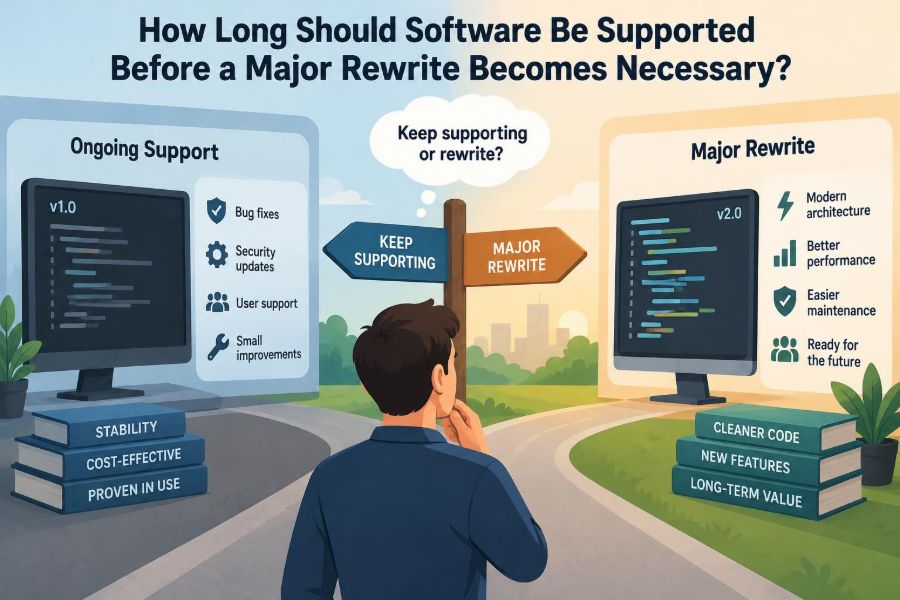
The choice is rarely “maintain forever” or “rewrite everything.” Most organizations have a spectrum of approaches that can be combined over time.
| Approach | Best fit | Main caution |
|---|---|---|
| Targeted refactoring | A specific module blocks safe changes | Needs clear boundaries and tests |
| Platform upgrade | Runtime or infrastructure support is ending | Compatibility work can uncover hidden assumptions |
| Component replacement | One subsystem is disproportionately risky | Interfaces and data ownership must be explicit |
| Incremental replacement | The system must stay live during change | Temporary integration complexity is real |
| Full rewrite | Core assumptions cannot meet future needs | Scope and behavior gaps can be severe |
🪓 Use the strangler approach when continuity matters
The strangler approach replaces parts of a system gradually. New functionality is built beside the old system, traffic or workflows are moved piece by piece, and retired sections are removed only after the replacement proves itself.
This reduces the “big bang” risk of switching everything at once. It also produces useful checkpoints: the team can learn whether the new boundaries, data model, and operations work in real conditions.
It is not free. During transition, teams must manage two paths and prevent unclear ownership of data and rules.
🏗️ Understand why rewrites fail
A rewrite often fails not because engineers cannot write new code, but because the project treats the existing system as disposable rather than as a source of requirements. The new build may recreate visible screens while missing edge cases, reporting needs, operational tools, and integration behavior.
Long rewrites also delay feedback. By the time a replacement is ready, customer expectations and business priorities may have changed.
Limit risk by delivering narrow, usable slices and validating them with real workflows rather than waiting for a grand launch.
🎯 Define the problem before selecting technology
“We should move to microservices,” “we need the latest framework,” or “the code is ugly” are not sufficient problem statements. Technology may be part of the solution, but it is not the decision criterion.
Describe the concrete failure: perhaps releases require a weekend, one reporting job blocks all processing, or a supported authentication method cannot be integrated. Then define what success looks like in observable terms.
This discipline prevents a rewrite from becoming a broad, moving target driven by aesthetic preference.
🧾 Build a decision record with evidence
A lightweight decision record makes trade-offs visible. It should state the current problem, options considered, expected benefits, risks, assumptions, dependencies, and the person or group accountable for the decision.
Include evidence from incidents, support burden, support lifecycles, user research, and technical investigation. Avoid pretending that uncertain estimates are precise forecasts.
Review the record periodically. New information may justify accelerating, narrowing, pausing, or reversing the chosen approach.
🧭 Set decision thresholds instead of arbitrary dates
A support policy should say what conditions trigger review. For example, an approaching end-of-support date, repeated inability to meet recovery expectations, or a critical business capability that cannot be delivered safely may require action.
These are thresholds, not automatic rewrite commands. A platform end-of-life could lead to an upgrade; a slow release process could be solved through testing and deployment improvements.
Calendar-based reviews remain useful because they catch quiet drift. The review should ask whether risks and costs have changed, not whether the application has reached a particular birthday.
🧮 Prioritize with a simple risk-and-value view
A practical portfolio discussion considers three dimensions: the consequence of failure, the likelihood that current limitations will cause failure, and the value gained by improving the system.
High-risk, high-value systems deserve early investigation and investment. Low-value systems may be candidates for retirement, containment, or minimal support rather than an ambitious rewrite.
Do not confuse visible annoyance with strategic urgency. A frustrating developer experience matters, but its priority depends on how it affects delivery, reliability, cost, and customer outcomes.
🛠️ Stabilize before you transform
If a system is constantly failing, beginning a huge rewrite can leave the organization supporting an unstable old product while trying to build a new one. Stabilization may need to come first.
Typical first steps include documenting operations, adding monitoring, automating backups, fixing the most frequent failure mode, improving deployment repeatability, and creating a minimal test safety net.
These investments are not wasted if replacement follows. They make the old system safer during transition and improve the team’s understanding of what the new system must preserve.
🧫 Run small experiments to reduce uncertainty
A proof of concept should answer a specific high-risk question, such as whether a new service can process historical records at required volume or whether a replacement can integrate with an existing identity system.
It should not become a disguised production rewrite with no decision point. Define the question, success criteria, time limit, and what decision will follow from the result.
Experiments are especially useful when the team is uncertain whether a targeted modernization can avoid a broader replacement.
🚦Plan migration as a product change
Users experience migrations through changed screens, revised reports, new permissions, delayed data, and altered support processes. A technically correct cutover can still fail if people cannot complete their work.
Involve affected users early, communicate what changes and what remains the same, and prepare support staff for predictable questions. For high-impact workflows, consider phased rollout and a practical rollback plan.
Migration success includes adoption and operational readiness, not merely a successful deployment.
📉 Know when retirement is better than replacement
Sometimes software should not be rewritten because the capability itself is no longer needed. An internal tool may duplicate a newer platform, support a retired process, or serve too few users to justify continued investment.
Retirement requires its own discipline: archive required records, communicate deadlines, migrate remaining users, revoke access safely, and remove infrastructure and credentials once obligations are met.
Stopping support can be the most responsible choice when the value no longer justifies the risk and cost.
⚠️ Avoid common rewrite decision traps
- The shiny-stack trap: choosing a rewrite mainly because a newer technology is appealing.
- The blank-slate trap: assuming existing behavior is irrelevant instead of discovering why it exists.
- The estimate trap: treating early migration estimates as commitments despite unknown data and edge cases.
- The parallel-team trap: assigning all experienced people to the rewrite and leaving the live system unsupported.
- The finish-line trap: defining success as launch rather than reliable operation and user adoption.
These traps are avoidable when decisions are grounded in evidence and work is broken into reversible steps.
🗺️ Create a practical support review cadence
For important systems, conduct a structured review at a sensible interval and whenever a major trigger appears. The goal is not a lengthy ceremony; it is a current, shared view of sustainability.
- Confirm business purpose and critical workflows.
- Review support status for platforms, dependencies, and infrastructure.
- Examine incidents, delivery friction, security exposure, and data concerns.
- Identify the smallest change that reduces the largest risk.
- Decide whether to maintain, modernize, replace incrementally, rewrite, retire, or investigate further.
Recording this decision prevents silent neglect and makes future reassessment easier.
🧠 The core principle: support outcomes, not code birthdays
There is no responsible rule such as “rewrite every five years” or “support for ten years.” The appropriate duration depends on whether the software continues to deliver required outcomes safely, economically, and adaptably.
A major rewrite is justified when core constraints cannot be resolved through narrower changes and when the organization can manage the discovery, migration, and operational risks involved. It is not justified merely because the code is old or unfashionable.
The strongest decisions preserve valuable behavior, make uncertainty explicit, and choose the smallest credible intervention that meets future needs.
Support software for as long as it can meet real obligations at an acceptable level of risk and cost—and rewrite only when evidence shows that incremental paths can no longer do so. That standard turns a vague debate about old code into a disciplined engineering decision. ⚙️ 🧭