
A customer places an order, receives a confirmation screen, and assumes everything is complete. Behind that simple interaction, the application may need to reserve inventory, request payment, email a receipt, notify a warehouse, and update analytics.
Now imagine the order is safely stored in the database, but the application crashes a moment before it tells the warehouse. The customer was charged. The order exists. Yet no package is prepared.
That gap is one of the most persistent reliability problems in distributed software. It appears anywhere an application must update its own data and also tell another system that something happened.
The transactional outbox pattern is a practical design for closing that gap. It does not make distributed systems magically simple, but it gives teams a durable, testable way to ensure important events are eventually delivered.
🧩 The Reliability Problem Hiding Between Two Systems
Many business actions have two parts. First, an application changes data in its database. Second, it publishes a message to a broker such as Kafka, RabbitMQ, or a cloud queue so that other services can react.
These actions usually involve separate systems with separate failure modes. A database may accept a transaction while a message broker is temporarily unavailable. A network request may time out even though the broker received the message. A process may stop between the two operations.
The dangerous result is a dual-write problem: the application has independently written to two places but cannot safely guarantee that they stay in agreement.
🛒 A Simple Order-Service Example
Consider a hypothetical order service. It receives a request, inserts an order record, and then publishes an OrderPlaced event. Inventory and email services consume that event independently.
A straightforward implementation might look like this:
saveOrder(order)
publish("OrderPlaced", order)
If the application fails after saveOrder succeeds but before publish finishes, the order persists without an event. Downstream systems may never learn that it exists.
Reversing the operations does not fix the problem. Publishing first can create an event for an order that later fails to save. Consumers may reserve stock or send an email for a purchase that never actually happened.
⚖️ Why Ordering Two Calls Cannot Create Atomicity
Atomicity means an operation happens completely or not at all. Database transactions provide this property for a group of changes inside one database: either all committed changes become visible, or none do.
Calling a database and then a broker is not one atomic operation. It is two operations separated by application code, networks, credentials, timeouts, and possible process failures.
Retrying also introduces ambiguity. If publishing times out, did the broker reject the message, or did it accept it and lose the response? A retry may prevent a missing event, but it can also create a duplicate.
💥 Failures That Create Lost Events
Lost events do not require dramatic infrastructure outages. Ordinary operational conditions are enough:
- The application process is terminated during deployment.
- A database commit succeeds, followed by a broker connection failure.
- A broker accepts a message but its acknowledgment is lost in transit.
- A bug throws an exception after data is saved but before an event is sent.
- A temporary permission, quota, or DNS problem blocks publishing.
When these paths are not designed explicitly, teams often discover them later through customer support tickets, manual reconciliation, or unexplained data differences between services.
📮 The Core Idea of the Transactional Outbox
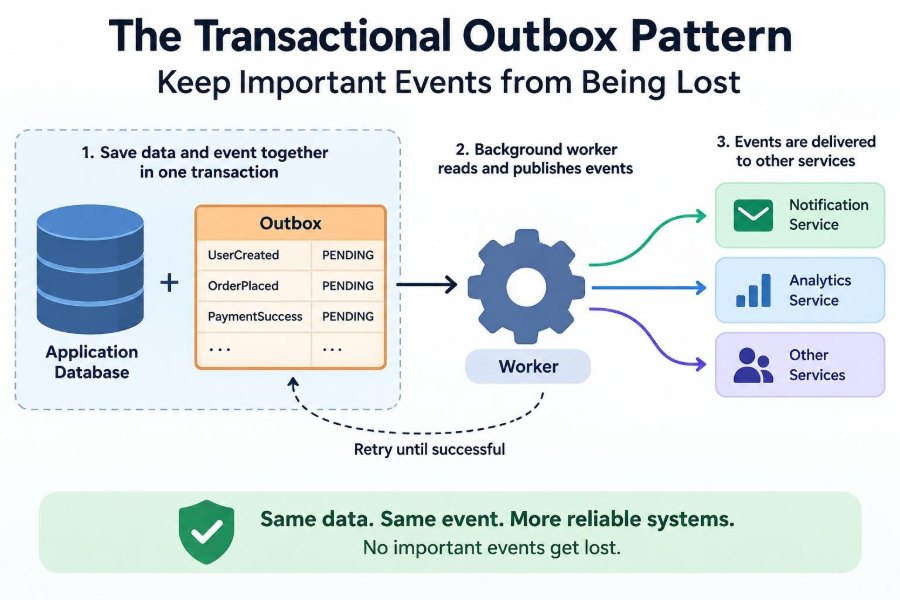
The pattern changes the second write. Instead of saving business data and directly publishing an external message, the application saves business data and an outbox record in the same local database transaction.
That outbox record describes the event that must eventually be delivered. A separate component reads pending records from the outbox and publishes them to the message broker.
Because the business change and outbox row share one transaction, they commit together or roll back together. An order cannot be permanently stored without a durable instruction to announce it.
🗃️ What an Outbox Record Contains
An outbox table is an ordinary durable data structure, not a special database feature. Its exact schema depends on the application, but common fields include:
- Event ID: a stable unique identifier used for tracing and deduplication.
- Event type: such as
OrderPlacedorPaymentCaptured. - Aggregate ID: the related business entity, such as an order ID.
- Payload: event data, often stored as JSON or another serialized format.
- Created time: useful for monitoring and ordering decisions.
- Delivery state: pending, published, failed, or similar status information.
The payload should represent a deliberate event contract, rather than an accidental dump of every database column. Other services may depend on it long after the originating schema changes.
🔒 The Local Transaction Is the Key Guarantee
In the order service, the database transaction now performs two writes:
begin transaction
  insert order
  insert outbox event: OrderPlaced
commit transaction
If the transaction fails, neither row remains. If it commits, both the order and the pending event are durable. This is the guarantee the pattern relies on.
The outbox does not make the database and broker part of a single transaction. Instead, it records the intent to publish in the one system where atomicity is available.
🚚 The Relay Turns Stored Intent into Delivery
A relay, sometimes called a publisher, dispatcher, or message relay, continuously finds unpublished outbox entries and sends them to the broker. It may run as a background worker in the same application, a separate service, or a change-data-capture pipeline.
After successful publication, the relay records that the entry was handled or removes it according to the retention strategy. If publication fails, it leaves the entry available for a later attempt.
This separation matters. The user-facing request no longer has to wait for a healthy broker before it can commit its own business transaction.
🔁 Why Delivery Is Usually At-Least-Once
The relay itself faces a smaller version of the original failure problem. It can successfully publish an event and then crash before marking the outbox row as published.
On restart, it sees the row as pending and sends it again. That behavior is correct for reliability, but it means the same event can arrive more than once.
Transactional outbox implementations therefore commonly provide at-least-once delivery: an event is delivered one or more times, rather than silently disappearing. Exactly-once processing across independent systems requires much stronger assumptions and is rarely a simple end-to-end promise.
🧠 Idempotency Makes Duplicate Delivery Safe
Idempotent processing means applying the same message repeatedly produces the same effective result as applying it once. This is the companion requirement to an outbox.
For example, an inventory service can store processed event IDs. Before reserving stock, it checks whether the event ID was already handled. If so, it safely does nothing.
Some operations are naturally idempotent. Setting an order status to shipped is easier to repeat safely than decrementing stock by one. When an operation is not naturally idempotent, consumers need a deduplication record or a carefully designed business key.
🧾 Producer and Consumer Responsibilities
Reliable event handling is a shared responsibility. The outbox producer guarantees a committed business action has a persistent event waiting to be sent. The relay retries publication. The consumer must still tolerate duplicate arrivals and temporary processing failures.
| Component | Primary responsibility | Typical failure response |
|---|---|---|
| Business service | Write business state and outbox event atomically | Roll back both on transaction failure |
| Relay | Publish pending events | Retry with controlled backoff |
| Broker | Durably route messages according to its configuration | Expose acknowledgments and delivery semantics |
| Consumer | Process events safely | Deduplicate and retry or route failures for review |
No single layer eliminates all failure modes. The value comes from making each responsibility explicit and compatible with the next.
🧭 Event Ordering Is a Separate Design Decision
Teams sometimes assume an outbox guarantees global ordering. It does not. Multiple application instances, relay workers, database commits, retries, and broker partitions can all affect observed order.
Often the meaningful requirement is narrower: events related to the same order or customer should be processed in order. A relay can use an aggregate ID as a partition key, and consumers can enforce sequence expectations where necessary.
Do not impose a global order unless the domain truly requires it. It can reduce throughput and complicate recovery. Define precisely which events must be ordered, for whom, and what should happen when an earlier event is delayed.
🧬 Choosing a Useful Event Payload
An event should communicate a business fact that occurred, not merely expose an internal database operation. OrderPlaced is usually clearer and more stable than orders_row_updated.
There are two common payload styles. A notification event contains an ID and asks consumers to fetch current data. An event-carried state transfer includes enough information for consumers to act without calling back.
Notifications are smaller but create runtime dependencies between services. Richer events reduce those calls but require deliberate versioning and may expose more data. The better choice depends on freshness needs, ownership boundaries, and data sensitivity.
🏷️ Versioning Events Without Breaking Consumers
Once an event is consumed by another system, it becomes a contract. Renaming fields, changing meanings, or removing values can break consumers that are deployed independently.
Prefer additive changes when possible: add an optional field, preserve existing meaning, and let consumers migrate before removing old fields. Include an event version when the contract may evolve substantially.
Versioning is not only a serialization concern. A field can remain technically valid while its business meaning changes. Document event semantics, ownership, and compatibility expectations alongside the schema.
⏱️ Polling the Outbox
The simplest relay periodically queries the outbox table for pending rows, publishes a batch, and updates their status. This approach is easy to understand, deploy, and debug.
Polling introduces a trade-off between delivery latency and database load. A shorter interval can make events appear quickly but increases repeated queries. Batching improves efficiency, while sensible indexes prevent scans of a growing table.
With several relay instances, use a safe claiming strategy so that workers do not constantly publish the same records. Database-specific row locking or lease columns can coordinate workers, but the consumer must still expect duplicates.
📡 Change Data Capture as an Alternative Relay
Change data capture, or CDC, reads committed database changes from a transaction log rather than repeatedly querying tables. A CDC connector can detect inserts into the outbox and forward them to a broker.
This can reduce application-level polling and can scale well for high event volumes. It also keeps the relay outside the business application’s runtime process.
CDC adds operational complexity. Teams need to manage connector health, database log retention, schema changes, offsets, and recovery. It is a strong option when the organization already operates CDC infrastructure, not an automatic upgrade for every application.
🧱 Where the Outbox Belongs in the Data Model
An outbox often lives in the same database as the business entities it represents. That placement is what allows one local transaction to save both the entity and the event.
Some teams use one shared outbox table for an entire service. Others partition or separate it by domain for access control and operational reasons. The key rule is simpler than the schema choice: the code that commits the business state must commit its outbox record in the same transaction.
Writing events to a separate “event database” without a distributed transaction usually reintroduces the dual-write problem.
🧹 Retention, Archiving, and Cleanup
An outbox can grow indefinitely if published records are never removed. That eventually affects index size, query speed, backup volume, and operational clarity.
Cleanup should happen only after records are safely published and after any useful audit or replay window has passed. Some systems delete old rows; others archive them to cheaper storage or retain compact delivery metadata.
Be careful with aggressive deletion. When an incident occurs, outbox history can help answer whether an event was created, when it was sent, and which identifier downstream systems should have received.
📊 Observability Reveals Silent Backlogs
The most concerning outbox failure is often not a visible crash. It is a quiet backlog: business transactions commit normally, but the relay cannot publish and the queue of pending events keeps growing.
Useful signals include pending-event count, age of the oldest pending event, publication error rate, retry count, relay throughput, and time from event creation to broker acknowledgment.
Logs and traces should carry stable identifiers such as event ID, aggregate ID, and correlation ID. These let an operator follow one business action from database commit through broker delivery and consumer processing.
🚨 Retries Need Limits and Visibility
Transient failures deserve retries: a short broker interruption or network reset may resolve without human action. Repeated immediate retries, however, can overload a struggling dependency and hide the fact that the system is unhealthy.
Use backoff, often with jitter so many workers do not retry simultaneously. Track failure reasons and surface entries that have exceeded a defined retry policy.
A dead-letter or quarantine workflow can isolate malformed payloads or persistent failures. It should not become a place where events are forgotten; someone needs a documented process to inspect, correct, replay, or deliberately discard them.
🧪 Testing the Failure Windows
Happy-path tests are not enough. The pattern exists because unusual timing matters, so tests should deliberately simulate it.
- Fail the transaction and confirm neither business row nor outbox row commits.
- Commit the transaction, stop the relay, then verify delivery after restart.
- Publish successfully but simulate failure before recording completion.
- Deliver the same event twice and confirm the consumer’s result is correct.
- Make the broker unavailable and verify pending events are retained and later drained.
Integration tests with a real database and broker are especially valuable here. Mocks can confirm method calls, but they may not expose transaction boundaries, locking behavior, serialization problems, or acknowledgment timing.
🧰 A Practical Implementation Sequence
Adopting an outbox is usually safest when done in small, observable steps rather than as a broad rewrite.
- Identify business changes whose missing notifications would cause real inconsistency or manual work.
- Define event names, payloads, IDs, ownership, and compatibility expectations.
- Add an outbox table and write it in the same transaction as the business change.
- Build a relay with retries, safe worker coordination, and metrics.
- Make consumers idempotent before relying on retries at scale.
- Exercise failure and restart scenarios, then define retention and incident procedures.
This sequence exposes assumptions early, especially assumptions about duplicate handling and event ownership.
🚧 Common Mistake: Publishing Inside the Database Transaction
A tempting approach is to call the broker while the database transaction is still open. If publishing fails, the application rolls back the database write.
This may appear to align outcomes, but it holds database resources while waiting on a network dependency. It also cannot resolve every ambiguous acknowledgment case: the broker might accept the event while the application believes publishing failed.
The outbox avoids coupling transaction duration to broker availability. Commit local truth quickly, then deliver asynchronously with durable retry capability.
🧯 Common Mistake: Marking Published Too Early
If a relay marks an event as published before receiving a reliable broker acknowledgment, a later publish failure can permanently lose the event. The database now says it is done even though delivery never happened.
Mark completion only after the broker client provides the acknowledgment appropriate to that broker’s durability configuration. Even then, retain idempotency because a crash after acknowledgment and before the status update still permits a repeat send.
The safe bias is clear: when uncertain, preserve the event for retry rather than erase the evidence that delivery is needed.
🪤 Common Mistake: Treating Duplicates as Impossible
Duplicate messages are not a sign that the pattern failed. They are an expected consequence of choosing reliable retry over silent loss.
A consumer that sends a non-idempotent email, charges a card, or decrements a balance for every arrival can create serious business errors. External side effects need their own idempotency keys and provider-aware safeguards.
Design review should ask a concrete question for each event: “What happens if this exact event is processed three times?” If the answer is unclear, the consumer is not ready.
🏗️ When the Pattern Is Worth Its Cost
The transactional outbox adds tables, workers or connectors, monitoring, cleanup, and duplicate-aware consumers. For a low-value notification where occasional loss is acceptable, that overhead may not be justified.
It is particularly useful when an event triggers fulfillment, accounting workflows, entitlement changes, synchronization with other services, or any action that would otherwise require difficult manual reconciliation.
Use the cost of an omitted event to guide the choice. The pattern is not about publishing every log message with maximum durability; it is about protecting business facts that other systems must eventually know.
🔄 How It Differs from Distributed Transactions
Some systems can use distributed transaction protocols to coordinate a database and message broker. In practice, this can increase operational coupling, reduce availability during failures, and may not be supported consistently across managed services or cloud architectures.
The outbox follows a different philosophy. It accepts asynchronous delivery and duplicate handling in exchange for a simpler local atomic commit and independently recoverable delivery.
This is not a universal replacement for every transactional requirement. If a domain truly requires a single synchronous decision across resources, investigate its guarantees carefully. For many event-driven workflows, eventual delivery is the more practical fit.
🌐 The Pattern Supports Eventual Consistency
After an order transaction commits, the warehouse view or email system may not update immediately. For a short period, services can hold different but valid views of the process. This is eventual consistency.
Applications should reflect that reality in their user experience and workflows. An order can be “accepted” before fulfillment is scheduled; a support screen can show that a notification is pending rather than implying every downstream action has finished.
Eventual consistency needs clear business states, compensating actions where appropriate, and realistic expectations about delay. The outbox makes the handoff durable; it does not mean every consumer has already completed its work.
🗺️ A Compact Mental Model
Think of the database transaction as a signed dispatch note placed inside the same locked box as the business record. Once the box is locked, the record and dispatch note either both exist or neither does.
The relay is the courier. It may need several attempts to hand over the note, and the recipient may see it twice. Because the note has an ID, the recipient can recognize repeated copies.
This model highlights the central design: store the obligation to communicate before attempting the communication.
✅ Bringing the Guarantees Together
A transactional outbox does not promise instant delivery, global ordering, or exactly-once effects everywhere. What it offers is more specific and more useful: a committed local business change is accompanied by a durable event record that can be retried until delivered.
That guarantee depends on several pieces working together: one local transaction, a reliable relay, deliberate event contracts, observability, and idempotent consumers. Leaving out any one of them weakens the overall design.
The strongest implementations treat delivery failures as normal operational conditions, not rare exceptions. They preserve evidence, retry safely, expose backlogs, and make duplicate processing harmless.
The transactional outbox pattern prevents important events from being lost by turning “send this message” into durable data before any external delivery is attempted. That shift replaces a fragile timing gap with a recoverable workflow that teams can monitor, test, and improve over time. ⚙️📬🔁