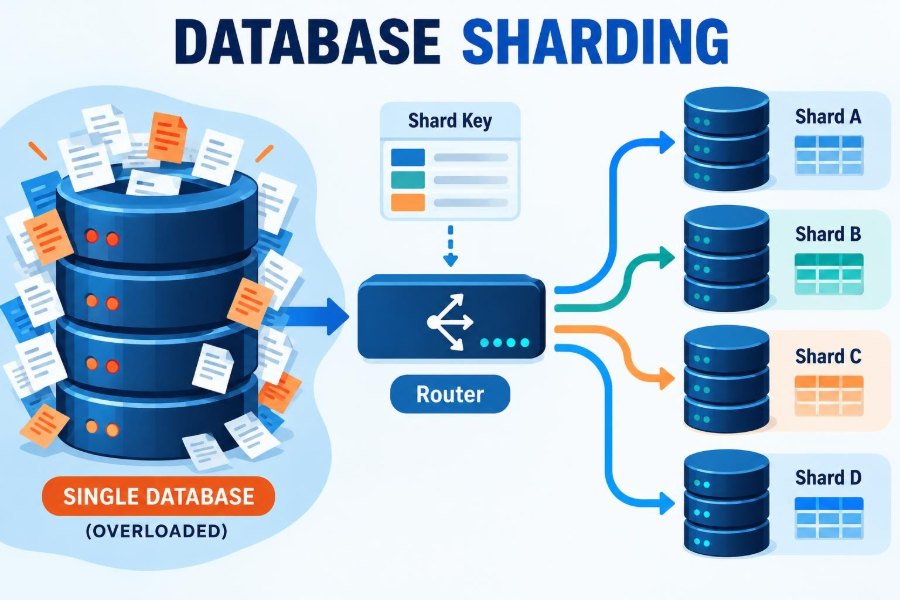

A small application can often keep every customer, order, message, and product record in one database server. The arrangement is easy to understand: one connection string, one set of tables, and one place to inspect when something goes wrong.
Then the application grows. A popular marketplace accumulates years of orders. A messaging product stores conversations for millions of accounts. A telemetry service receives a steady stream of events. Queries take longer, storage fills up, and one busy group of users can slow down everyone else.
Adding a larger machine may help for a while. Eventually, though, there are physical, financial, and operational limits to making one server bigger. The application needs a way to spread data and work across several machines without losing track of where anything lives.
Database sharding is one approach to that problem. It can make a system capable of handling far more data and traffic, but it also turns database design into a distributed-systems problem. Understanding both sides is essential before adopting it.
📈 When One Database Server Becomes the Bottleneck
A single database server has finite CPU, memory, disk capacity, network bandwidth, and input/output throughput. It can serve many requests, but each write, index update, backup operation, and complex query competes for a share of those resources.
The warning signs are usually practical rather than dramatic: storage growth is difficult to accommodate, maintenance windows become risky, a few tables dominate workload, or peak traffic produces unacceptable latency. A server may still be healthy overall while one workload pattern has become its limiting factor.
Sharding addresses a specific form of growth: data and requests that can be divided into mostly independent groups. It is not a universal cure for slow queries or poor schema design.
🏗️ Why Vertical Scaling Eventually Has Limits
Before sharding, teams commonly use vertical scaling: moving the database to a machine with more memory, faster storage, additional processor cores, or a larger managed-service tier. This preserves the simple model of one logical database.
Vertical scaling is often the best early choice because it requires few application changes. Better indexes, query tuning, archiving old data, caching, and read replicas may also solve the immediate issue with much less complexity.
But a single primary database remains a central write path and a central capacity boundary. At some point, the next larger machine may be unavailable, disproportionately expensive, or unable to provide enough write throughput. Sharding scales outward by adding servers instead.
🧩 What a Database Shard Actually Is
A shard is an independent database instance that stores only a subset of a dataset. Together, all shards represent the application’s complete logical data.
Imagine an online learning platform whose data is organized by school. One shard might hold schools in one group, while another holds the rest. A request for a student’s assignments is directed to the shard that contains that student’s school data.
Each shard commonly has similar tables and schema, but different rows. This is called horizontal partitioning: splitting records across databases by rows rather than splitting columns into separate tables.
🗂️ Sharding Is More Than Ordinary Table Partitioning
Database products often support partitioned tables inside one database server. Those partitions can improve maintenance and query performance, especially for large time-based tables. Yet they still share the same server’s core resources and failure domain.
Sharding distributes partitions across separate database nodes. That can increase aggregate storage and write capacity, but requests must now locate the right node and tolerate network failures between components.
| Approach | Where data is divided | Typical benefit | Main trade-off |
|---|---|---|---|
| Table partitioning | Within one database system | Manage large tables more efficiently | Still constrained by one server or cluster |
| Read replication | Copies of the same data | Distribute read traffic | Does not split primary write ownership |
| Sharding | Across independent database nodes | Scale storage and writes horizontally | Application and operational complexity |
🧭 The Router Is the Map to Your Data
Once data lives on multiple shards, the application needs a routing decision: which shard should receive this query? That decision may live in application code, a database proxy, a dedicated routing service, or features provided by a distributed database.
For example, code might calculate a shard from a customer ID before opening a database connection. More sophisticated systems consult a metadata service that records which shard owns each tenant or range.
Routing must be reliable and fast. If every request must scan all shards to find one account, much of the benefit of sharding disappears. A clear routing path is the foundation of the design.
🔑 Choosing a Shard Key
The value used to decide a record’s home is the shard key. Common choices include tenant ID, customer ID, organization ID, geographic region, or a range derived from an identifier.
A good shard key keeps related data together and spreads workload reasonably evenly. In a business application, organization ID is often attractive because users, projects, invoices, and permissions usually belong to one organization.
The key should also match frequent access patterns. If nearly every request begins with an organization ID, routing is straightforward. If the application often asks for records without knowing the key, it will need a separate index, a search system, or expensive cross-shard work.
⚖️ Even Distribution Is a Design Goal, Not a Guarantee
A shard plan should avoid placing most records or most requests on a single machine. Hashing a stable identifier is one common strategy: a hash function maps each key to one of many shard buckets, producing a distribution that is often reasonably balanced.
Range-based sharding assigns consecutive values to a shard, such as account IDs within particular ranges. It can make range queries simpler, but newly created sequential IDs may all land on the newest shard and create a hotspot.
Data volume and traffic volume are different. Ten quiet customers may occupy more storage than one highly active customer, while one popular tenant may generate most writes. Capacity planning needs to examine both.
🌍 Geographic Shards Can Reduce Distance
Some systems assign data by region: for example, accounts created in one service region may be stored in a nearby shard group. Keeping data closer to users can reduce network latency and may help satisfy locality requirements.
Geography is not automatically a sufficient key. A large region can still become uneven, and users may travel or collaborate across regions. The design needs explicit rules for which location owns an account and how exceptions are handled.
Regional sharding also increases operational responsibilities. Each region needs monitoring, deployment procedures, disaster recovery plans, and carefully tested behavior when another region is temporarily unavailable.
🔎 Queries Work Best When They Include the Shard Key
A request such as “show the invoices for organization 482” has an efficient route when organization 482 determines a shard. The router sends one query to one database, and the result comes back without a distributed search.
A request such as “find all invoices matching this email address” may be harder if email is not the shard key. The system might maintain a global lookup table, use a search index, or query every shard and merge results.
The last option, often called a scatter-gather query, becomes increasingly expensive as shard count grows. It should be an intentional exception, not the normal path for routine application screens.
🔄 Cross-Shard Joins Change How You Model Relationships
Within one relational database, a join can connect related tables efficiently. Across independent shards, a conventional database join usually cannot happen because each database sees only its local rows.
Teams often solve this by colocating related records under the same shard key. If orders, order items, and customer-specific preferences share a customer or organization key, they can remain on one shard.
For genuinely global relationships, applications may combine results in code, keep a denormalized read model, or use an analytics system designed for broad aggregation. These choices trade some simplicity or immediate consistency for scalable access patterns.
💳 Transactions Are Simplest Inside One Shard
A database transaction groups operations so they succeed or fail together. Local transactions within a shard retain the familiar guarantees of the chosen database system.
A transaction spanning two shards is harder. Coordinated commit protocols exist, but they can add latency, reduce availability during failures, and complicate recovery. Not every database or deployment uses them in the same way.
Many sharded applications redesign workflows to avoid distributed transactions. A hypothetical order system might store an order and its items in one shard, then publish an event for a separate inventory service to process. The workflow needs retries and clear compensation behavior if a later step fails.
⏳ Consistency Requires Explicit Decisions
When data is copied or updated across shard boundaries, different components may not observe the change at exactly the same instant. This is often described as eventual consistency: the system converges after propagation rather than presenting an immediate global view.
That can be acceptable for a search index or a dashboard that refreshes shortly after an event. It may be unacceptable for a balance check, permission change, or operation that must prevent duplicate allocation.
The useful question is not whether eventual consistency is inherently good or bad. It is which business actions require immediate correctness, which can tolerate delay, and how the interface communicates temporary states to users.
🪞 Replication and Sharding Solve Different Problems
Replication creates copies of data, often to improve availability, support disaster recovery, or distribute read load. Sharding divides ownership, so different primaries handle different subsets of writes.
Most production sharded systems use both. Each shard may have replicas, allowing a failed node to be replaced and some read traffic to be served elsewhere. That means the unit of operation is often a replicated shard rather than a lone server.
Replication introduces its own choices, including synchronous versus asynchronous copying and replica lag. A read immediately after a write may need to go to the primary if a stale replica would produce a confusing result.
🛡️ Sharding Can Limit Some Failures, but Adds Others
If one shard becomes unavailable, a well-designed system may keep other shards functioning. That can reduce the blast radius compared with losing one database that contains every account.
However, shared components can still become system-wide dependencies. A routing service, metadata database, credential provider, deployment error, or faulty application release can affect all shards at once.
Resilience comes from removing single points of failure, testing failover, and defining degraded behavior. Sharding alone does not make a system highly available; it changes where availability risks appear.
🔥 Hot Shards Are the Uneven-Load Problem
A hot shard receives substantially more traffic, writes, or storage growth than its peers. It may result from a celebrity customer, a huge organization, a popular geographic region, or a poorly chosen sequential key.
Adding more empty shards does not help if the overloaded tenant cannot move. The design needs a mitigation path, such as assigning large tenants to dedicated shards, splitting a tenant’s internal workload where the domain permits it, or changing the routing map.
Monitor load per shard, not just fleet averages. An average latency figure can look healthy while one shard is close to saturation and its users experience persistent delays.
📚 Indexes Still Matter on Every Shard
Sharding does not repair an inefficient query. A query that scans millions of local rows, sorts without an appropriate index, or returns far more data than needed remains costly, even when the overall dataset is divided.
Each shard should have indexes that support its common local access paths. Composite indexes often need to begin with the shard key or tenant boundary when queries filter by it, followed by columns used for sorting or further filtering.
Indexes also have costs: they use storage and make writes more expensive because each change may update multiple structures. Measure real query plans and workload behavior instead of indexing every column preemptively.
🆔 Global Identifiers Need Careful Planning
Auto-incrementing numeric IDs are convenient inside one database, but independent shards can generate the same values. Systems therefore need identifiers that remain unique across the entire application.
Possible approaches include universally unique identifiers, time-ordered identifiers, IDs containing a shard component, or centrally allocated ranges. The right option depends on storage format, index behavior, ordering needs, and database support.
An identifier can also reveal assumptions. If code treats an ID as proof of a record’s shard location, migration becomes harder when the record later moves. Separating identity from current location gives the routing layer more flexibility.
🧱 Schema Changes Must Reach Every Shard Safely
With one database, a schema migration runs once. With many shards, the same change must be applied repeatedly, tracked, and verified across the fleet.
Safe migrations are usually backward compatible. A team might first add a nullable column, deploy code that can handle both old and new forms, backfill data gradually, and only later enforce a new constraint or remove obsolete fields.
Long-running locks and simultaneous large backfills can cause outages. Automation should record migration status per shard and make retries idempotent, meaning a repeated operation has the same safe effect.
🧠 The Application Must Understand Data Ownership
Sharding is not merely an infrastructure change. Application services, background workers, administrative tools, and data pipelines need to know how to find the correct data owner.
A practical architecture often exposes a small data-access layer that accepts a tenant or account context and chooses a shard internally. This prevents routing rules from being duplicated throughout the codebase.
Authorization is related to routing but not identical. A request should be routed by a trusted server-side context, then checked for permission on that shard. Never rely on a client-supplied shard identifier as an access-control mechanism.
📊 Observability Must Be Shard-Aware
Logs, metrics, and traces should include safe identifiers such as shard name, operation type, and tenant class where appropriate. Without that context, diagnosing a slow request across many databases becomes guesswork.
Useful signals include connection usage, query latency, error rates, replication delay, disk growth, lock waits, cache behavior, and queue depth for every shard. Alerting should highlight both absolute failures and meaningful imbalance between peers.
Centralized dashboards are valuable, but they should preserve the ability to drill into one shard. Aggregates answer “is the fleet healthy?” while per-shard data answers “who is affected and why?”
🔐 Security Boundaries Do Not Appear Automatically
Separating tenants across shards can reduce accidental exposure through certain query mistakes, especially if large customers receive dedicated infrastructure. But a shard is not automatically a complete security boundary.
Each shard still needs encryption, access controls, audit practices, secure backups, patching, and secret rotation. Operations staff and services should receive only the permissions required for their tasks.
Data residency, retention, and deletion rules may become easier to target when data ownership is explicit. They also become harder to prove if copies, logs, analytics pipelines, and backups are not included in the data inventory.
💾 Backups and Recovery Become a Fleet Operation
Every shard needs backups that can be restored and tested. A backup strategy is incomplete if it only confirms that files were created; recovery procedures must establish that usable data can be restored within required time expectations.
Cross-shard workflows add another concern: restoring one shard to an earlier point may leave it temporarily inconsistent with events processed elsewhere. Systems may need event replay, reconciliation jobs, or clearly documented recovery runbooks.
Keep the shard map and routing metadata protected as carefully as the data itself. Recovering databases is much less useful if the application cannot determine where records belong.
🧰 Alternatives May Solve the Problem More Simply
Sharding should compete with less complex options. Archiving old records can shrink active tables. Caching can protect databases from repeated reads. Read replicas can absorb read-heavy traffic, and asynchronous queues can smooth bursty write workloads.
A specialized search engine can handle global text search better than asking every transactional shard. An analytical warehouse or column-oriented store can handle large reporting queries without competing with live user transactions.
Managed distributed databases may automate some partitioning, replication, and rebalancing tasks. They still require thoughtful data modeling, key selection, query design, and an understanding of their consistency and transaction semantics.
🚦 Signs That Sharding Is Actually Justified
Sharding becomes more credible when a workload has sustained capacity needs that one primary cannot meet economically or operationally, and when data naturally groups around a stable ownership key.
It is particularly suitable when most requests are tenant-local, user-local, or region-local. It is less appealing when routine operations require arbitrary global joins, frequent global constraints, or perfectly synchronized updates across all records.
- Verify that query tuning, indexing, caching, and lifecycle policies have been considered.
- Identify the dominant write and storage constraints, not only a general feeling that the database is “large.”
- List the application’s common access patterns and confirm that most include a routable key.
- Design operational ownership, monitoring, backup, and failure procedures before splitting production data.
🚚 Migrating to Shards Is a Controlled Change
Migration rarely needs to be a single disruptive move. Teams can introduce a routing layer while data is still in one database, establish a shard map, and move a small, well-understood group of tenants first.
A common approach copies historical data, synchronizes changes during a transition period, validates counts and business invariants, then directs the selected tenants’ traffic to the new shard. The exact mechanics depend on the database and consistency requirements.
Rollback plans matter. Know whether writes can be temporarily paused, how divergent records will be reconciled, and which source of truth applies at each migration stage. Practice the procedure on realistic non-production data first.
🧪 Testing Must Include Distributed Failure Cases
Unit tests can verify routing logic, but sharded behavior also needs integration and operational testing. Test missing route metadata, a slow shard, a failed replica promotion, partial migrations, duplicate event delivery, and retry behavior.
Load tests should use realistic skew, not only evenly distributed synthetic tenants. A design that performs well with equal-sized accounts may fail when one tenant produces a large fraction of write traffic.
Chaos-style experiments can be useful when carefully controlled: deliberately make a non-production dependency fail and confirm that timeouts, fallbacks, alerts, and recovery procedures behave as designed.
📝 Documentation Prevents Invisible Coupling
Future engineers need more than a list of shard names. Document the shard key, routing rules, ownership boundaries, identifier format, migration process, consistency expectations, and approved patterns for global queries.
Also document prohibited shortcuts. For example, an administrator script that queries every production shard directly may create unbounded load or bypass auditing. A supported tool or API makes safe behavior easier than improvised access.
As the application evolves, review new features for shard impact early. A seemingly small global search, reporting screen, or new relationship can quietly introduce a costly cross-shard dependency.
🎯 The Core Principle: Divide Along Natural Boundaries
Successful sharding follows the shape of the application. It assigns data to durable ownership boundaries and makes the frequent path local: one request, one route, one shard, and usually one transaction.
The benefit is not simply “more databases.” It is the ability to add capacity by distributing independent work while keeping each piece understandable. The cost is accepting that global operations, movement of data, and failure handling require deliberate engineering.
For many systems, the right answer is to delay sharding until simpler measures are exhausted. For systems with clear tenant-local workloads and persistent growth, a thoughtfully designed shard strategy can provide a durable path beyond one server.
Database sharding works best when it turns a large global dataset into smaller, well-owned local workloads without hiding the complexity of coordinating what remains global. Build toward that boundary carefully, measure real constraints, and keep the ordinary request path simple. ⚙️🗂️🚀