
A checkout page can look healthy right up until a payment provider responds slowly. A mobile app can work perfectly in a demo, then fail when one database connection pool is exhausted during a busy evening. These incidents rarely begin as one dramatic mistake; they emerge from ordinary dependencies behaving in unusual combinations.
Teams already test code, deploy carefully, watch dashboards, and prepare backups. Yet production systems are not controlled laboratories. Networks lose packets, cloud services throttle requests, certificates expire, machines restart, and users arrive in bursts.
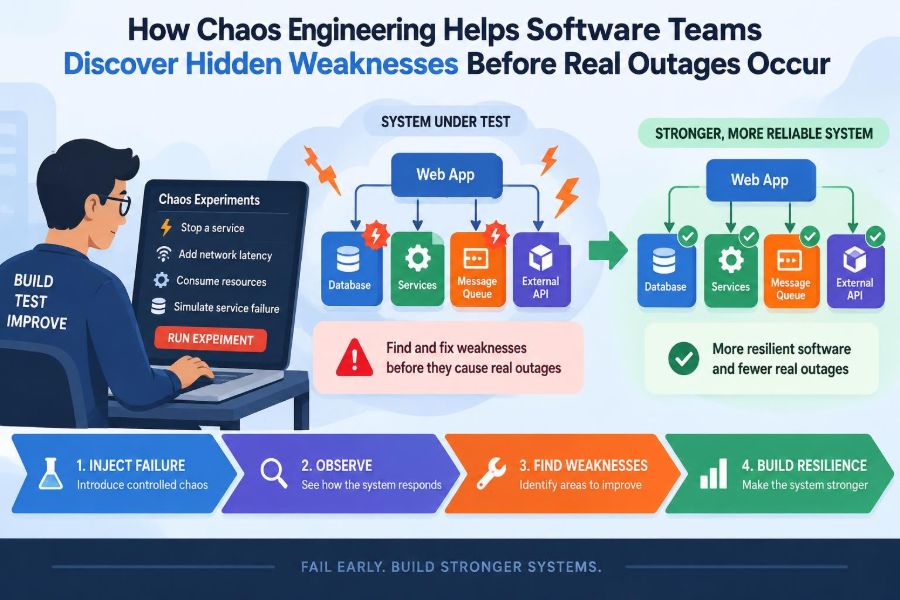
Chaos engineering is a disciplined way to learn how a system behaves under those conditions before customers are the ones discovering the answer. It deliberately introduces limited, reversible failure and uses the result to improve resilience.
The goal is not to “break things for fun.” It is to replace assumptions such as “the failover should work” with evidence that it does—or a clear plan for fixing it.
🌪️ What Chaos Engineering Actually Means
Chaos engineering is the practice of running controlled experiments on a system to test its ability to withstand turbulent conditions. An experiment changes one carefully selected condition, observes the system, and compares the outcome with an expected healthy state.
The word “chaos” can be misleading. Good chaos engineering is structured, measured, and bounded. A team might temporarily stop one noncritical service instance, add network delay between two components, or simulate a dependency returning errors.
Its central question is practical: when part of our system behaves badly, do users still receive an acceptable service?
🧩 Why Ordinary Testing Leaves Gaps
Unit tests verify small pieces of code. Integration tests check that selected components work together. End-to-end tests exercise important user journeys. All are valuable, but they often run in simplified environments with predictable data, timing, and dependencies.
Many operational failures live between those boundaries. A retry policy may work in isolation but overwhelm a struggling downstream service when thousands of callers retry at once. A failover configuration may exist but use credentials that were never copied to the standby environment.
Chaos experiments focus on these system-level interactions, especially the assumptions that are difficult to prove through ordinary test suites.
🔍 Hidden Weaknesses Are Usually Assumptions
Distributed systems depend on assumptions: DNS will resolve, clocks will be close enough, messages will eventually arrive, a third-party API will respond quickly, and an autoscaler will add capacity before queues become unmanageable.
Most assumptions are reasonable most of the time. The risk appears when an assumption is undocumented, unmonitored, or embedded in several services at once. A small failure then travels through the system because each component responds in a way that made sense locally.
Chaos engineering turns assumptions into testable hypotheses. That shift makes resilience work concrete rather than aspirational.
🧠 The Steady State Is Your Starting Point
Before injecting any fault, define the system’s steady state: observable signals that represent acceptable normal operation. For a retail service, that might include successful checkout rate, response latency, error rate, and the ability to create orders.
A steady state should describe user value, not merely infrastructure activity. CPU usage alone cannot show whether customers can complete a purchase. Likewise, a green health check may hide delayed notifications or missing records.
Choose a small number of meaningful signals. They become the experiment’s success criteria and its safety alarms.
🧪 A Hypothesis Makes Failure Experiments Useful
A productive experiment begins with a falsifiable statement. For example: “If one recommendation-service instance becomes unavailable, product pages will continue to load without recommendations, and checkout latency will remain within the team’s normal target.”
This describes the fault, the expected behavior, and the user-facing boundary. If the result differs, the team has learned something specific: perhaps traffic was not rerouted, a fallback was missing, or an unrelated shared resource became saturated.
“Let’s see what happens” can uncover surprises, but it is not enough for safe learning. A hypothesis gives the team a reason to observe particular signals and decide what to change afterward.
🎯 Start With the Customer Journey, Not the Server
Infrastructure-focused experiments are useful, but customer journeys provide the best prioritization. Map the steps required to search, sign in, pay, upload a file, or retrieve a report. Then identify the services, data stores, queues, and external providers involved.
Ask which failures would be visible to a user and which can be degraded gracefully. A missing personalization widget may be tolerable; an inability to submit a medical record or payment is not.
This perspective helps teams invest in resilience where it protects real outcomes rather than where it merely produces interesting technical tests.
🗺️ Map Dependencies Before You Disturb Them
A dependency map shows more than service names. It records who calls whom, what protocol is used, where data is stored, which dependencies are shared, and what happens when each dependency is slow or unavailable.
Hidden shared dependencies deserve special attention. Several independent-looking services might rely on the same identity provider, message broker, DNS resolver, configuration store, or network path. Losing one shared component can create a much larger blast radius than expected.
The map does not need to be perfect. Building it often reveals uncertainty worth investigating before the first experiment begins.
📦 Faults Come in More Forms Than “Server Down”
Stopping a virtual machine is only one failure mode. Real incidents commonly involve degraded rather than fully absent components. A service that answers in ten seconds can be more dangerous than one that fails immediately because callers may hold threads and connections while waiting.
Useful fault categories include:
- Network latency, packet loss, connection failures, and partial partitions.
- Resource pressure involving CPU, memory, disk space, file descriptors, or connection pools.
- Dependency errors, throttling, malformed responses, and slow third-party APIs.
- Process restarts, unavailable instances, and failed deployment rollbacks.
- Data-path failures, such as delayed messages, duplicate deliveries, or unavailable replicas.
Select faults that reflect plausible risks for the architecture, not a generic catalogue.
🐢 Slow Dependencies Reveal Cascading Failure
Imagine a hypothetical order service that calls tax, inventory, and payment services. If the tax service becomes slow, order-service requests may wait. Its worker pool fills, new requests queue, and eventually even customers who do not need tax calculation can be affected.
This is a cascading failure: a local problem expands because resources are shared or because components keep waiting on one another. Chaos experiments are especially good at revealing these propagation paths.
The usual defenses are timeouts, bounded queues, concurrency limits, fallbacks, and isolation between workloads. None is automatically correct; each must be tuned to the service’s user promise and capacity.
⏱️ Timeouts Are Product Decisions as Well as Technical Ones
A timeout determines how long one component is willing to wait for another. Without one, a slow dependency can consume threads or connections indefinitely. With one that is too short, healthy but variable network calls may be abandoned unnecessarily.
Experiments help teams observe the actual trade-off. What happens when a dependency responds just beyond the configured timeout? Does the user receive a useful fallback? Does the request get cancelled downstream, or does unnecessary work continue?
Timeouts should align across call chains. A frontend waiting longer than its backend can produce confusing results; a backend with no margin to return a fallback may simply pass its failure upward.
🔁 Retries Can Heal or Harm
Retries help with transient problems such as a short network interruption. But immediate, unlimited retries can multiply load precisely when a dependency is least able to handle it. This pattern is often called a retry storm.
A resilient design usually makes retry behavior explicit: limit attempts, add backoff, introduce random variation so callers do not retry in sync, and retry only operations that are safe to repeat. Payment submission, for example, requires careful idempotency controls to avoid duplicate charges.
Fault injection can show whether retry logic provides recovery or merely moves the outage to another component.
🚧 Circuit Breakers and Graceful Degradation
A circuit breaker temporarily stops calls to a dependency after repeated failures. Instead of allowing every request to wait and fail, it fails quickly or returns a fallback while periodically checking whether the dependency has recovered.
Graceful degradation means preserving the most important service even when optional features disappear. A news site might serve articles without recommendations; a collaboration tool might allow viewing documents while temporarily delaying search indexing.
These are product choices, not only library settings. Teams must decide what data can be stale, what actions can be queued, and what must never be silently approximated.
🧱 Bulkheads Prevent One Problem From Sinking Everything
In ships, bulkheads divide compartments so flooding in one area does not sink the entire vessel. In software, the same idea separates resources: one customer tier, endpoint, tenant, or dependency should not consume every worker, connection, or queue slot.
For example, a report-generation workload may use a separate queue and worker pool from interactive account access. If reports become expensive, people can still sign in and perform time-sensitive tasks.
Chaos tests can validate these boundaries by placing pressure on one workload and verifying that protected paths retain capacity.
🌐 Network Failure Is Often Partial
Systems rarely experience a clean, universal “network down” event. One availability zone may have trouble reaching another. Requests in one direction may work while responses fail. Some clients may use cached DNS records while others resolve a new address.
A network partition occurs when components cannot reliably communicate despite still running. It forces difficult questions: should each side continue accepting writes, become read-only, or reject requests until communication returns?
The right answer depends on consistency requirements. Experiments should be designed carefully because data reconciliation after a partition can be more consequential than the initial loss of connectivity.
🗃️ Data Consistency Deserves Special Care
Not every operation needs immediate consistency, meaning every reader sees the latest write at once. Some systems can safely show a slightly stale delivery estimate or search result. Others, such as inventory reservations or permission changes, may need stronger guarantees.
Chaos engineering exposes where a design relies on eventual consistency—the model in which replicas converge over time. Test what happens when messages are delayed, delivered twice, or processed out of order.
Do not use broad production data faults as an early experiment. First establish backups, restore procedures, audit trails, and clear limits. Resilience is not an excuse to gamble with irreversible information.
📨 Queues Add Resilience but Also New Failure Modes
Message queues decouple producers from consumers, allowing a service to accept work even when downstream processing is temporarily slower. That can improve availability, but it shifts the question from “did it finish now?” to “will it finish correctly later?”
Experiments should check queue depth, consumer lag, dead-letter handling, duplicate processing, and recovery after consumers restart. They should also verify that alerts distinguish a healthy backlog from one that will violate a user-facing deadline.
A queue is a buffer, not an unlimited solution. If producers outpace consumers for too long, storage and recovery capacity become part of the incident.
📈 Observability Turns an Experiment Into Learning
You cannot learn much from a fault you cannot observe. Observability is the ability to understand a system’s internal behavior from outputs such as metrics, logs, traces, and domain events.
Metrics show trends like error rate, saturation, and latency. Logs provide detailed events. Distributed traces follow a request across services, often revealing the precise dependency call where waiting began. Business metrics reveal whether users actually completed key tasks.
Before running an experiment, ensure dashboards are understandable and alerts route to the right people. If the team cannot distinguish injected behavior from unrelated trouble, stop and improve visibility first.
🚦 Guardrails Keep Experiments Safe
Every experiment needs an explicit blast radius: the maximum scope of systems, users, or resources that could be affected. Start with one instance, a small percentage of traffic, a noncritical endpoint, or a staging environment that resembles production.
Also define abort conditions before starting. Examples include a sharp rise in failed transactions, loss of a critical safety signal, unexpected effects outside the target service, or an operator’s judgment that conditions are no longer understood.
Guardrails are not bureaucracy. They make it possible to explore failure without turning controlled learning into an uncontrolled incident.
🛑 A Rollback Plan Must Be Boring and Tested
For each experiment, document how to stop the injected fault and how to verify recovery. The action should be simple enough for someone other than the experiment author to execute under pressure.
Stopping the fault does not always restore the system immediately. Queues may need to drain, caches may need to warm, and connection pools may recover gradually. Define which signals demonstrate genuine recovery rather than assuming it.
When possible, rehearse the rollback mechanism independently. An untested “off switch” is another assumption waiting to fail.
🏗️ Where to Run the First Experiments
Staging environments offer a lower-risk place to test tooling, permissions, hypotheses, and recovery procedures. Their limitation is realism: they may lack production traffic patterns, data volume, external integrations, and operational complexity.
Production experiments provide stronger evidence but demand tighter scope and mature guardrails. Many teams progress gradually: begin in development, validate in staging, then run small production tests during staffed periods with clear customer-impact limits.
The choice is not ideological. It depends on the risk of the fault, the fidelity of nonproduction environments, and the team’s ability to detect and stop harm.
👥 People and Processes Are Part of the System
An outage is not handled by software alone. On-call engineers need usable alerts, access to dashboards, clear ownership, and escalation paths. A technically resilient platform can still produce a poor outcome if nobody knows who can make a decision.
Some exercises intentionally test operational response rather than infrastructure behavior. A team might simulate a dependency alarm and observe whether the runbook helps an unfamiliar responder identify the relevant service and mitigation.
These exercises should be blameless. Their purpose is to improve systems and documentation, not to grade individuals under artificial stress.
📚 Game Days Build Shared Operational Muscle
A game day is a planned session in which a team runs one or more resilience scenarios together. It can combine fault injection with discussion, monitoring practice, communication drills, and follow-up design work.
Good game days have a clear audience, defined scope, observers, and time for debriefing. They produce concrete artifacts: updated runbooks, new alerts, architecture decisions, or tickets with owners and deadlines.
A dramatic scenario is less valuable than a focused one that teaches the team something they can act on next week.
📝 A Practical Experiment Template
Consistency makes chaos engineering repeatable. A lightweight template prevents teams from skipping essential safety and learning steps.
- State the customer journey and steady-state signals.
- Write the hypothesis and identify the dependency or condition to change.
- Set blast radius, duration, abort conditions, and rollback steps.
- Assign observers and confirm dashboards, permissions, and communications.
- Inject the fault gradually, observe outcomes, and stop if guardrails trigger.
- Record results, decide corrective actions, and rerun after changes when appropriate.
The final step matters most. An experiment that finds a weakness but produces no ownership or retest is only an interesting incident.
🛠️ Start Small With High-Confidence Scenarios
A sensible first experiment targets a known, low-risk failure mode. For instance, in a replicated stateless service, temporarily remove one instance while confirming load balancing, autoscaling, user latency, and alert behavior.
Avoid starting with broad database corruption, region-wide simulations, or arbitrary production traffic disruption. Those scenarios may be relevant later, but early work should build confidence in the team’s controls and observation skills.
Small experiments also make cause and effect easier to interpret. Change one meaningful variable before combining faults.
⚖️ Common Mistakes That Undermine the Practice
One common mistake is treating chaos engineering as a one-time demonstration. Resilience decays as services, dependencies, and traffic patterns change. Useful experiments are revisited when architecture changes or after significant incidents.
Another is measuring only technical survival. If servers remain running while customers cannot finish critical tasks, the experiment has not succeeded. Teams should connect resilience criteria to user outcomes.
- Injecting faults without clear abort conditions.
- Running tests without notifying essential responders or support teams.
- Testing only full outages and ignoring latency, saturation, and partial failure.
- Fixing symptoms while leaving unclear ownership or missing documentation.
🔐 Security, Compliance, and Ethical Boundaries
Experiments must respect security controls, contractual commitments, privacy obligations, and internal change-management rules. A test that exposes sensitive data, bypasses audit requirements, or disrupts a regulated workflow is not justified by its learning value.
Use least-privilege access for fault-injection tools, record actions, and protect credentials. Consider whether customers need notification for a planned activity, particularly when even small degradation could affect a critical service.
When uncertainty is high, reduce scope or choose a safer environment. Responsible resilience work treats customer trust as a constraint, not a metric to optimize around.
📊 How to Judge Whether Resilience Improved
Success is not the number of experiments completed. Look for evidence that important failure modes have clearer behavior: faster detection, smaller impact, more reliable degradation, better recovery, and fewer unknown dependencies.
Track corrective actions to completion and retest them. A team may also notice qualitative improvements, such as more accurate service ownership, clearer runbooks, or architecture discussions that explicitly address dependency failure.
Be cautious about simplistic scores. A system can pass a narrow experiment while remaining vulnerable to a different combination of load, timing, or human error.
🔄 Chaos Engineering Complements Reliability Work
Chaos engineering does not replace code review, capacity planning, backups, incident response, security testing, or disaster recovery. It complements them by checking whether those practices work together under realistic stress.
For example, a disaster recovery plan may specify failover. A controlled experiment can reveal whether monitoring detects the transition, applications reconnect, data remains within expected consistency bounds, and operators have the access needed to respond.
Think of it as continuous validation of reliability assumptions, not a separate resilience department or a substitute for sound engineering.
🚀 Building a Sustainable Program
A sustainable practice begins with ownership. Platform teams may provide safe tooling and standards, while product teams choose customer journeys and interpret business impact. Both perspectives are needed.
Create a small experiment backlog from incident reviews, architecture changes, recurring alerts, and dependency maps. Schedule work at a pace that allows findings to be fixed, rather than accumulating a large list of known weaknesses.
Over time, teams can automate repeatable checks in delivery pipelines or scheduled windows. Automation should preserve human review for scope, changing risk, and unexpected observations.
💡 The Core Principle: Learn Before Customers Have To
Complex software cannot be made failure-free. It can, however, be designed to fail in understood, contained, and recoverable ways. Chaos engineering provides a method for discovering whether that design is real.
The strongest experiments are not those that create the biggest disruption. They are the ones that test a meaningful assumption, protect users with firm guardrails, reveal an actionable weakness, and verify the improvement afterward.
That discipline changes resilience from a collection of reassuring diagrams into demonstrated operational capability.
Chaos engineering helps teams earn confidence by safely testing how their systems behave when normal conditions disappear—before a real outage makes the lesson urgent. ⚙️🛡️📈