
A product team is building a marketplace. At first, every listing looks simple: a title, price, seller, photos, and category. Then come variants, shipping rules, promotions, reviews, inventory reservations, and reporting requirements.
Another team is collecting telemetry from devices. Events arrive quickly, fields vary by firmware version, and engineers want to preserve the raw payload even when they do not yet know every future question they will ask.
Both teams need a database, but they do not need the same database properties in the same proportions. Choosing PostgreSQL or MongoDB is less about declaring one “better” and more about understanding the shape, relationships, access patterns, and guarantees your application actually needs.
This decision matters because a data model influences application code, operational work, reporting, performance tuning, and the cost of changing direction later. A fashionable choice can still be a poor fit.
🧭 1. Start With the Application, Not the Database
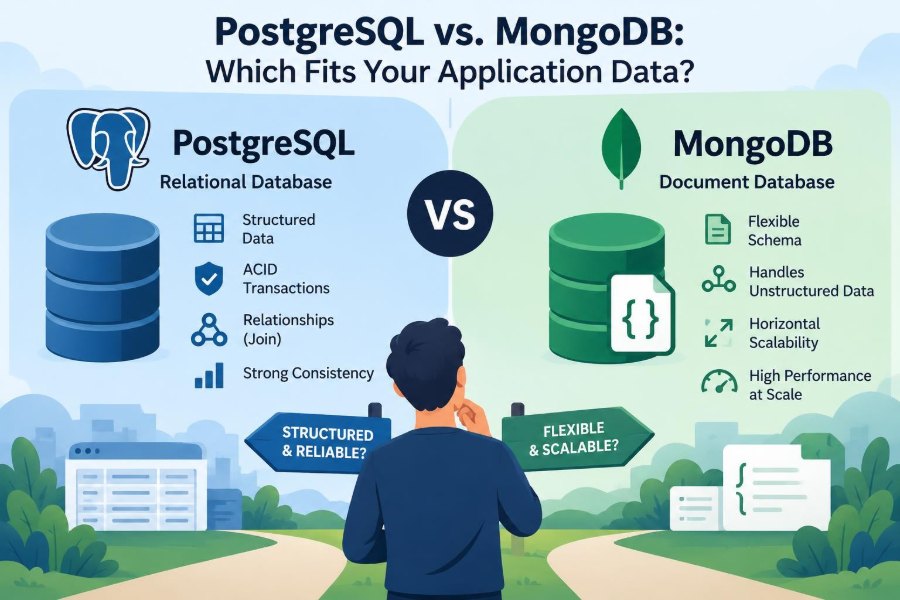
PostgreSQL and MongoDB solve overlapping problems, yet they encourage different modeling habits. PostgreSQL is a relational database built around tables, relationships, SQL, and strong transactional behavior. MongoDB is a document database built around flexible BSON documents, collections, and document-oriented queries.
The useful first question is not “Which database scales?” Both can support serious production systems. Ask instead: what must remain true about the data, and how will the application read and change it?
🏗️ 2. Understand the Core Data Model
In PostgreSQL, data commonly lives in rows within tables. Columns describe attributes, primary keys identify rows, and foreign keys can express relationships between tables.
In MongoDB, data lives in documents within collections. A document can contain nested objects and arrays, so a customer record can hold addresses, preferences, and recent activity in one hierarchical structure.
Neither model prevents the other kind of structure. PostgreSQL can store JSON documents, and MongoDB can reference related documents. The difference is which approach feels natural and receives the most direct tooling.
🗂️ 3. Schema Means Different Things
PostgreSQL usually uses an explicit schema: a table defines its columns, types, constraints, and defaults. This makes expectations visible and lets the database reject malformed data early.
MongoDB permits documents in one collection to have different fields. That flexibility is valuable when records genuinely vary, but it moves more validation responsibility into application code, collection validators, or both.
Flexible schema does not mean no schema. Every application has expectations about its data; the question is whether those expectations are enforced primarily by the database or by convention and code.
🔗 4. Relationships Are Often the Deciding Factor
Relational systems are designed for connected data. An order can reference a customer, line items can reference products, and permissions can connect users to organizations and roles.
PostgreSQL makes these relationships explicit through keys and joins. A foreign key can prevent an order from pointing to a customer that does not exist, while a query can combine several normalized tables for a report.
MongoDB works especially well when a document is a useful aggregate: data that is commonly loaded and changed together. Relationships still exist, but choosing between embedding and referencing requires deliberate design.
🧩 5. Embedding Can Simplify a Document Model
Embedding places related data inside a parent document. For example, an order document might include an array of line items containing the product name, quantity, and price at purchase time.
This can make a common read fast and straightforward because one query returns the complete order. It can also preserve historical snapshots naturally: a later product rename need not alter the name shown on an old invoice.
- Embed when child data belongs to one parent and is read with it.
- Embed when the child has a limited, manageable size.
- Embed when the parent and child usually change together.
Embedding becomes less appealing when the same child must be independently updated, queried, or shared by many parents.
🧷 6. Referencing Preserves Independent Entities
A MongoDB document can store identifiers that point to other documents, much like an application-level foreign key. A product catalog, for instance, may keep products separate from orders because products are shared across many records.
References reduce duplication, but retrieving a complete view may require multiple queries or an aggregation pipeline. PostgreSQL handles this style of connected data directly with joins and referential constraints.
When relationships are central rather than exceptional, PostgreSQL often reduces the amount of consistency logic your application must invent.
🛡️ 7. Data Integrity Is a Product Feature
Integrity rules are not merely database details. They protect user trust: an account balance should not become inconsistent, an invoice should not lose its customer, and a booking should not exceed capacity.
PostgreSQL provides declarative tools such as NOT NULL, unique constraints, check constraints, foreign keys, and exclusion constraints. These rules live near the data and apply regardless of which service or script writes to the database.
MongoDB offers validation rules and unique indexes, and applications can enforce further rules. Its approach can be sufficient, but teams should identify which guarantees are essential and where each one will be enforced.
🔒 8. Compare Transactions Carefully
Both PostgreSQL and MongoDB support transactions. The outdated idea that document databases cannot provide transactional behavior is incorrect.
PostgreSQL is particularly well suited to workflows involving many related rows and strict consistency. Its transactional model, isolation controls, and relational constraints are foundational to systems such as financial workflows, reservations, and business operations.
MongoDB provides atomic updates at the single-document level and also supports multi-document transactions. Multi-document transactions are valuable when needed, but if most important writes require them, that can signal that a heavily relational model deserves consideration.
⚡ 9. Atomicity Depends on the Unit of Change
A MongoDB document is a natural atomic boundary. Updating a profile and its embedded preferences together can happen as one document operation.
In PostgreSQL, a transaction can coordinate changes across any number of related rows and tables. This is convenient when the business operation naturally spans separate entities.
The best fit often follows the aggregate boundary. If a business action typically changes one self-contained object, a document model can be elegant. If it consistently changes a network of records, relational transactions may map more directly to reality.
📐 10. SQL Is More Than Query Syntax
SQL gives PostgreSQL a powerful language for filtering, joining, grouping, sorting, window calculations, common table expressions, and ad hoc investigation. Analysts, administrators, and backend developers can often ask new questions without adding a specialized query layer.
This matters when product requirements evolve. A team may begin with simple operational queries and later need cohort analysis, reconciliations, exports, or complex reporting across years of records.
MongoDB queries and aggregation pipelines are capable and expressive, especially for document-shaped data. But SQL’s broad familiarity and relational algebra are often an advantage for highly connected analytical questions.
🔎 11. MongoDB Queries Favor Document Access
MongoDB is pleasant when an application commonly fetches or updates a document by identifier or by fields within that document. Nested fields and arrays are first-class parts of the query model.
An API serving a content item with localized text, metadata, media settings, and an array of blocks can map closely to one document. The code may avoid reconstructing a response from several tables.
That convenience is strongest when the stored document and the application’s read model are similar. If every endpoint must assemble information from many collections, the initial simplicity can fade.
📊 12. Reporting Changes the Conversation
Operational data is not always queried only by the application that created it. Finance, support, product, and leadership may eventually need reports that cross customers, transactions, regions, plans, and time periods.
PostgreSQL is frequently a comfortable choice for this work because joins and aggregations are core capabilities. It also supports views and materialized views, which can help package or precompute recurring query results.
MongoDB can aggregate data effectively, but teams should test representative reporting workloads early. A database that is ideal for a document-serving API may not be the easiest home for broad relational analysis.
🧱 13. Normalization Reduces Contradictions
Normalization organizes relational data so a fact is stored in an appropriate place rather than copied repeatedly. For example, a current customer email can live in the customer table instead of being duplicated across every active subscription.
This reduces update anomalies. Change the email once, and current records remain consistent. The trade-off is that reading a rich view can require joins.
Normalization is not a rule to pursue blindly. Purposeful duplication, such as preserving an order-time shipping address, is often correct. The key is knowing whether a copied value is a snapshot or a fact that must stay synchronized.
📦 14. Denormalization Is a Deliberate Trade-off
Document models commonly denormalize by embedding or duplicating data that is frequently read together. This can reduce round trips and make common reads simpler.
But duplicated facts create an update problem. If a seller changes their display name and that name appears in thousands of documents, decide whether old documents should change, whether a background update is acceptable, or whether the name should be referenced instead.
Denormalization buys read convenience by creating consistency responsibilities. That can be an excellent bargain when it matches the domain.
🧾 15. PostgreSQL Can Store JSON Too
The comparison is not strictly rows versus documents. PostgreSQL supports JSON and JSONB values, allowing a relational schema to include flexible attributes when they are useful.
A product table might keep stable fields such as identifier, seller, category, and price in typed columns while storing category-specific attributes in a JSONB column. This is useful when a bicycle and a book need different descriptive properties.
Use this capability thoughtfully. If every important field is buried in unstructured JSON, you may lose some of the clarity, constraints, and query ergonomics that made a relational database attractive.
🧠 16. A Hybrid Model Is Often Sensible
Real applications rarely fit a pure textbook design. PostgreSQL can combine normalized tables with JSONB metadata. MongoDB can combine embedded subdocuments with references to separately managed entities.
The goal is not ideological purity. It is a model that clearly represents ownership, lifecycle, validation, and access patterns.
For example, a learning platform might store users, enrollments, payments, and permissions relationally while keeping flexible lesson-editor content in JSON. A single well-chosen database can sometimes support both needs.
🚀 17. Performance Starts With Workload Shape
Neither PostgreSQL nor MongoDB is automatically faster. Performance depends on data volume, indexes, query patterns, document size, hardware, concurrency, network behavior, and the quality of the data model.
A one-document lookup may be efficient in MongoDB. A multi-table query with suitable indexes may be efficient in PostgreSQL. Either system can perform poorly when asked to scan large amounts of unindexed data unnecessarily.
Benchmark the operations that matter: representative reads, writes, peak concurrency, pagination, report generation, and failure recovery. A synthetic benchmark that does not resemble production decisions is weak evidence.
🗃️ 18. Indexes Are Essential in Both Systems
An index helps a database locate matching records without scanning everything. PostgreSQL and MongoDB both offer several index types and both require trade-offs.
Indexes can accelerate reads, filtering, sorting, and uniqueness checks. They also consume storage and add work to writes because every relevant index must be maintained when data changes.
- Index fields used frequently for selective filters.
- Consider compound indexes for common multi-field queries.
- Use uniqueness constraints or unique indexes for identifiers that must not repeat.
- Inspect query plans instead of guessing why a query is slow.
Index design should follow observed query patterns, not a reflex to index every column or field.
📏 19. Document Size and Growth Matter
Embedding an ever-growing array is risky. A user document containing every event they have ever generated, for example, becomes difficult to retrieve, update, and manage as activity accumulates.
MongoDB has a maximum document size, so unbounded collections of child data should generally be modeled separately. Even below that limit, very large documents can make ordinary reads more expensive than intended.
PostgreSQL tables naturally encourage unbounded child records to become rows in another table. In either database, model histories, logs, messages, and events with expected growth in mind.
🔄 20. Concurrency Is About Conflicting Changes
Concurrency problems arise when several requests attempt to read or modify related data at nearly the same time. Examples include selling the last item, assigning the last seat, or applying the same coupon twice.
PostgreSQL offers mature transactional mechanisms for coordinating these cases, including row-level locking and isolation choices. Proper use still requires careful application design.
MongoDB can safely update a document atomically and can use transactions for broader workflows. The important task is to define the invariant first, then prove that the chosen update or transaction preserves it under concurrent requests.
🧪 21. Model One Real Workflow Before Committing
Do not choose from feature lists alone. Take a difficult, representative workflow and model it in both systems. For a marketplace, that might be “place an order while decrementing inventory, recording payment state, and preserving item snapshots.”
Write the expected reads, writes, constraints, indexes, and failure cases. Then ask what happens if a request is retried, a worker crashes midway, or two users act simultaneously.
This small exercise reveals whether a design depends on fragile application coordination or aligns naturally with the database’s strengths. 🧪
🛠️ 22. Migrations Are Part of Everyday Engineering
PostgreSQL schema migrations are explicit changes to tables, constraints, indexes, and data. They require planning, especially for large tables, but they make structural evolution visible and reviewable.
MongoDB can evolve fields gradually because older and newer document shapes may coexist. This can ease early iteration, yet it also means readers may need to handle multiple versions until old documents are migrated or retired.
In both systems, safe evolution needs a plan: add compatible writes, support old reads where necessary, backfill data, validate results, and remove obsolete paths later.
🔐 23. Security and Access Patterns Still Apply
Database choice does not remove security responsibilities. Use authentication, authorization, encryption in transit, secret management, backups, auditing appropriate to your environment, and least-privilege access.
PostgreSQL has strong role and privilege concepts and can support row-level security policies. MongoDB provides access control and deployment security features suited to its ecosystem.
More importantly, do not expose a database query interface directly to untrusted clients without a carefully designed authorization layer. A flexible query capability can become a data-exposure risk if application boundaries are weak.
🧰 24. Operations Shape the Practical Choice
A technically suitable database can still be a poor organizational fit if nobody can operate, observe, back up, restore, upgrade, and troubleshoot it confidently. Managed services may reduce some burden, but they do not eliminate design decisions.
Consider your team’s existing experience, monitoring practices, incident response process, migration tools, client libraries, and hosting constraints. Familiarity alone should not decide the architecture, but operational competence has real value.
Practice restoration, not only backup creation. A backup strategy is incomplete until the team knows it can restore correct data within the needs of the business.
⚖️ 25. A Practical Side-by-Side View
| Concern | PostgreSQL often fits well when… | MongoDB often fits well when… |
|---|---|---|
| Data shape | Entities have stable attributes and rich relationships. | Records are naturally hierarchical and vary in shape. |
| Consistency | Cross-entity rules and transactions are central. | Most important changes fit within one document. |
| Queries | Joins, SQL reporting, and ad hoc analysis are common. | Applications mostly retrieve self-contained documents. |
| Evolution | Explicit schema and constraints provide useful discipline. | Different document versions must coexist during rapid iteration. |
| Modeling risk | Overly rigid schemas can slow poorly planned changes. | Uncontrolled duplication and inconsistent shapes can spread. |
This table is a starting point, not a verdict. Individual requirements can outweigh any row in it.
🎯 26. Choose PostgreSQL When Relationships Drive the System
PostgreSQL is often a strong default for business applications with users, roles, orders, invoices, inventory, permissions, workflows, and reporting. These domains tend to involve related entities, integrity rules, and questions that cross multiple records.
It is also compelling when the team expects sophisticated SQL queries or wants the database to enforce substantial correctness rules. JSONB can provide flexibility without abandoning relational foundations.
That does not mean PostgreSQL requires rigid, tedious designs. Good relational modeling can be practical, incremental, and highly adaptable.
📄 27. Choose MongoDB When Documents Are the Natural Boundary
MongoDB is often a strong candidate for content-oriented records, configurable forms, catalogs with highly variable attributes, event-like payloads, user-facing document aggregates, and systems where a complete object is usually read and written together.
It can support rapid changes when data shape is still emerging, provided the team maintains validation, versioning, and indexing discipline. Its document model may make application objects feel direct and intuitive.
Use it because the domain has meaningful document boundaries, not merely because avoiding joins sounds convenient.
🏁 28. The Core Principle: Model the Truth You Must Protect
The right database is the one that makes important operations clear, correct, and maintainable. Start from business invariants, ownership boundaries, query patterns, reporting needs, growth expectations, and operational capabilities.
Choose PostgreSQL when connected data, declarative integrity, multi-entity transactions, and SQL analysis are central. Choose MongoDB when self-contained, evolving documents are central and embedding matches the way data is used.
The best choice is not the database with the most impressive reputation; it is the one whose model makes your application’s important truths hardest to break. ⚖️ 🗃️ 🚀