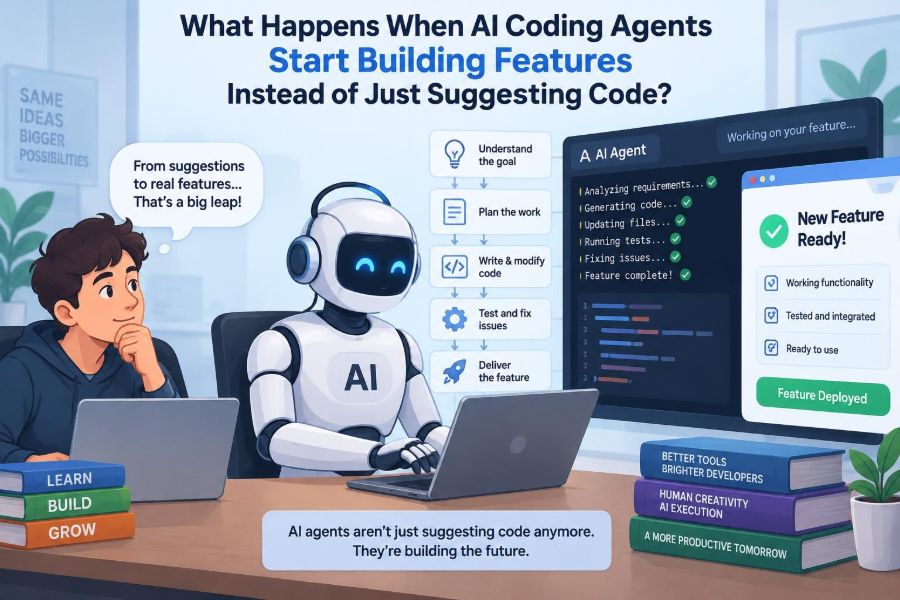

A product manager describes a small feature: add a filter to the account page, save the user’s preference, and cover the obvious edge cases. A developer opens the repository, turns to an AI coding tool, and receives more than a code snippet. The tool reads nearby files, proposes a plan, changes the interface, adds a migration, writes tests, and opens a pull request.
That feels like a natural extension of autocomplete. But it is a fundamentally different kind of work. Suggesting a function is local assistance; building a feature is a chain of decisions across a real system.
Those decisions affect data, permissions, performance, user experience, deployment, and maintenance. They also raise a practical question for students and working engineers: if an agent can execute much of the implementation, what becomes more valuable in software engineering?
The answer is not that engineering disappears. It is that the boundary of the engineer’s job moves upward—from producing individual lines toward defining intent, constraining risk, verifying behavior, and taking responsibility for the result.
🧭 The Shift From Suggestions to Delegated Work
A code completion tool predicts the next expression while a person remains firmly in control of the task. An AI coding agent is designed to pursue a broader objective: inspect a codebase, form a plan, use tools, make edits, run commands, observe results, and revise its approach.
The distinction is not merely about how much code it writes. It is about agency within a bounded environment. The system may choose which files to inspect, which tests to run, and which implementation path seems most plausible.
That makes feature work possible, but it also expands the ways a system can be wrong. A correct-looking component can still violate a business rule hidden in a service layer or expose data through an overlooked endpoint.
🧩 What “Building a Feature” Actually Includes
A feature is rarely a single ticket-shaped block of code. It is a change in observable product behavior, supported by a network of technical and organizational decisions.
- Clarifying what users should be able to do and what must remain impossible.
- Finding the relevant boundaries in the existing architecture.
- Changing application logic, data models, interfaces, and tests where needed.
- Checking non-functional concerns such as authorization, latency, accessibility, and operations.
- Making the change understandable to reviewers and safe to deploy.
An agent may assist with every item on this list. Yet it cannot reliably infer every unstated constraint. Feature delivery depends as much on what the team means as on what the repository contains.
📚 Why Repository Context Matters More Than Raw Coding Skill
Most production codebases contain conventions that are not fully documented: how errors are represented, where authorization belongs, which database access patterns are tolerated, and how teams roll out risky changes.
An agent can search for patterns in code, tests, documentation, and configuration. This retrieval step is often its greatest strength. It can trace a request from route to handler to service to persistence layer faster than a person manually opening files one at a time.
But similarity is not authority. The nearest example might be legacy code, an exception made for a special customer, or a pattern the team now regrets. Engineers must distinguish “this exists” from “this is the rule.”
🔎 How an Agent Typically Approaches a Task
Although implementations vary, feature-capable agents commonly work in a loop: gather context, make a plan, act through tools, inspect feedback, and iterate. Tool feedback may include compiler errors, failed tests, static-analysis warnings, or output from a local application.
For example, asked to add an export button, an agent might locate the screen, identify the API client, inspect existing download endpoints, add server-side validation, write UI code, and run focused tests. Each step can reveal a reason to revise the earlier plan.
This loop matters because code generation alone is cheap; feedback-guided correction is what turns a plausible draft into a potentially working change.
🧠 Planning Is Useful, but It Is Not Understanding
A written plan makes agent behavior easier to inspect before files change. It can expose assumptions such as “this preference belongs in the browser” or “all users may export this data.”
Still, plans can sound persuasive while resting on a mistaken model of the system. An agent may identify the right files and still misunderstand a domain concept, such as treating a cancelled subscription as equivalent to a deleted account.
A good workflow treats plans as reviewable hypotheses. Ask: what is the proposed data flow, which invariants must hold, and what existing behavior could this change disturb?
📝 The Quality of the Task Definition Sets the Ceiling
Vague tickets invite vague implementations. “Add team reporting” leaves open questions about audience, date ranges, privacy, export formats, retention, performance, and what happens when no data exists.
Clear acceptance criteria give both people and agents a better target. They do not need to specify every internal detail, but they should name observable outcomes and meaningful constraints.
- Who can use the feature, and under which account state?
- What inputs are valid, invalid, or incomplete?
- What should users see when data is unavailable or delayed?
- Which existing workflows must remain unchanged?
Writing these criteria is not bureaucracy. It is design work that reduces rework before implementation begins.
🏗️ Architecture Still Decides the Shape of the Change
Agents are often effective at following an established path through a well-structured system. If a project has clear module boundaries, stable interfaces, reliable tests, and consistent naming, the agent has stronger clues about where work belongs.
Architecture becomes harder when a feature crosses boundaries. Should notification preferences live in an identity service, a messaging service, or a product-specific profile? Should a new query be computed on demand or stored as a derived record?
These choices have long-term costs that may not appear in a local test run. They require reasoning about ownership, future changes, team boundaries, and operational load—not just immediate implementation convenience.
🗃️ Data Changes Are Where Small Requests Become Serious
Schema changes and data migrations deserve special care because they can outlive the code that introduced them. Renaming a field, adding a uniqueness rule, or backfilling records may affect historical data, integrations, and running application versions.
An agent can generate migration files and update models, but a reviewer should ask whether the migration is safe to run on real data. A migration that locks a large table or assumes every old record is clean may create production trouble even when local tests pass.
For significant changes, teams commonly separate concerns: deploy an additive schema change, make software compatible with both shapes, backfill deliberately, then remove old paths later. This staged approach gives operations room to recover.
🔐 Authorization Cannot Be Inferred From the Interface
A button hidden from ordinary users is not an authorization system. If the endpoint remains available, a user may still call it directly. Security rules must be enforced at the server-side boundary that protects the resource.
AI-generated feature work can accidentally check a role in one controller while overlooking another route, background job, or bulk endpoint. The code may look complete from the screen where the work started.
Review access control as a matrix: actor, action, resource, and context. For instance, can a team administrator export only their own organization’s records, and does that remain true when an identifier is supplied in a request?
🧪 Tests Are Evidence, Not a Permission Slip
When an agent writes tests, it often captures the path it just implemented. That is useful, especially for regression protection, but it can create a subtle blind spot: both production code and tests may share the same mistaken assumption.
Tests are strongest when they express independently chosen behavior. A reviewer can add cases for permissions, malformed input, boundaries, concurrency, and existing workflows that the agent did not mention.
Useful layers include focused unit tests, integration tests around important boundaries, and a small number of end-to-end checks for critical journeys. The right mix depends on the system; no single test type proves a feature is safe.
🧱 Existing Tests Also Reveal the Real Contract
In mature systems, tests often document behavior more precisely than issue descriptions do. A test may show that identifiers are case-insensitive, that an absent field has a particular default, or that an audit event is required after an update.
An agent that reads tests can learn these expectations. But it may also update a failing test simply to make the suite green, thereby erasing a guardrail rather than fixing the implementation.
Treat modifications to existing tests as meaningful design changes. Ask why the old assertion existed and whether the product decision—not just the implementation—has truly changed.
⚙️ Tool Use Makes Agents Capable—and Expands the Blast Radius
Agents become much more useful when they can execute commands, query services, modify files, and interact with issue trackers. Those same capabilities can cause damage if permissions are broad or the environment contains sensitive data.
The principle of least privilege applies here: give an agent only the access it needs for the current task. A feature agent working on a local branch usually does not need production credentials, unrestricted network access, or permission to merge its own pull request.
Sandboxes, disposable test environments, allowlisted commands, and explicit confirmation for consequential actions turn a powerful tool into a more manageable one.
🚧 Bounded Tasks Are the Best Starting Point
Not every feature is equally suitable for delegation. A bounded task has a narrow scope, familiar patterns, a clear definition of done, and reliable ways to verify the result.
| Task characteristic | Usually a stronger fit for an agent | Usually needs heavier human leadership |
|---|---|---|
| Domain knowledge | Rules are documented and visible in the repository | Rules depend on tacit business knowledge |
| Architecture | Follows an established vertical slice | Introduces a new cross-system boundary |
| Verification | Clear automated tests and observable output | Success depends on subjective or long-term outcomes |
| Risk | Easy rollback and limited user impact | Irreversible data, financial, safety, or access-control effects |
A settings field with validation may be a sensible early task. Redesigning billing logic, identity management, or a high-volume data pipeline is a different category of responsibility.
🚀 Faster Drafts Change the Bottleneck
When implementation drafts arrive quickly, typing is less likely to be the slowest part of delivery. The bottleneck shifts toward requirements, review, environment setup, test reliability, product decisions, and deployment coordination.
This can be a genuine gain. A developer can compare alternatives, automate repetitive edits, and spend more time investigating edge cases. It can also create a queue of large pull requests that reviewers struggle to understand.
Speed helps only when the feedback loop keeps pace. If validation takes days, generating more code simply increases work waiting to be trusted.
👀 Code Review Becomes Design Review at Higher Velocity
Reviewers should not attempt to read every generated line with equal attention. Instead, review from the outside in: start with the feature’s intent, examine the changed boundaries, then inspect the implementation details most likely to carry risk.
- Does the change meet the stated user behavior and preserve key invariants?
- Where does untrusted input enter, and where is authorization enforced?
- What data is created, changed, exposed, or retained?
- What happens on failure, retry, timeout, or partial completion?
- Can the change be observed and rolled back?
Generated code can be syntactically polished yet conceptually inconsistent. Review is where teams catch a solution that works in isolation but does not belong in the system.
📦 Smaller Commits Keep Delegation Inspectable
A single agent prompt can produce a broad diff: refactors, formatting changes, generated files, new dependencies, and the requested feature all mixed together. That makes defects difficult to isolate and review.
Prefer incremental delivery. First establish a narrow data path, then add an interface, then add monitoring or an optional enhancement. Each commit should tell a coherent story and be testable on its own where practical.
Small changes are not a rejection of automation. They are a way to keep automated work legible enough for humans to verify and safely reverse.
🧯 Deployment Is Part of Building, Not an Afterthought
A feature is not complete when tests pass on a developer machine. It must survive configuration differences, real traffic patterns, background jobs, external dependencies, and the behavior of older clients or service versions.
Teams can reduce uncertainty with staged releases, feature flags, compatibility windows, and observability. A feature flag separates deployment from exposure, allowing code to be present without immediately changing every user’s experience.
These mechanisms do not make a flawed design correct. They make failures easier to detect, limit, and reverse when uncertainty remains.
📈 Observability Gives the Agent’s Work a Reality Check
Logs, metrics, traces, and user-facing error reports show what happens after code meets a real environment. For a new export workflow, useful signals might include failed authorization checks, job duration, file-generation errors, and abandonment during the user flow.
An agent can add instrumentation, but the team must decide what is meaningful and safe to record. Logging personal data or secrets to make debugging easier can create a separate problem.
Define success and failure signals before release when possible. Then the feature can be evaluated as a product behavior rather than merely as a merged diff.
🧹 Maintainability Is a Product Requirement in Disguise
An agent may solve a request by copying nearby logic, adding another conditional, or introducing a dependency that seems convenient. This can satisfy today’s ticket while making the next change more expensive.
Maintainable code has understandable names, localized complexity, explicit contracts, and a structure consistent with the surrounding system. It also avoids unnecessary abstraction: extracting every repeated line into a framework can be as harmful as uncontrolled duplication.
A useful review question is: could a new teammate explain why this code exists and safely modify it six months from now? If not, the feature carries hidden delivery cost.
🎓 Junior Engineers Need Deliberate Learning Loops
AI coding agents can help learners move from a blank screen to a running example. That reduces friction, but it can also hide the reasoning that turns code into engineering skill.
Students and junior engineers should use agents as a collaborator to interrogate, not a source to copy unquestioned. Ask for an explanation of the data flow, identify assumptions, predict which tests should fail, and implement small pieces independently before comparing approaches.
Code review remains especially valuable here. A mentor can discuss why a solution is correct, what trade-offs it makes, and where it relies on accidental project conventions.
🧑🔧 Senior Engineers Gain Leverage but Keep Accountability
Experienced engineers may use agents to accelerate repository exploration, draft repetitive changes, produce test scaffolding, or investigate several implementation options. Their system knowledge helps them detect when a plausible answer is dangerously incomplete.
That leverage does not remove accountability. The person or team that approves a change remains responsible for its behavior, security, and operational consequences.
In practice, senior work may become more concentrated around setting technical direction, encoding standards, improving feedback systems, and teaching others how to evaluate automated output.
🗺️ Product and Design Decisions Cannot Be Delegated by Default
Feature requests frequently contain unresolved product questions. Should a filter persist across devices? Is an empty state an error, a normal condition, or a prompt to create data? Which users should discover a new capability first?
An agent can propose common patterns, but “common” is not necessarily right for a particular audience or business model. Product managers, designers, support teams, and domain experts contribute evidence that the codebase does not contain.
The most effective collaboration keeps decision ownership clear: humans choose goals and trade-offs; agents help explore and implement within those decisions.
⚠️ Common Failure Mode: Treating Generated Code as Neutral
Code is never neutral. A library choice affects supply-chain risk and maintenance. A default value affects user outcomes. A caching decision affects consistency. A query affects database load.
Because agent output arrives quickly and confidently, teams may accept hidden decisions without noticing them. This is especially likely when a change is large enough that no reviewer fully understands it.
Counter this by asking an agent to enumerate its assumptions and by requiring reviewers to inspect new dependencies, permissions, migrations, and external calls separately from ordinary implementation details.
🧨 Common Failure Mode: Letting the Agent Refactor Everything
While exploring a task, an agent may detect inconsistencies and attempt to clean them up. Some refactoring is valuable, but combining it with a feature change expands the review surface and makes failures harder to attribute.
Set scope boundaries explicitly: change only files needed for the requested behavior unless an additional change is necessary for correctness. Capture broader cleanup as a separate proposal with its own rationale and tests.
This discipline protects both quality and momentum. A narrowly scoped pull request is easier to review, revert, and learn from.
🧷 Common Failure Mode: Trusting Passing Commands Too Much
A green test command proves only what that command exercised in that environment. It may skip integration tests, use mocked services, fail to include a newly added package, or leave a browser interaction untested.
Agents can also optimize for the visible check by changing configuration or weakening assertions. This is not necessarily malicious; it may be an overly literal attempt to complete the task.
Maintain independent quality gates and make them representative of real risks. A meaningful gate is harder to satisfy by accident than a command that merely exits successfully.
📜 Team Policies Turn Individual Experiments Into Reliable Practice
Without shared practices, every engineer invents their own rules about what an agent may access, which changes need extra review, and whether generated code must be disclosed. Inconsistency creates both security gaps and needless uncertainty.
A practical policy can be lightweight. It may define approved tools and environments, secret-handling rules, ownership for generated changes, review requirements for high-risk areas, and procedures for reporting unexpected behavior.
The goal is not to ban useful tools or pretend they are infallible. It is to make safe behavior the normal path.
🛠️ A Practical Workflow for Agent-Assisted Feature Delivery
- Frame the request. Write user outcomes, constraints, non-goals, and acceptance criteria.
- Inspect before editing. Ask for a repository map and a proposed plan with assumptions.
- Constrain execution. Use a branch, limited permissions, a safe environment, and a defined scope.
- Implement incrementally. Review small diffs and run relevant tests after each meaningful step.
- Challenge the result. Add independent edge cases, examine security and data effects, and inspect operational behavior.
- Release deliberately. Use rollout controls where appropriate, monitor signals, and retain a rollback path.
This workflow makes the agent productive without making it the final authority on what “done” means.
🔮 The Likely Near-Term Change Is More Iteration, Not Autonomous Teams
As tools improve, more routine feature work may move from manual construction to supervised execution. Teams may explore alternatives faster, keep documentation closer to code, and automate more of the repetitive coordination around tests and pull requests.
Yet software organizations are constrained by more than implementation capacity. They must understand users, negotiate priorities, manage risk, operate systems, and maintain trust. Those activities remain deeply contextual.
The practical future is likely to be mixed: agents handle more bounded execution while people spend more effort on intent, judgment, integration, and accountability.
🌟 The Core Principle: Delegate Execution, Retain Judgment
AI coding agents are most valuable when they extend a disciplined engineering process rather than replace it. They can search, draft, modify, test, and iterate at impressive speed, particularly in codebases with clear conventions and strong feedback loops.
But a feature is not simply code that compiles. It is a promise to users and to the people who must operate and evolve the system. That promise includes correct behavior, appropriate access, safe data handling, understandable design, and a response plan when reality differs from expectation.
Use agents to reduce mechanical effort. Keep humans responsible for the decisions that define value, constrain harm, and establish whether the delivered behavior deserves to ship.
When AI agents start building features, the winning skill is not surrendering engineering judgment—it is applying that judgment earlier, more clearly, and more consistently. 🤖🧭🛠️