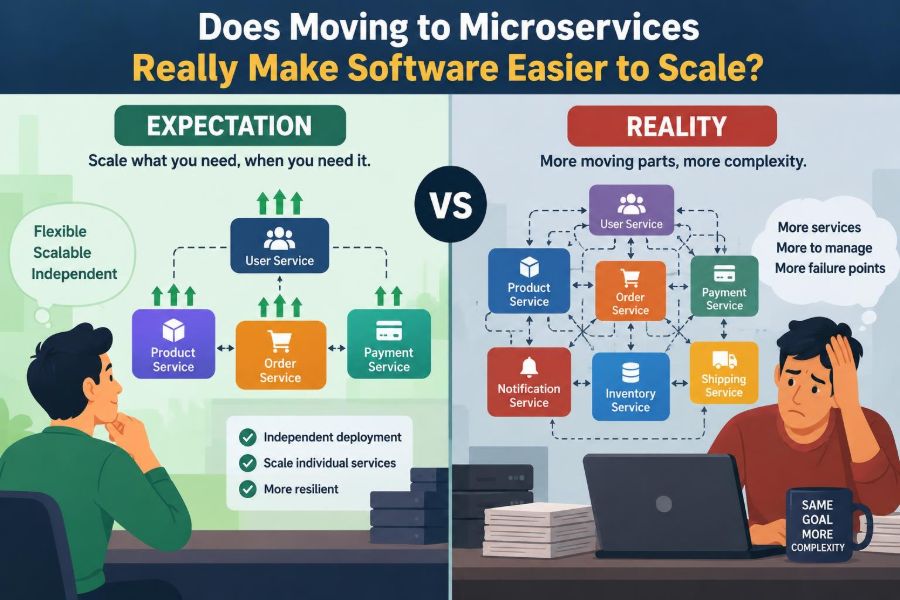

A product is growing. The original application was quick to build, easy to run on one deployment pipeline, and familiar to every developer on the team. Then traffic rises, releases slow down, and one busy feature appears to consume more resources than everything else.
Someone suggests microservices. The promise sounds compelling: split the system into independently deployable services, scale only what is busy, and let teams move without stepping on one another.
Sometimes that is exactly the right move. Sometimes it replaces a set of visible problems with a larger set of distributed ones: unreliable network calls, difficult debugging, inconsistent data, and operational work that a small team cannot yet support.
The useful question is not whether microservices are “better” than monoliths. It is whether their extra complexity solves a specific scaling constraint that your software, team, and infrastructure actually have.
🧭 The expectation behind the microservices move
Microservices are often presented as a direct route to scale. The intuition is straightforward: if an application is made of smaller services, each service can grow independently.
That expectation combines several different goals: handling more traffic, shipping changes more safely, isolating failures, and allowing more engineers to work in parallel. These goals are related, but they are not the same problem and do not always require the same architecture.
🏗️ What a microservice actually is
A microservice is a small, independently deployable application that owns a narrowly defined business capability and usually its related data. A checkout service, catalog service, notification service, and identity service might be separate services.
The important word is independently. A set of modules inside one application is not automatically a microservices system. Services need separate deployment, runtime boundaries, and clear ownership; otherwise the organization inherits coordination costs without gaining much autonomy.
📈 Scaling has more than one meaning
“Scale” can mean several things, so an architecture discussion should name the bottleneck precisely.
| Type of scale | Typical constraint | Possible response |
|---|---|---|
| Traffic scale | More requests than current capacity handles | Add instances, cache reads, optimize slow paths |
| Data scale | Database storage, queries, or writes become limiting | Indexes, partitioning, replicas, archival, redesign |
| Team scale | Engineers block one another or cannot understand changes | Clear ownership, modular boundaries, better delivery practices |
| Change scale | Releases are risky or slow as the product evolves | Tests, deployment automation, decoupled components |
Microservices may help with some of these constraints. They do not automatically solve all of them.
🧱 Why a well-built monolith can scale far
A monolith is an application deployed as one unit. That does not mean it is unstructured, outdated, or incapable of serving substantial demand.
A modular monolith can contain strong internal boundaries, separate domains, background workers, caches, queues, and multiple application instances behind a load balancer. For many systems, these techniques address the real performance problem while preserving the simplicity of local function calls and one coordinated deployment.
🔍 Find the real bottleneck first
Before splitting code, measure what is constrained. A slow checkout may come from an unindexed database query, a synchronous call to a payment provider, a large response payload, or CPU-heavy image processing.
Turning that code into a service does not make the query indexed or the external provider faster. It can even add network latency. Profiling, tracing, load testing, and production metrics should guide the decision rather than a diagram’s apparent neatness.
⚖️ Vertical and horizontal scaling still matter
Vertical scaling means giving one machine or process more CPU, memory, or faster storage. Horizontal scaling means running multiple copies and distributing work among them.
Both approaches work for monoliths and microservices. A stateless monolith can often be replicated horizontally quite effectively. Conversely, a microservice that depends on one overloaded database may remain difficult to scale no matter how many service instances are added.
🎯 Selective scaling is the clearest microservices advantage
Microservices are genuinely useful when workload differs sharply by capability. Consider a hypothetical marketplace where browsing product listings receives far more traffic than seller account updates.
With separate services, the catalog workload can receive additional compute and caching without multiplying every other part of the application. This is more efficient than scaling the entire application solely because one pathway is busy.
That benefit is strongest when the service can operate with relatively independent data and has a clearly measurable demand pattern.
🌐 A method call becomes a network call
Inside a monolith, one module can call another in memory. The call is usually fast, and failures are comparatively simple: it returns, throws an error, or exhausts local resources.
Across services, every interaction must account for DNS resolution, connection pools, serialization, timeouts, load balancing, authentication, partial failure, and changing network conditions. The network is not a transparent extension of local code.
Distributed systems trade local simplicity for deployment and scaling independence. That trade can be worthwhile, but it must be consciously accepted.
⏱️ Latency accumulates along request paths
A user request that passes through an API gateway, identity service, product service, inventory service, and recommendation service collects latency at each hop. Parallel calls can reduce total wait time in some designs, but they add coordination and failure-handling work.
Small delays matter most on frequently used paths. Teams should map critical request flows and avoid creating chains in which every service synchronously waits for another service before it can respond.
🧯 Failure isolation is real but conditional
A separate service can fail without necessarily crashing every process in the system. That is a meaningful advantage, especially when expensive workloads such as report generation or media processing need isolation.
But isolation only works if dependencies are designed for it. If the order service cannot complete or degrade gracefully whenever recommendations are unavailable, a recommendation outage still damages checkout. Timeouts, fallbacks, bulkheads, and circuit breakers are design work, not automatic properties of service boundaries.
🔁 Retries can quietly amplify an outage
When a request fails, retrying may help with a short-lived network interruption. During overload, however, many clients retrying at once can send more work to an already struggling dependency.
Retries should have limits, backoff delays, and clear rules about which operations are safe to repeat. An operation that creates a charge or shipment must be idempotent: repeating the same request should not create duplicate side effects.
🗃️ Data ownership changes the hardest problems
A common microservices principle is that each service owns its data. This prevents every service from editing the same database tables and keeps boundaries meaningful.
The difficult part appears when a business workflow crosses those boundaries. An order may need inventory reservation, payment authorization, and shipment creation. In a monolith, these might be handled in one database transaction. Across services, there is no simple shared transaction that remains fast, available, and loosely coupled.
🔄 Eventual consistency needs product decisions
Many distributed workflows use eventual consistency: information becomes consistent across services after messages are processed rather than at one exact instant. For example, an order may first be marked “pending,” then become “confirmed” after inventory and payment events arrive.
This is not merely an implementation detail. Product teams need to decide what users see while processing is incomplete, what happens after a failure, and how support staff correct exceptions. A system can be technically correct and still confusing if its intermediate states are poorly designed.
📬 Events reduce coupling, not responsibility
Event-driven architecture can let a service publish a fact such as “order placed” without synchronously calling every downstream consumer. This can reduce direct dependencies and smooth bursts of work through queues.
It also introduces delivery concerns: messages can be delayed, duplicated, processed out of order, or fail after publication. Consumers need idempotency, versioned event schemas, monitoring, and a way to recover missed or malformed messages.
🧾 Distributed transactions have expensive alternatives
For cross-service workflows, teams commonly use compensating actions rather than one global transaction. If payment succeeds but inventory reservation fails, the system may issue a refund or void the authorization.
This approach is often called a saga pattern. It fits workflows that can tolerate intermediate states and reversals, but it demands careful business rules. Not every action is easy to undo, and compensation can have its own failure cases.
👥 Team boundaries can be a stronger reason than traffic
Microservices often help most when several teams work on distinct product areas with different release schedules and expertise. A team owning billing can test, deploy, and operate billing without coordinating every small change with a team owning search.
This only works when ownership is real. If every change requires approval from a central platform group and modifications across five services, the architecture has not created autonomy; it has distributed the waiting.
🧩 Domain boundaries matter more than service size
A useful boundary often follows a business domain: catalog, fulfillment, billing, or customer identity. Domain-driven design calls such a boundary a bounded context, meaning a part of the business with its own language and rules.
Splitting by technical layers is often less effective. A “database service,” “validation service,” and “email service” may sound reusable, but they can force many business operations to coordinate through generic components. Start with cohesive business responsibilities, not a target number of services.
🚦 Deployment independence changes release risk
Independent deployment can reduce the blast radius of a change. A team may update a recommendation algorithm without rebuilding and releasing the entire product.
Yet independent deployment requires compatibility discipline. APIs and events need versioning or additive changes, and consumers need time to migrate. A service that silently changes a field or behavior can break another team’s production workflow even when its own tests pass.
🧪 Testing becomes a system-wide practice
Unit tests remain valuable, but they cannot prove that service contracts, credentials, queues, and real deployment settings work together. Integration tests and contract tests become more important.
Contract testing checks that a provider and consumer agree on the shape and behavior of an interface. End-to-end tests cover critical user journeys, though relying only on them can make feedback slow and failures hard to diagnose.
- Use unit tests for local business logic.
- Use contract tests for service interfaces.
- Use integration tests for infrastructure-dependent behavior.
- Keep a focused set of end-to-end checks for essential flows.
🔭 Observability is no longer optional
When one process handles a request, logs may be enough to begin debugging. When a request crosses many services, engineers need a way to follow it across boundaries.
Observability commonly combines structured logs, metrics, and distributed traces. A correlation or trace ID travels with the request, allowing a team to see which service was slow, which dependency failed, and how long each step took.
Without this visibility, microservices can turn ordinary incidents into time-consuming investigations.
🛠️ Platform maturity determines the operational cost
Every service needs builds, deployment automation, configuration management, secrets handling, health checks, dashboards, alerts, and rollback procedures. Ten services do not create ten times the work if these capabilities are standardized; without standardization, they can create far more.
A platform team or shared internal platform can make safe defaults easy: service templates, central identity, logging conventions, and self-service deployment. This investment may be essential before a large service estate is sustainable.
🔐 Security boundaries multiply too
More services create more identities, endpoints, credentials, permissions, and dependencies to patch. A service-to-service request needs authentication and authorization, not just trust because it originated “inside” the network.
Least-privilege access limits what a compromised component can do. Secret rotation, dependency updates, audit trails, and secure defaults become routine operational responsibilities rather than occasional security projects.
💸 Cost is broader than infrastructure bills
Service-based systems may use infrastructure more efficiently when only high-demand components scale. They may also increase spending on compute overhead, networking, observability tools, managed messaging, and duplicated runtime capacity.
The larger cost is often human attention. Engineers spend time maintaining pipelines, handling incidents, coordinating contracts, and understanding cross-service behavior. That effort can be justified for a complex product, but it should be treated as a real budget.
🧠 Cognitive load can rise faster than code size
A developer changing one feature may need to understand several repositories, API contracts, event topics, deployment environments, and ownership rules. The code in each service can be small while the system remains mentally large.
Good documentation, service catalogs, clear on-call ownership, and consistent conventions reduce this burden. So does resisting unnecessary service creation. A new service should remove a meaningful coordination problem, not merely relocate code.
📦 The distributed monolith trap
A distributed monolith consists of separately deployed services that must still be released, queried, and changed together. It carries network failure and operational complexity while preserving the coupling of one large application.
Warning signs include synchronous call chains on every request, shared databases, coordinated releases as the norm, and teams unable to change a service without editing several others. The answer is not always more separation; sometimes it is simplifying dependencies or consolidating an artificial split.
🪜 Start with modularity before distribution
Many teams benefit from first improving the monolith. Organize code around domains, keep module interfaces explicit, prevent direct access to another module’s internals, and make dependencies visible.
This creates an architectural option: when a domain later needs independent scaling or ownership, it can be extracted with less risk. It also produces a cleaner system if extraction never becomes necessary.
✂️ Extract one service for a concrete reason
A sensible first extraction has a clear boundary and a measurable goal. Examples include a CPU-intensive document conversion worker, a notification pipeline with bursty asynchronous demand, or a search indexer that needs its own technology and release cadence.
Avoid beginning with the most central, transaction-heavy domain. Extracting the order or identity core first can force the team to solve difficult data and security problems before it has developed distributed-operating experience.
🗺️ Use a gradual migration path
The strangler approach replaces parts of an existing application incrementally. A new component takes over one route or capability while the remaining functionality stays in the original system.
This reduces the risk of a large rewrite, but temporary coexistence must be managed carefully. Define data ownership, migration checkpoints, rollback plans, and an end state so the transition does not become permanent duplication.
📏 Decide with evidence, not architecture fashion
Use a decision record that states the problem, alternatives, expected benefits, new risks, and signals that would show success or failure. For example, the goal may be to isolate a worker that causes resource contention, not vaguely to “become microservices.”
Useful evidence includes request patterns, database load, deployment lead time, incident history, team ownership conflicts, and the current ability to operate services reliably. No single metric decides the question; the goal is to make assumptions visible.
✅ Questions to ask before splitting
- Which specific workload, team, or release constraint cannot be addressed inside the current application?
- Can the proposed component own its data and operate through a stable interface?
- What happens when this service is slow, unavailable, or returns incomplete data?
- Can the team monitor, deploy, secure, and support it in production?
- Will the split reduce coordination, or create new synchronous dependencies?
- What is the smallest reversible experiment that tests the hypothesis?
If answers are vague, improve the modular monolith and operational foundations first. “Future scale” is not a sufficient design requirement unless it is tied to a plausible workload or organizational need.
🏁 The core principle: optimize for the constraint you have
Microservices can make parts of a system easier to scale, deploy, and own. They do so by creating independence, and independence is valuable when there is a real boundary in workload, data, or team responsibility.
They also make the overall system harder to reason about and operate. Networks fail, data becomes asynchronous, interfaces evolve, and every service requires production care. A modular monolith is often the more effective choice until those trade-offs are justified by evidence.
The mature architectural choice is not a label. It is matching technical structure to the constraints that matter now, while preserving a safe path to change later.
Moving to microservices makes scaling easier only when the independence gained is worth the distributed complexity introduced. Build clear boundaries, measure the real bottleneck, and evolve deliberately rather than splitting by default. ⚙️📈🧩