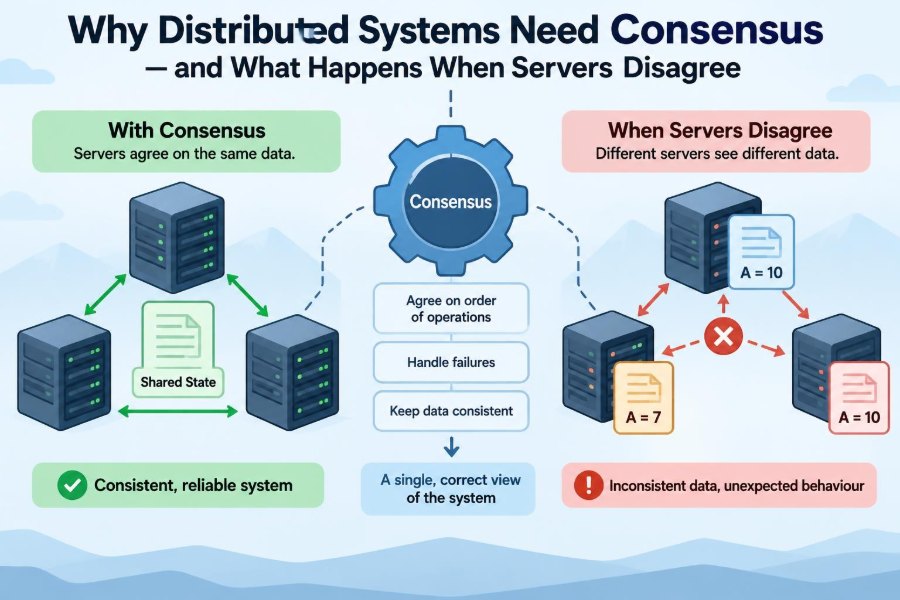

You tap “Pay,” see a confirmation screen, and expect the transfer to happen once. You do not expect one bank server to record the payment, another to reject it, and a third to process it again later.
That expectation becomes surprisingly hard to meet when an application runs across many machines. Servers can be slow, temporarily unreachable, restarted, or separated by a network problem—while users continue to send requests.
Distributed systems are built to survive those ordinary failures. But survival alone is not enough. The machines must also make certain shared decisions in the same order, even when each machine has only a partial and delayed view of events.
That shared-decision problem is called consensus. It sits beneath databases, coordination services, replicated logs, and many systems that must remain correct while parts of the infrastructure disagree.
🧩 A distributed system has no single perfect view
A distributed system is a collection of independent computers that communicate by exchanging messages. Each computer has its own memory, clock, processor, and local view of the network.
Messages take time to arrive, may arrive out of order, or may not arrive at all. A server that looks silent might have crashed, might be overloaded, or might simply be cut off from the observer. Those cases can look identical from far away.
This is why coordination cannot safely rely on one machine’s assumptions. The system needs rules for deciding which observations count and when a decision is final.
🗂️ What consensus actually means
Consensus is a protocol by which a group of machines agrees on a value or, more commonly, a sequence of operations. In practice, the useful goal is often: every healthy participating server eventually accepts the same ordered log.
For a replicated key-value store, the log might say: set account A to a new balance, then reserve inventory item 42, then change an order status. Applying the same operations in the same order produces the same state.
Consensus is not merely “most servers have similar data.” It is a disciplined way to establish one authoritative history despite failures and delays.
📜 The replicated log is the central mental model
Imagine a durable notebook copied across five servers. Each new command must receive a numbered position before it becomes part of the shared history.
If position 105 contains “create order 893,” no valid server should later place a different command at position 105. Once enough servers have accepted that entry, it can be committed and applied to their local state machines.
This pattern is called state machine replication. The state machine may be a database, scheduler, metadata service, or configuration store; the consensus layer protects the ordered input it receives.
🏦 Why agreement matters beyond databases
Consensus is needed whenever a distributed system must make a decision that cannot safely fork. Financial transfers are an obvious example, but the same need appears in less visible infrastructure.
- Choosing which node is the current primary for a replicated service.
- Allocating a unique lease or lock to one worker.
- Recording the membership of a cluster.
- Assigning partitions of a message stream to consumers.
- Storing service configuration that every component must interpret consistently.
Not every operation needs this cost. A page-view counter may tolerate temporary divergence; an exclusive job scheduler usually cannot.
⚖️ Consistency is not the same as availability
In everyday language, “consistent” can mean reliable. In distributed systems, it has more precise meanings. A system might preserve valid data constraints, return recent writes, or make operations appear to occur in one global order; these are related but different properties.
Consensus protocols are often used to support linearizability: each completed operation appears to take effect at one instantaneous point between its request and response. If a successful write is followed by a read, that read should observe the write.
This strong behavior is valuable, but it may require the system to reject or wait on requests during certain failures. Availability and correctness must be evaluated against the actual business requirement.
🌐 Networks create uncertainty, not just delay
A slow network and a broken network can be indistinguishable for a period of time. Server A may stop hearing from server B without knowing whether B has failed or whether packets between them are being dropped.
This condition is a network partition: the cluster is split into groups that cannot reliably communicate. Each group may still be internally healthy, which makes the failure dangerous. Both sides may believe they should continue operating.
A correct consensus design prevents both groups from independently making conflicting authoritative decisions.
🔀 A split-brain failure is conflicting authority
“Split brain” describes a situation where two parts of a system both act as leader or primary. Suppose two database nodes each accept writes for the same customer record while disconnected from one another.
When communication returns, there is no universally safe way to merge every conflict. One node may have shipped an order while the other cancelled it; both actions may already have triggered external effects.
The best defense is not clever conflict repair afterward. It is preventing two independent authorities from being valid at the same time.
🧮 Majorities provide the overlap that protects decisions
Many consensus systems require approval from a quorum, commonly a majority of voting members. In a five-member cluster, a majority is three; in a three-member cluster, it is two.
Any two majorities overlap by at least one member. That overlap carries knowledge of previously accepted decisions into future decisions, making it much harder for a new leader to contradict committed history.
A majority is not inherently magical. It is a carefully chosen threshold with an overlap guarantee. Some systems use other quorum configurations, but their safety argument must preserve comparable intersection properties.
👥 Why an odd number of voters is common
Clusters often use three or five voting members because an odd count avoids adding a voter that does not increase failure tolerance. Three voters can tolerate one unavailable voter; four voters still generally need three votes and can also tolerate only one.
Adding a fourth node may still make sense for read capacity, geography, or storage, but it does not automatically improve consensus availability. Voting membership and data replicas are related design choices, not always the same thing.
As clusters grow, coordination messages, recovery time, and operational complexity grow too. Larger is not automatically safer.
🧭 Leaders simplify the normal path
Protocols such as Raft commonly elect one server as leader for a limited term. Clients send proposed changes to that leader, which assigns log positions and asks followers to replicate them.
A leader reduces the chance of competing orderings during normal operation. It does not become correct merely by claiming authority: its entries must still be acknowledged by a quorum before they are committed.
If followers stop hearing from the leader, they can begin an election. The design must ensure an old leader cannot continue safely after losing its authority.
🗳️ Elections require more than a timeout
When a follower waits too long without leader contact, it may request votes for a newer election term. Voters ordinarily grant at most one vote per term, which helps prevent multiple candidates from each collecting a majority.
Election rules also protect log history. A candidate whose log is missing entries that have already been committed should not become leader and overwrite that history.
Timeouts are deliberately varied so every server does not campaign at the same instant. Even so, a cluster can have periods with no leader while candidates collide or communication remains poor.
⏱️ Clocks are useful but cannot settle truth
Servers use timers to suspect failure, but physical clocks drift and scheduling pauses happen. A machine suspended by a virtualized environment may wake up believing a short interval has passed when the rest of the cluster has moved on.
Consensus protocols therefore do not treat “my clock says the leader is dead” as proof. A timeout is a trigger to seek votes; the quorum vote is what establishes a new authority.
This distinction is fundamental: time helps detect suspicion, while overlapping agreement establishes safety.
📨 Message order cannot be assumed
Networks do not promise that messages sent later will arrive later. A delayed replication request can appear after a newer request, and retransmitted messages can create duplicates.
Consensus protocols include terms, log indexes, and previous-entry checks so followers can detect stale, duplicate, or inconsistent messages. They repair divergent uncommitted suffixes instead of blindly appending whatever arrives.
Application code needs similar caution. A distributed protocol should make retrying safe rather than assume each request is delivered exactly once.
🔁 Retries can duplicate effects
Consider a client that sends “charge this card,” then loses the response. The server might have completed the request, or might never have received it. Retrying without protection can charge twice.
Consensus can establish that a command occupies one log position, but an application still needs idempotency: repeating the same request should have the same intended effect as processing it once.
A common approach is a client-generated request ID stored with the result. When the same ID arrives again, the service returns the earlier result instead of performing the action anew.
🧱 Safety and liveness answer different questions
Safety asks whether the system can do something wrong, such as commit contradictory entries or grant two valid exclusive locks. A safe system must avoid that outcome under its stated assumptions.
Liveness asks whether the system can eventually make progress. During a long partition, a minority side may become unavailable for writes; this hurts liveness but protects safety.
Good engineering names the trade-off honestly. “The service kept accepting requests” is not a success if it accepted incompatible decisions.
🚧 The CAP trade-off is often oversimplified
The CAP theorem concerns a distributed system facing a network partition. At that moment, a system cannot simultaneously guarantee strong consistency for every operation and remain available to every request on both sides of the partition.
It does not mean engineers permanently choose any two of three attractive letters. Networks work normally much of the time, and systems can offer different guarantees for different data and operations.
A consensus-backed service generally chooses consistency over serving writes from a partitioned minority. It may respond with an error, redirect clients, or wait until a quorum can be reached.
🧊 What a minority partition experiences
Suppose a five-voter cluster splits into a group of three and a group of two. The group of three can form a quorum, elect a leader if needed, and commit new entries. The group of two cannot.
The minority may still serve carefully defined stale reads, depending on the product’s guarantees. It should not commit new authoritative writes, because doing so would enable a conflicting history.
To users, this can look like a partial outage. That is frustrating, but it is a deliberate refusal to invent a second source of truth.
📖 Reads deserve the same design attention as writes
It is tempting to assume replication makes every read safe. A follower may lag behind the leader, however, and after a leadership change an old leader may no longer be authoritative.
Systems commonly offer several read modes: leader reads, quorum-confirmed reads, lease-based reads under specific assumptions, and local stale reads. Each has different latency, availability, and freshness behavior.
Document the promise in user-facing terms. “Your settings may take a few seconds to appear on another device” is very different from “a confirmed transfer is immediately visible everywhere.”
🧰 Raft makes the mechanics approachable
Raft is a widely taught consensus algorithm designed around understandable roles: leader, follower, and candidate. It organizes time into terms and replicates a log from the elected leader to followers.
Its key rules include one leader per term under normal assumptions, majority acknowledgment before commitment, and restrictions that keep committed entries from being replaced. These rules make it suitable for coordination and metadata services.
Raft is not a product or a shortcut around distributed-systems design. Applications still must decide membership, persistence, client semantics, monitoring, and the consequences of external side effects.
🏛️ Paxos and its family shaped the field
Paxos is another foundational family of consensus algorithms. Its basic form describes how participants can choose a value despite asynchronous communication and failures, using proposal-number rules that preserve safety.
Many production designs use multi-instance or leader-oriented variants to agree on a sequence of values efficiently. The terminology can feel less intuitive at first than Raft’s, but the underlying goal is similar: prevent conflicting chosen values.
Engineers should learn the invariants rather than treat algorithm names as brand labels. A system’s behavior depends on its exact implementation and operational configuration.
🛡️ Failure models define what guarantees mean
Most mainstream consensus deployments assume crash faults: a server may stop, restart, delay messages, or behave incorrectly because of ordinary bugs, but it does not deliberately send contradictory protocol messages to deceive peers.
Byzantine fault-tolerant protocols address a stronger model in which participants may act maliciously or arbitrarily. They require different quorum assumptions and usually more communication overhead.
The right model follows the threat environment. Treating a corrupted host as a simple crash can be unsafe; deploying Byzantine machinery where all nodes are under one controlled administrative domain may be unnecessary complexity.
💾 Durable storage survives the reboot
A server must persist critical consensus state before reporting success where the protocol requires it. If a node forgets its vote or accepted log entries after a power failure, it can violate rules that other nodes relied upon.
Durability is not synonymous with “data reached memory.” Caches, storage controllers, filesystem behavior, and cloud-volume semantics affect when data truly survives a crash.
Storage latency therefore appears directly in the write path. Stronger durability often costs time, but skipping it can turn a recoverable outage into corrupted agreement.
📦 Membership changes are consensus decisions too
Replacing a failed node or scaling a cluster changes who is allowed to vote. That change cannot be treated as an informal operational detail.
If an old configuration and a new configuration can each independently make decisions, their quorums may not overlap. Safe membership-change protocols ensure a controlled transition, often requiring agreement that bridges the configurations.
Automation should respect this process. Rapidly adding and removing voters during instability can make recovery harder rather than improving resilience.
🧪 Test the failures, not only the happy path
A local test with three processes on one laptop rarely reveals the hardest behaviors. Useful tests introduce delayed packets, dropped messages, reordered responses, process pauses, disk errors, clock irregularities, and repeated client requests.
Jepsen-style fault testing is one influential approach to examining whether a distributed system’s observed behavior matches its claims. The broader lesson applies even without specialized tooling: test under adversarial timing.
Also test recovery. The critical question is not only whether the cluster elects a leader, but whether it converges without losing committed data or repeating externally visible work.
📊 Monitor quorum health, not just CPU
A consensus service can have low CPU use while being unable to make progress because replicas cannot communicate quickly enough. Operational dashboards need protocol-level signals alongside host metrics.
- Current leader and leadership changes over time.
- Replication lag and the distance between committed and applied entries.
- Election frequency, failed vote attempts, and unavailable voters.
- Disk latency and errors affecting log persistence.
- Client timeouts, rejected writes, and retry rates.
Frequent leadership churn is not merely noise. It can indicate network instability, overloaded nodes, overly aggressive timeouts, or a failing storage path.
🧯 Recovery requires restraint
During an incident, operators may be tempted to force a node into leadership, delete logs, or reconfigure membership until the system responds. Those actions can destroy the evidence and state needed for a safe recovery.
Prefer documented recovery procedures that identify the last known committed state, preserve data before destructive steps, and restore a quorum deliberately. If the system’s guarantees are unclear, stop automated write traffic before improvising.
Operational runbooks should explain which actions are safe for a minority partition, a lost leader, a failed disk, and suspected data divergence. Calm procedures are part of correctness.
🧑💻 Design APIs around uncertain outcomes
A timeout does not mean an operation failed. It means the caller does not know whether it succeeded. APIs should let clients query status by request ID, retry safely, and distinguish a confirmed rejection from an unknown outcome.
For workflows that call external systems, use patterns such as an outbox: commit an intent to durable local state, then deliver it asynchronously with deduplication and reconciliation. No consensus protocol can undo an email, package shipment, or payment provider action that has already happened.
The boundary between a replicated log and the outside world is where many “exactly once” claims become conditional. Be explicit about those conditions.
🧠 Choose consensus only for the decisions that need it
Consensus adds network round trips, durable writes, operational work, and reduced availability during quorum loss. Using it for every metric, cache entry, or collaborative draft can create unnecessary cost.
Alternative designs may be better when temporary divergence is acceptable: asynchronous replication, conflict-free replicated data types, append-only event collection, or business-level conflict resolution. These approaches do not eliminate trade-offs; they move conflict handling into a different layer.
A useful question is: what incorrect concurrent outcome would be unacceptable, and when must the system prevent it? The answer identifies where strong agreement belongs.
🧭 A practical decision checklist
Before introducing a consensus-backed component, make the intended guarantee concrete. Vague requirements such as “highly available and consistent” are not sufficient to design or evaluate the system.
- What shared decision must have one authoritative answer?
- Can clients tolerate stale reads, and for how long?
- What should happen when fewer than a quorum of voters is reachable?
- Which state must survive power loss before a success response?
- How will retries be deduplicated and unknown outcomes reconciled?
- What failure model and geographic latency does the deployment assume?
These questions often reveal that the hardest work is product semantics and operations, not selecting an algorithm.
🔑 The core principle: agreement protects a single history
Servers disagree naturally because they observe events through unreliable communication and can fail independently. Consensus does not make networks reliable or failures disappear; it gives the system a disciplined way to proceed without allowing incompatible histories to become authoritative.
Quorums create overlap, elections establish bounded leadership, durable logs preserve decisions, and carefully designed clients cope with retries and uncertainty. When a quorum is unavailable, refusing a write can be the correct result—not a protocol failure.
The practical goal is not to make every server respond all the time. It is to ensure that when the system says a critical decision is complete, that decision has a coherent place in the shared record.
Distributed systems need consensus when correctness depends on many independent machines preserving one trusted order of decisions, even when communication and hardware stop cooperating. Build for uncertainty, make trade-offs visible, and treat recovery as part of the design. ⚙️🔒🌐