
When software systems grow, one architectural decision becomes increasingly important: Should the application be built as one large system, or should it be divided into many smaller services? 💻
This is the core difference between monolithic architecture and microservices architecture.
Both approaches can be excellent. Both can also become painful when used in the wrong situation.
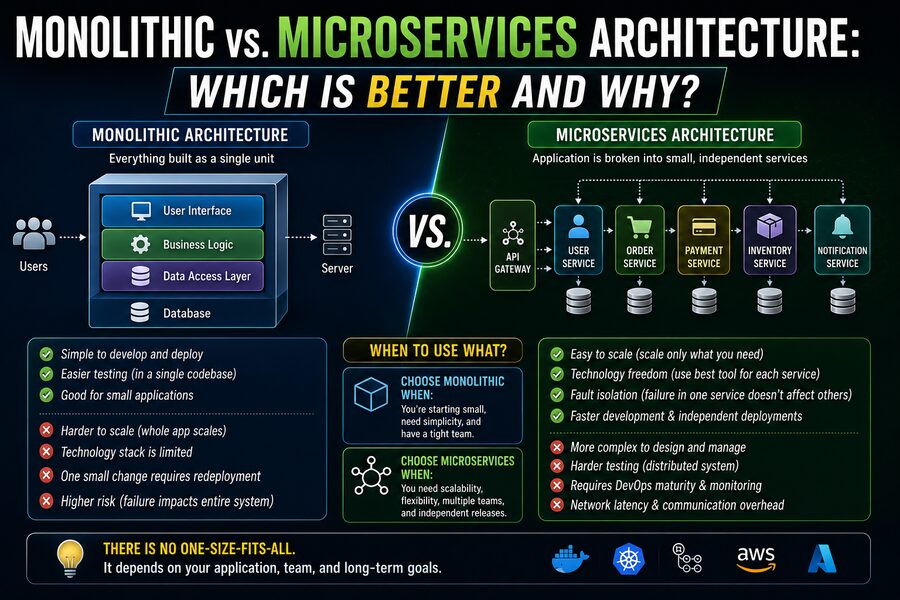
A monolith keeps most of the application inside one deployable system. Microservices divide the application into multiple independently deployable services, each responsible for a specific business capability.
The better choice depends on factors such as team size, product complexity, expected scale, deployment frequency, reliability requirements, operational maturity, and development speed.
So the real question is not:
“Are microservices better than monoliths?”
A more useful question is:
“Which architecture best matches the problem we are trying to solve?” 🤔
🧱 What Is a Monolithic Architecture?
A monolithic application is built and deployed as a single main software unit.
Imagine an online shopping application containing:
- User authentication
- Product catalog
- Shopping cart
- Payments
- Order processing
- Notifications
- Administration
In a traditional monolith, all these features may exist inside the same application codebase and run as part of the same deployed system.
A simplified structure might look like:
User Interface → Application Logic → Database
Even if the internal code is divided into modules, the application is usually built and deployed together.
This does not mean a monolith must be badly organized. A well-designed monolith can have clean internal boundaries, modular code, and excellent maintainability.
🔗 What Is Microservices Architecture?
A microservices architecture divides a system into smaller independent services.
Each service usually focuses on a specific business capability.
For the same online store, there might be:
- Authentication service 🔐
- Product service 📦
- Cart service 🛒
- Payment service 💳
- Order service
- Notification service 🔔
These services communicate over a network using technologies such as:
- HTTP APIs
- REST
- gRPC
- Message queues
- Event streams
Each service can often be developed, deployed, and scaled independently.
Instead of one large application, the organization operates a distributed system made of many cooperating applications.
⚙️ The Biggest Engineering Difference
The most important difference is where complexity lives.
A monolithic system concentrates complexity inside one application.
Microservices distribute complexity across the network.
This distinction is extremely important.
In a monolith, one function can often call another function directly.
For example:
Order Module → Payment Module
This may happen as a normal in-memory function call.
In microservices, the order service may need to contact the payment service across a network:
Order Service → Network Request → Payment Service
Now engineers must consider:
- Network latency
- Timeouts
- Retries
- Service failures
- Authentication
- Data serialization
- Version compatibility
Microservices can create excellent organizational boundaries, but they introduce the challenges of distributed computing. 🌐
🚀 Why Monoliths Are Often Easier to Build Initially
For many new projects, a monolith is the fastest way to begin.
Developers can run the complete application locally, make changes, test it, and deploy it as one unit.
There may be:
- One repository
- One deployment pipeline
- One application server
- One primary database
- One debugging environment
This simplicity reduces the amount of infrastructure required.
A startup building its first product often needs to answer a more important question than architecture:
Will customers actually want this product?
A monolith can allow the team to experiment rapidly without spending large amounts of engineering effort maintaining distributed infrastructure.
🧠 Monolith Does Not Mean “Old” or “Bad”
The word “monolith” is sometimes used negatively in software discussions.
But monolithic architecture is not inherently outdated.
A well-structured monolith can be:
- Fast
- Reliable
- Easy to deploy
- Easy to debug
- Cost-effective
- Highly scalable
Many successful applications have operated as monoliths for years.
The real problem is usually not that an application is monolithic.
The problem is when it becomes a poorly structured monolith where every feature depends on every other feature.
This is sometimes called a big ball of mud. 🧶
Good modular design matters regardless of architecture.
🧩 What Is a Modular Monolith?
A modular monolith is a single deployable application whose internal components are carefully separated.
For example:
Application
→ User Module
→ Billing Module
→ Orders Module
→ Inventory Module
Each module has defined responsibilities and boundaries.
The application is still deployed as one system, but engineers avoid unnecessary coupling between modules.
This approach can provide many benefits associated with microservices without immediately introducing network complexity.
For many organizations, a modular monolith is an excellent starting point. 🏗️
📦 Why Microservices Became Popular
Microservices became popular partly because very large organizations encountered problems with massive monolithic systems.
Imagine hundreds or thousands of developers working on one application.
A small change to the recommendation engine might require rebuilding and deploying the entire system.
Teams could interfere with each other’s work.
Deployment coordination could become difficult.
Different components might need very different scaling behavior.
Microservices attempt to solve these organizational and technical problems by creating independent boundaries.
A recommendation team can own one service.
A payments team can own another.
An inventory team can own another.
Each team can make changes without necessarily coordinating every release with the entire engineering organization.
👥 Team Independence Is a Major Microservices Advantage
Microservices are often as much about organizational architecture as software architecture.
Consider a company with 500 engineers.
If every developer modifies the same codebase and deployment pipeline, coordination can become extremely difficult.
Microservices allow teams to own complete business capabilities.
A team might control:
Code → Testing → Deployment → Monitoring → Operations
This autonomy can dramatically improve development speed at large scale.
However, if an organization has only five developers, dividing the product into 30 services may create far more overhead than benefit.
🚀 Independent Deployment
One of the strongest arguments for microservices is independent deployment.
Suppose a company wants to change the notification system.
In a monolithic architecture, that change may require deploying the whole application.
In a microservices architecture, only the notification service may need to be deployed.
This can reduce deployment risk and allow teams to release features independently.
However, true deployment independence requires careful API design.
If one service constantly requires simultaneous changes in five other services, the architecture is technically distributed but still tightly coupled.
That defeats much of the purpose.
📈 Independent Scaling
Another important advantage is the ability to scale services separately.
Imagine an e-commerce application.
The product catalog might receive millions of requests.
The internal administration system might receive only a few hundred.
In a monolith, scaling may mean running additional copies of the entire application.
With microservices, engineers can scale only the high-demand services.
For example:
Product Service → 100 instances
Admin Service → 3 instances
This can improve resource efficiency.
It is especially useful when different components have dramatically different workloads.
💥 Failure Isolation
Microservices can also improve failure isolation.
Suppose the recommendation service fails.
If the system is designed carefully, customers may still be able to:
- Search products
- Add items to carts
- Make purchases
Recommendations might temporarily disappear, but the entire store does not necessarily stop.
In a monolith, a severe problem in one component can potentially affect the whole process.
However, microservices do not automatically provide resilience.
Poorly designed service dependencies can create cascading failures where one unavailable service causes many others to fail.
Engineers must deliberately design for failure. 🛡️
🌐 The Network Becomes Part of the Application
In a monolith, communication between components is usually fast and reliable because it happens inside the same process.
With microservices, communication happens across networks.
Networks can:
- Slow down
- Drop packets
- Become unavailable
- Return requests out of order
- Experience partial failures
Distributed systems must therefore expect network problems.
Developers often implement:
- Timeouts
- Retries
- Circuit breakers
- Load balancing
- Service discovery
- Rate limiting
These systems add operational complexity that monolithic applications may not require.
⏱️ Latency Can Become a Problem
A local function call may complete in microseconds or less.
A network call can take milliseconds.
That may still seem fast, but latency can accumulate.
Imagine a user request requiring:
Service A → Service B → Service C → Service D → Service E
If every call adds latency, the final response may become significantly slower.
Engineers therefore try to avoid unnecessarily “chatty” microservice designs.
Sometimes multiple data requests can be combined, cached, or processed asynchronously to reduce latency.
🗄️ Database Design Changes Dramatically
Many monolithic systems use one shared relational database.
Different modules can participate in the same database transaction.
For example:
- Create an order.
- Deduct inventory.
- Record payment.
- Commit everything together.
If one step fails, the entire transaction can be rolled back.
This gives strong consistency guarantees.
Microservices often follow the principle that each service owns its own data.
For example:
Order Service → Orders Database
Inventory Service → Inventory Database
Payment Service → Payments Database
This improves independence but creates a difficult question:
How do we maintain consistency across several databases?
🔄 Distributed Transactions Are Difficult
Suppose a customer places an order.
The order service records the purchase.
Then the payment service must charge the card.
Then inventory must be reserved.
What happens if payment succeeds but inventory reservation fails?
There is no longer one simple database transaction containing everything.
Microservices often use patterns such as:
- Event-driven architecture
- Saga patterns
- Compensating transactions
- Eventual consistency
These techniques can work extremely well, but they require careful design.
This is one of the biggest conceptual differences between monolithic and distributed systems.
📨 Event-Driven Microservices
Microservices often communicate through asynchronous events.
For example:
Order Service publishes: “Order Created”
Then:
Inventory Service receives event → reserves stock
Notification Service receives event → sends email
Analytics Service receives event → updates statistics
The order service does not necessarily call each service directly.
This reduces coupling and can improve scalability.
Technologies such as message brokers and event-streaming platforms are often used.
However, event-driven systems introduce new concerns:
- Duplicate events
- Event ordering
- Delivery guarantees
- Schema changes
- Replay behavior
Distributed architecture solves some problems by creating new engineering problems.
🐛 Debugging a Monolith Is Usually Simpler
Suppose a user reports an error during checkout.
In a monolith, engineers may inspect one log stream and follow one application call stack.
In microservices, the request might travel through ten services.
The failure could originate anywhere.
Engineers need technologies such as:
- Centralized logging
- Metrics
- Distributed tracing
- Correlation IDs
- Observability dashboards
Distributed tracing allows engineers to follow a request across multiple services.
Without strong observability, debugging microservices can become extremely difficult. 🔍
📊 Monitoring Becomes Essential
Operating 50 microservices means monitoring 50 applications.
Teams need visibility into:
- CPU usage
- Memory usage
- Request rates
- Error rates
- Latency
- Database performance
- Queue depth
- Service availability
One failing instance may not matter if several healthy ones remain.
But engineers still need systems capable of detecting failures quickly.
Microservices therefore usually require a mature operational platform.
Technologies such as containers, orchestrators, service meshes, CI/CD pipelines, and centralized monitoring often become part of the architecture.
🐳 Containers and Microservices
Microservices are commonly packaged inside containers.
A container bundles an application with the environment needed to run it.
Container technologies make it easier to deploy many independent services consistently.
An orchestrator can then:
- Start services
- Stop services
- Replace failed instances
- Scale workloads
- Route traffic
However, containers are not exclusive to microservices.
Monolithic applications can also be containerized.
Likewise, microservices do not strictly require containers.
The concepts are related but separate.
🛡️ Security Becomes More Complex
A monolithic application may expose a relatively small number of external interfaces.
Microservices create many network endpoints.
Now engineers must secure communication between services.
Security concerns may include:
- Authentication
- Authorization
- Encryption
- Secret management
- API gateways
- Certificate management
- Network segmentation
An attacker who compromises one service should ideally not gain unrestricted access to every other service.
Microservices can create strong security boundaries, but only if they are deliberately designed and enforced.
💰 Infrastructure Cost
A small monolithic application may run on only a few servers or cloud instances.
A microservices architecture may require:
- Many compute instances
- Load balancers
- Message brokers
- Monitoring platforms
- Logging infrastructure
- Container orchestration
- Distributed databases
The cost is not only financial.
There is also engineering cost.
Teams need people capable of maintaining the platform.
For a small organization, this operational overhead can outweigh the architectural benefits.
🔧 Testing Is Different
Testing a monolith can often be straightforward.
The entire application may run locally, and integration tests can exercise many components together.
Microservices require more sophisticated testing strategies.
Developers may need:
- Unit tests
- Contract tests
- Integration tests
- End-to-end tests
- Service virtualization
- Test environments
A change in one service must not unexpectedly break another service.
Consumer-driven contract testing can help verify that service APIs remain compatible.
🔄 Versioning APIs Matters
In a monolith, changing a method signature can often be handled by updating all callers in the same codebase.
With microservices, different services may be deployed at different times.
Suppose Service A depends on version 1 of an API while Service B begins providing version 2.
Engineers must maintain compatibility during the transition.
This is why microservice APIs need careful evolution.
Breaking changes can become operationally expensive.
🔀 Technology Flexibility
Microservices can allow different teams to choose different technologies.
One service might use:
- Java
Another might use:
- Go
Another:
- Python
And another:
- Node.js
This is sometimes called polyglot architecture.
It can be useful when different technologies fit different workloads.
However, unlimited flexibility can create chaos.
If 20 services use 15 different languages and frameworks, maintaining expertise, security patches, and developer tooling becomes difficult.
Many organizations therefore standardize on a smaller approved technology set.
⚡ Performance: Which Architecture Is Faster?
For direct internal communication, monoliths often have a performance advantage.
Calling a function inside one process is generally much faster than making a network request between services.
Microservices introduce:
- Serialization
- Network latency
- Authentication
- Data transfer
- Additional infrastructure
However, microservices can sometimes improve overall system performance through independent scaling and workload specialization.
So there is no universal answer.
A monolith often has lower communication overhead.
Microservices offer greater scaling flexibility.
📈 Scalability Is More Than Traffic
People often assume:
“If my application gets large, I need microservices.”
Not necessarily.
Many monolithic applications can scale horizontally by running multiple copies behind a load balancer.
The more important question is whether different parts of the system need different scaling, deployment, ownership, or reliability characteristics.
If every component scales similarly, a monolith may remain perfectly reasonable.
Microservices become more attractive when parts of the system have strongly different operational needs.
👨💻 Small Teams Usually Benefit From Simplicity
Suppose a startup has four engineers.
If those four engineers create 25 microservices, they may spend a large percentage of their time maintaining:
- Deployment pipelines
- Cloud infrastructure
- API contracts
- Monitoring
- Service discovery
- Logging
- Network security
That is time they are not spending building customer features.
For many small teams, the best architecture is often a well-structured modular monolith.
If the business grows, specific modules can later be extracted into services when there is a clear reason.
🏢 Large Organizations May Benefit More From Microservices
Now imagine a global technology company with thousands of engineers.
A single monolithic deployment may become a serious organizational bottleneck.
Teams might need independent:
- Release schedules
- Scaling policies
- Ownership
- Reliability targets
- Technology choices
Microservices can allow each team to control its own area of the product.
At this scale, the additional infrastructure cost may be justified because it reduces coordination between large numbers of teams.
✂️ When Should a Monolith Be Split?
A monolith should not be split merely because it has become large.
Good reasons might include:
- One module needs dramatically different scaling.
- Different teams need independent deployment.
- One component requires strict fault isolation.
- A module has a clear business boundary.
- Development coordination has become a major bottleneck.
Poor reasons include:
“Microservices are modern.”
or:
“Large companies use them.”
Architecture should solve real problems, not follow trends.
🚨 The Distributed Monolith Problem
One of the worst outcomes is something called a distributed monolith.
This happens when an application is divided into many services, but the services remain tightly dependent on each other.
For example, deploying Service A requires simultaneously deploying B, C, and D.
Now the organization has:
- Microservice network complexity
- Distributed debugging problems
- Deployment overhead
but none of the true independence.
In many cases, this is worse than a normal monolith. 😬
Effective microservices require genuinely useful boundaries.
🧭 Domain-Driven Design Can Help Find Boundaries
One technique for identifying service boundaries is Domain-Driven Design, or DDD.
Instead of dividing services based on technical layers such as:
- User interface service
- Database service
- Validation service
DDD encourages teams to organize systems around business capabilities.
Examples might include:
- Orders
- Payments
- Shipping
- Inventory
- Customer accounts
Each capability owns the logic and data associated with its part of the business.
These boundaries are sometimes described using the concept of bounded contexts.
Good service boundaries tend to reduce unnecessary communication.
🧠 Conway’s Law and Software Architecture
A famous idea in software engineering is Conway’s Law.
It suggests that organizations tend to design systems that reflect their communication structures.
If a company has independent payments, search, and inventory teams, its software may naturally evolve into similar boundaries.
This helps explain why microservices often work well in large organizations.
The architecture mirrors the organizational structure.
For smaller companies with one tightly connected engineering team, forcing highly separated services may create artificial boundaries.
🔁 Migrating From a Monolith to Microservices
Organizations rarely need to rewrite everything at once.
A common strategy is the strangler pattern.
Engineers gradually extract one capability from the monolith.
For example:
Original Monolith
First extract:
Notification Service
Later:
Payment Service
Then perhaps:
Search Service
Over time, the monolith becomes smaller.
This gradual approach is usually less risky than attempting a complete rewrite.
📊 Monolith vs. Microservices at a Glance
🧱 Monolithic Architecture
Advantages:
- Easier initial development
- Simpler deployment
- Easier local testing
- Lower operational complexity
- Fast internal communication
- Easier transactions
- Often cheaper to operate
Challenges:
- Large deployments can become risky
- Teams may become tightly coordinated
- Scaling individual components is harder
- Large codebases can become difficult to maintain
- Failures can affect larger portions of the system
🔗 Microservices Architecture
Advantages:
- Independent deployments
- Independent scaling
- Strong team ownership
- Better fault boundaries
- Flexible technology choices
- Good fit for large organizations
Challenges:
- Network complexity
- Distributed data management
- Higher infrastructure cost
- Harder debugging
- More monitoring requirements
- More complicated testing
- Increased security surface
🏆 So Which One Is Better?
Neither architecture is universally better.
For a new product or small engineering team, a monolith is often the most practical choice.
For a large platform with many independent teams and different scaling requirements, microservices can provide enormous benefits.
A useful rule is:
Choose the simplest architecture that solves your current problems while leaving room for future evolution.
Do not introduce distributed complexity before it provides meaningful value.
In many cases, that means starting with a modular monolith and extracting microservices only when specific business or operational pressures justify them.
🌟 Final Thoughts
The debate between monolithic and microservices architecture is sometimes presented as a battle between “old” and “modern” software design.
That framing is misleading.
Both are architectural tools. 🛠️
A monolith centralizes software into one deployable unit and offers simplicity, straightforward transactions, lower operational overhead, and easier debugging.
Microservices divide the system into independently deployable services, providing stronger team autonomy, independent scaling, and fault isolation—but at the cost of distributed-system complexity.
The crucial trade-off can be summarized like this:
Monolith → simpler software operations, stronger internal coupling
Microservices → greater organizational independence, more distributed complexity
The best architecture depends on the system and the organization building it.
A five-person startup and a company with 5,000 engineers face completely different problems.
That is why good software architecture is not about choosing the most fashionable pattern.
It is about understanding your constraints and deliberately choosing the structure that creates the least unnecessary complexity while allowing the product and team to grow. 🧠🏗️
Sometimes that means one well-designed application.
Sometimes it means hundreds of independent services.
And often, the smartest path is to start simple—and split only when the benefits clearly outweigh the cost. 🚀