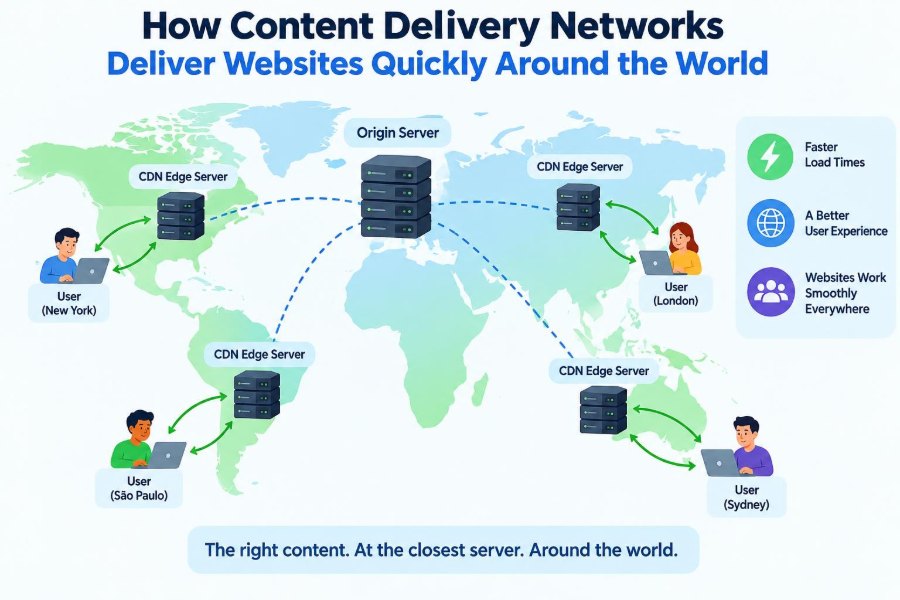

A student in Singapore opens a learning platform hosted in North America. A customer in Brazil loads a store built by a company in Europe. A colleague in Australia joins a product launch streamed from the same site.
In each case, the website may appear almost instantly—or it may feel frustratingly slow. The difference is often not the application code alone. It is the distance that data must travel, the route it takes, and how much work the origin server must do.
Content delivery networks, usually called CDNs, are designed to reduce those delays. They place copies of useful content closer to users and use distributed infrastructure to deliver requests efficiently.
Understanding CDNs matters for software engineers because they affect performance, reliability, security, architecture, deployment, and cost. They are not simply a “speed switch”; they are a carefully coordinated layer between users and an application.
🌐 1. The Basic Problem: Distance Creates Delay
Every network request takes time. A browser must reach a server, send a request, wait for a response, and receive the requested bytes.
When a user and server are far apart, signals cross more networks and travel farther through physical infrastructure. Even fast fiber-optic networks cannot eliminate the effects of distance.
Modern pages also make many requests for scripts, stylesheets, images, fonts, API data, and video. Small delays can accumulate into a noticeably slower experience.
🚚 2. What a CDN Is
A content delivery network is a distributed set of servers that stores, processes, or forwards web content from locations near users. These locations are commonly called points of presence, or PoPs.
Instead of every visitor fetching the same file from one origin server, many visitors can receive a cached copy from a nearby edge location. The word edge refers to infrastructure positioned closer to end users than the central origin.
A CDN is not necessarily a replacement for an origin server. It is usually an additional layer in front of it.
🏢 3. The Origin Server Still Matters
The origin is the authoritative source for a website’s content. It may be an application server, object storage bucket, load balancer, or another service that holds the original files and generates dynamic responses.
When the CDN does not have a suitable cached response, it requests that content from the origin. This event is called a cache miss.
The origin remains responsible for new content, uncached pages, personalized responses, database-backed operations, and business logic.
📍 4. Points of Presence Bring Content Closer
A PoP is a physical location containing CDN equipment, network connectivity, and edge servers. CDN providers operate PoPs in many regions and connect them through partnerships and private backbone networks.
When a user makes a request, the CDN aims to direct it to an appropriate PoP. “Closest” does not always mean geographically closest; it often means the location with the best network path, capacity, and health.
This reduces the amount of the journey that must reach the distant origin. ⚡
🧭 5. DNS Helps Choose Where a Request Goes
Before a browser can contact a website, it generally needs to resolve a domain name such as www.example.com into an IP address. DNS is often part of the CDN routing process.
A CDN can answer DNS queries with an address associated with a suitable edge location. The decision may use the resolver’s apparent location, network routing information, server availability, and traffic-management rules.
DNS-based routing is useful, but it is not perfect: the DNS resolver may not be in the same place as the user, and cached DNS answers can remain in use for a while.
🛣️ 6. Anycast Routes Users to an Available Edge
Many CDNs also use anycast. With anycast, multiple edge locations advertise the same IP address, and internet routing selects a reachable route to one of them.
This lets users connect to a nearby or well-connected edge without needing a different IP address for every location. It can also simplify failover when a particular site has a problem.
Routing decisions are made by network protocols, so the selected PoP is based on real network topology rather than a simple map measurement.
🗃️ 7. Caching Is the CDN’s Core Technique
Caching means storing a reusable copy of a response so it can be served again without repeating the original work. For a static image, that may avoid a trip to the origin entirely.
A cache entry is associated with a cache key, which commonly includes the requested URL and may include selected query parameters, headers, or cookies. The key determines which requests are considered equivalent.
Correct caching is as important as fast caching. If the key ignores information that changes the response, the CDN could serve the wrong content.
✅ 8. Cache Hits and Cache Misses
A cache hit occurs when the edge already has a fresh response that matches the request. The edge can return it immediately.
A cache miss occurs when no matching stored response exists, or when the stored response can no longer be used without checking the origin. The CDN then fetches, validates, or regenerates the response through the origin path.
A high cache-hit ratio can lower origin traffic, but it is not the only metric that matters. A site must also preserve correctness, freshness, and personalization.
⏳ 9. Cache-Control Defines Freshness
HTTP response headers tell browsers and shared caches how content may be stored and reused. The most important family is Cache-Control.
For example, a long-lived static asset might use a directive resembling public, max-age=31536000, immutable. A frequently changing HTML page may use a much shorter lifetime or require revalidation.
Engineers should choose policies based on how content changes, not on a desire to cache everything forever.
🔁 10. Revalidation Avoids Downloading Unchanged Content
When a cached response becomes stale, a cache does not always need to download the whole resource again. It can ask the origin whether its copy is still valid.
HTTP validators such as ETag and Last-Modified support conditional requests. If nothing changed, the origin can return a response indicating that the cached body may continue to be used.
Revalidation still requires a round trip, but it can save bandwidth and origin processing compared with transferring the full resource.
🏷️ 11. Versioned Assets Make Long Caching Safe
Build systems often create filenames containing a content hash, such as app.4f8c2a.js. When the file changes, its name changes too.
This pattern allows an asset to be cached for a long period because the browser requests a new URL when new content is deployed. Older versions remain available for pages that still reference them.
Versioned assets are one of the simplest and most reliable CDN optimization strategies.
🧹 12. Purging Removes Content Before It Expires
Sometimes a response must stop being served before its normal cache lifetime ends. A purge, also called invalidation, asks the CDN to remove or mark cached objects as unusable.
Teams may purge a URL after correcting a document, replacing an image, or responding to a publishing error. Some platforms also support tag-based or prefix-based invalidation.
Purging is valuable, but versioned URLs are often safer for static deployment because they reduce reliance on a global invalidation operation.
🧩 13. Static and Dynamic Content Need Different Strategies
Static files usually have the greatest caching potential because the same bytes can be served to many people. Images, JavaScript bundles, CSS, downloadable files, and fonts are common examples.
Dynamic responses are generated from current data, user identity, location, inventory, or application state. They may still benefit from CDN routing, connection reuse, request collapsing, or carefully scoped caching.
| Content type | Typical CDN approach |
|---|---|
| Hashed CSS and JavaScript | Cache for a long period at browser and edge |
| Public product image | Cache at edge, often with image optimization |
| Personal account page | Usually avoid shared caching |
| Public API catalog | Use a short cache lifetime or controlled revalidation |
🔐 14. Personalized Content Must Not Leak
A dangerous CDN configuration can cache one user’s private response and return it to another user. This can happen when caches fail to distinguish users or ignore authentication-related headers.
Authenticated pages, account data, checkout flows, and responses containing sensitive information generally need strict cache controls. In many cases, the CDN should pass them through without shared storage.
Engineers should explicitly test behavior around cookies, authorization headers, query strings, redirects, and error pages.
🧠 15. The Cache Key Is a Design Decision
The cache key answers: “Which request properties make this response different?” A basic key might use scheme, host, path, and query string.
Some applications also vary content by language, device capability, or accepted encoding. Including every header and cookie creates too many cache variations, while including too little risks incorrect responses.
Use only the request dimensions that genuinely affect the representation. This improves both correctness and cache efficiency.
🗜️ 16. Compression Shrinks Transfers
Text-based resources such as HTML, CSS, JavaScript, JSON, and SVG often compress well. CDNs can negotiate compressed variants using HTTP content encoding.
Smaller responses usually transfer faster and consume less bandwidth. The CDN may cache separate variants for different supported encodings, such as a modern compressed representation and a fallback representation.
Already compressed formats, including many images and videos, usually need different optimization techniques rather than general text compression.
🖼️ 17. Image CDNs Transform Media at the Edge
Images can dominate page weight. An image-focused CDN may resize, crop, convert, compress, and select an appropriate format based on the requested dimensions and browser capabilities.
Instead of storing every possible image size at the origin, an application can request a controlled transformation and cache the output at the edge. This is especially useful for responsive layouts.
Transformation URLs must be designed carefully to prevent arbitrary expensive operations or an unbounded number of cache entries.
🎥 18. Video Uses CDN Capacity Differently
Video delivery often divides media into short segments. A player requests segments as playback continues and can select different quality levels according to network conditions.
CDNs help by serving popular segments near viewers and absorbing high concurrent demand. Live events are particularly challenging because many viewers request newly created segments at nearly the same time.
Streaming does not remove the need for encoding, packaging, player logic, and origin planning, but it makes global distribution more practical.
🌊 19. CDNs Absorb Traffic Spikes
A product announcement, ticket release, or viral post can cause a sudden increase in requests. If many of those requests are cacheable, edge servers can answer them without sending every request to the origin.
This protects origin capacity and can prevent a popular static asset from becoming a bottleneck. Some CDNs also collapse simultaneous requests for the same missing object, reducing duplicate origin fetches.
However, a CDN cannot magically scale an uncached database transaction. Dynamic bottlenecks still require application-level capacity planning.
🛡️ 20. Security Is Often Delivered at the Edge
Because a CDN receives traffic before the origin, it is a useful place to apply security controls. Common capabilities include TLS termination, rate limiting, bot controls, web application firewall rules, and distributed denial-of-service mitigation.
These controls can block or challenge suspicious traffic before it reaches application infrastructure. They also centralize policy enforcement across regions.
Security features require careful tuning. Overly broad rules can block legitimate users, APIs, monitoring systems, or search crawlers.
🔒 21. TLS Is Part of Performance Too
HTTPS protects data in transit, but establishing secure connections involves negotiation and cryptographic work. Edge locations can terminate TLS close to users, reducing connection setup delay and offloading work from origins.
Connection reuse and modern HTTP protocols can further reduce overhead when browsers request many resources from the same host. A CDN can provide these capabilities consistently across a global footprint.
Certificate management remains an operational responsibility, even when a CDN automates much of the process.
⚙️ 22. Edge Computing Adds Controlled Logic
Some CDN platforms run small pieces of code at edge locations. This is often called edge computing or edge functions.
Useful tasks include redirects, request normalization, A/B test assignment, geographic routing, header changes, lightweight authentication checks, and selecting an origin. Running this work near users can avoid an extra trip to a central service.
Edge code has limits in runtime, storage, debugging, and consistency. It works best for focused request-handling logic, not as a careless replacement for an entire backend.
🔄 23. Multi-Layer Caching Reduces Origin Pressure
Content may be cached in several places: the browser, a service worker, a local CDN edge, a regional shield layer, and the origin infrastructure. Each layer can reduce work for the layers behind it.
Origin shielding designates an upstream CDN cache that receives misses from many edge PoPs. Instead of dozens of locations independently reaching the origin, they can reuse content through that shield.
This is especially helpful for globally popular resources and origins with limited connection capacity.
📊 24. Measure the Right Things
CDN performance should be observed from both user-facing and infrastructure perspectives. A fast edge response is useful only if the page still renders correctly and the application remains reliable.
Useful signals to monitor
- Cache-hit and cache-miss patterns
- Origin request volume and response time
- Response status codes and error rates
- Latency by region and network
- Bandwidth use for large assets and media
- Core user experience metrics collected from real browsers
Compare changes over time and across locations. A global average can hide a serious regional problem.
🧪 25. Test CDN Behavior, Not Just Application Code
Deployment testing should include headers and caching behavior. Verify that public assets receive the intended cache directives and private endpoints cannot be stored in a shared cache.
Test a first request and a repeated request. Check whether a changed asset gets a new URL, whether an invalidation works as expected, and whether query strings or headers create unintended cache fragmentation.
Use staging environments carefully: caches can make an old deployment appear current unless names, rules, and invalidation plans are deliberate.
🚧 26. Common CDN Mistakes
Many CDN issues come from treating caching as a provider default rather than an application design concern.
- Caching HTML aggressively without a dependable update strategy
- Forwarding every cookie and header, which makes responses effectively uncacheable
- Ignoring query-string rules and serving the wrong variant
- Using one URL for changing assets instead of versioning them
- Assuming the CDN makes slow origin APIs fast
- Skipping observability until a regional outage occurs
Clear ownership between application, platform, and security teams prevents these problems.
🧭 27. Choosing a CDN Architecture
The right setup depends on the application. A documentation site may need long-lived static caching, while a commerce site needs careful handling for product pages, APIs, carts, and logged-in sessions.
Start by identifying what is public, what changes often, what is private, and where users are located. Then define cache rules, origin routes, invalidation procedures, and fallback behavior for each class of content.
Architecture should follow content behavior—not just a checklist of CDN features.
🌍 28. The Core Principle: Put Reusable Work Near the User
A CDN improves delivery by moving reusable content and selected request-processing work closer to the people who need it. That reduces repeated origin work and avoids unnecessary long-distance trips.
The real goal is not merely a high cache-hit ratio. It is a system that serves correct, secure, current content quickly while keeping the origin available for work that truly must happen there.
When engineers combine thoughtful cache policies, versioned assets, safe personalization rules, edge routing, and careful measurement, a website can feel local even when its users are worldwide. 🌍⚡🛡️