
Modern software systems often need to handle thousands—or even millions—of actions at the same time. Users place orders, upload photos, send messages, request reports, receive notifications, process payments, and interact with services that depend on dozens of other systems behind the scenes. 💻🌐
If every part of a large application had to communicate directly and wait for every other part to finish, the entire system could become slow, fragile, and difficult to scale.
This is where message queues become extremely useful.
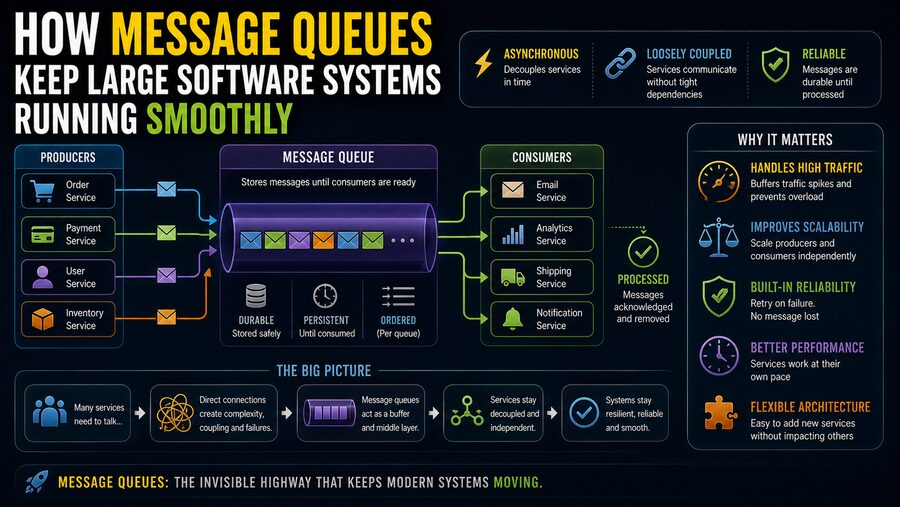
A message queue is a system that allows one part of an application to send a message that another part can process later. Instead of requiring two services to communicate at exactly the same moment, the queue acts as a temporary buffer between them.
The basic idea is:
Producer ➡️ Message Queue ➡️ Consumer
The producer creates a message.
The queue stores it temporarily.
The consumer retrieves and processes it.
This simple pattern helps large software systems remain responsive, handle traffic spikes, recover from temporary failures, and scale individual components independently. ⚙️📨
🧠 What Is a Message Queue?
A message queue is a software mechanism that stores messages until another application or service is ready to process them.
A message might contain information such as:
- An order ID
- A payment request
- An email notification
- A file-processing task
- A user registration event
- A request to generate a report
- A shipment update
The sender does not necessarily need to know exactly when the receiver will process the message.
This creates a powerful form of separation called decoupling.
Instead of one component directly depending on another, both depend on the queue.
That makes the overall architecture more flexible and resilient. 🔗
🛒 An Online Shopping Example
Imagine an online store.
A customer presses:
Place Order
Several things may need to happen:
- Save the order.
- Process payment.
- Update inventory.
- Send a confirmation email.
- Notify the warehouse.
- Generate analytics data.
- Create a shipping task.
A simple application might try to perform every task immediately before showing the customer a success message.
That creates a problem.
What if the email server is slow?
What if the analytics system is temporarily unavailable?
What if the warehouse service takes several seconds to respond?
The customer may be forced to wait even though those tasks do not all need to finish immediately.
A message queue provides a better architecture.
The checkout service might save the order and then publish messages such as:
OrderCreated
SendConfirmationEmail
ReserveInventory
StartFulfillment
Other services can process those messages independently.
The customer receives a response quickly while background systems continue working. 🛍️⚡
⏳ Asynchronous Processing
Message queues are closely associated with asynchronous processing.
In synchronous communication, one service calls another and waits for a response.
Conceptually:
Service A ➡️ Service B ➡️ wait ➡️ response
During that waiting period, Service A may be unable to complete its work.
With asynchronous communication:
Service A ➡️ Queue ➡️ continues working
Service B processes the message when it is ready.
This allows systems to perform more work without requiring every component to operate at the same speed.
Asynchronous processing is especially useful for tasks that can happen in the background.
Examples include:
📧 Sending emails
🖼️ Resizing images
📊 Generating analytics
🎥 Encoding videos
📄 Creating reports
🔔 Sending notifications
🧾 Processing logs
🚦 Queues Absorb Traffic Spikes
One of the most important advantages of message queues is their ability to act as a buffer.
Suppose an online ticketing system normally receives 1,000 requests per minute.
Suddenly, tickets for a major concert go on sale and the system receives 100,000 requests per minute. 🎟️
A backend processing service may not be able to handle that volume immediately.
Without a queue, incoming requests might overwhelm the service.
With a queue, messages can accumulate temporarily.
For example:
Incoming traffic: 10,000 tasks/sec
Worker capacity: 3,000 tasks/sec
The queue temporarily stores the excess 7,000 tasks per second.
As traffic drops, workers continue processing the backlog.
This smooths out sudden bursts of demand.
The concept is similar to a waiting line at a busy restaurant: customers do not all need to be served at the exact instant they arrive. 🍽️
⚙️ Producers and Consumers
Most queue-based systems involve two primary roles.
📤 Producer
A producer creates messages and places them into the queue.
Examples include:
- Web servers
- Mobile backends
- Payment systems
- IoT devices
- Database services
📥 Consumer
A consumer retrieves messages and performs work based on them.
Examples include:
- Email workers
- Image processors
- Payment processors
- Notification services
- Analytics pipelines
The queue sits between the two.
Because producers and consumers are separated, they can often be developed, deployed, and scaled independently.
📦 What Is Inside a Message?
A message usually contains enough information for the consumer to understand what needs to happen.
For example:
Order ID: 843192
Customer ID: 5192
Event: OrderCreated
Timestamp: 14:32:10
A message may also contain metadata such as:
- Priority
- Retry count
- Correlation ID
- Expiration time
- Routing information
Some systems send complete data inside the message.
Others send only an identifier and let the consumer retrieve additional data from a database.
The best approach depends on the application architecture.
🔁 Reliable Delivery
Large software systems must assume that failures will happen.
Servers crash.
Networks disconnect.
Databases become temporarily unavailable.
Applications may restart unexpectedly.
A robust message queue helps prevent work from being silently lost.
One common approach is called acknowledgment.
The sequence works like this:
Queue ➡️ Consumer receives message ➡️ Consumer processes it ➡️ Consumer sends acknowledgment
Only after receiving the acknowledgment does the queue consider the message successfully handled.
If the consumer crashes before acknowledging the message, the queue can make the message available again.
This allows another worker to retry the task. 🔄
♻️ Retry Mechanisms
Retries are extremely important in distributed systems.
Imagine a service trying to send an email.
The email provider is temporarily unavailable.
Instead of permanently failing the task, the system can retry later.
A retry strategy might look like:
Attempt 1 ➡️ failed
Wait 5 seconds.
Attempt 2 ➡️ failed
Wait 30 seconds.
Attempt 3 ➡️ success
This increasing delay is often called exponential backoff.
It prevents systems from repeatedly hammering an unavailable service.
Retries make temporary failures much less disruptive.
☠️ Dead-Letter Queues
Some messages cannot be processed successfully even after many retries.
Perhaps the data is malformed.
Maybe a required user account no longer exists.
Perhaps a software bug causes the same message to fail repeatedly.
Instead of retrying forever, systems often move the problematic message to a dead-letter queue, commonly abbreviated as DLQ.
The flow becomes:
Main Queue ➡️ repeated failures ➡️ Dead-Letter Queue
Engineers can then inspect these messages separately.
This prevents one bad message from continuously interfering with normal processing. 🛠️
📈 Message Queues Make Scaling Easier
Suppose one consumer can process 100 image-resizing jobs per second.
If the system suddenly needs to handle 500 jobs per second, developers may start additional consumer instances.
For example:
1 worker = 100 jobs/sec
5 workers = approximately 500 jobs/sec
All workers can read from the same queue.
The queue distributes messages among them.
This pattern is known as competing consumers.
It enables horizontal scaling, meaning capacity increases by adding more machines or application instances rather than relying on one extremely powerful server.
⚖️ Load Balancing Through Queues
Queues naturally distribute work.
Suppose ten workers are waiting for tasks.
As messages arrive, workers take available messages and process them.
Faster workers may complete tasks and request new messages more frequently.
Slower workers handle fewer.
This can create a form of dynamic workload balancing.
The queue therefore becomes both a communication mechanism and a work-distribution system. ⚙️
🔒 Decoupling Makes Systems More Resilient
Consider two services:
Order Service
and
Email Service
If the Order Service directly calls the Email Service whenever an order is created, then the Order Service depends on the Email Service being available.
If the email service crashes, order processing might also fail.
With a queue:
Order Service ➡️ Queue ➡️ Email Service
the order service can publish a message even if the email worker is temporarily unavailable.
The queue stores the message.
When the email service returns, it continues processing.
This reduces failure propagation.
One component can experience a temporary outage without necessarily bringing down the rest of the system.
🔄 At-Most-Once, At-Least-Once, and Exactly-Once
Message-delivery guarantees are an important design topic.
1️⃣ At-Most-Once
A message is delivered zero or one time.
Duplicates are avoided, but a failure may cause a message to be lost.
2️⃣ At-Least-Once
The system ensures a message is delivered one or more times.
Messages are unlikely to be lost, but duplicates can occur.
🎯 Exactly-Once
The goal is for the effects of a message to happen exactly once.
This is much harder to guarantee in distributed systems.
Many real-world architectures use at-least-once delivery and design consumers to handle duplicate messages safely.
🧠 Idempotency Prevents Duplicate Problems
Suppose a payment message is delivered twice.
If the payment system simply charges the customer every time it sees the message, the customer could be charged twice. 💳⚠️
To prevent this, consumers are often designed to be idempotent.
An idempotent operation can safely be repeated without changing the final result beyond the first successful execution.
For example, a payment service may store a unique transaction ID.
If it receives the same payment request again, it checks:
Has transaction 82391 already been processed?
If yes, it does not charge the customer again.
Idempotency is essential when systems use retries or at-least-once delivery.
📜 Message Ordering
Some applications require messages to be processed in a particular order.
Consider a bank account:
Deposit $100
then
Withdraw $50
If the messages are processed in the wrong order, the result could temporarily or permanently differ.
Some message-queue systems preserve ordering within specific queues or partitions.
However, maintaining strict global ordering can limit scalability.
Engineers therefore often preserve order only where it is actually required.
For example, messages for the same customer account might always use the same partition.
🧩 Queues and Microservices
Message queues are particularly common in microservices architectures.
A microservices application divides a large application into smaller services.
For example:
🛒 Order Service
💳 Payment Service
📦 Inventory Service
🚚 Shipping Service
📧 Notification Service
Instead of tightly coupling these services through direct calls, messages can represent events.
An Order Service might publish:
OrderCreated
The Inventory Service listens and reserves products.
The Payment Service processes payment.
The Notification Service sends confirmation.
This style is sometimes called event-driven architecture.
📣 Queues Versus Publish/Subscribe
Traditional queues often deliver a message to one consumer.
But sometimes several systems need to receive the same event.
Suppose an OrderCreated event must be processed by:
- Inventory
- Analytics
- Fraud detection
A publish/subscribe, or pub/sub, model allows multiple subscribers to receive the same event.
Conceptually:
Publisher ➡️ Event
Then:
➡️ Inventory Service
➡️ Analytics Service
➡️ Email Service
➡️ Fraud Service
This is related to message queuing but serves a slightly different communication pattern.
Modern messaging platforms often support both approaches.
🚌 Message Brokers
A message broker is software that receives, stores, routes, and delivers messages between applications.
Popular technologies historically and currently used for messaging include systems such as:
- RabbitMQ
- Apache Kafka
- Apache ActiveMQ
- Amazon SQS
- Google Cloud Pub/Sub
- Azure Service Bus
These technologies differ significantly in architecture and behavior.
Some focus on traditional queues.
Others operate more like durable event logs or streaming platforms.
The correct choice depends on requirements such as throughput, ordering, retention, latency, and delivery guarantees.
🌊 Message Queues Versus Event Streams
A traditional queue usually removes or marks messages complete after consumers process them.
An event-streaming platform may keep messages for a defined period even after they have been read.
This allows consumers to replay historical events.
For example:
Monday: OrderCreated event stored
Tuesday: Analytics service crashes
Wednesday: Analytics service restarts and replays Monday’s events
This is useful for auditing, analytics, and rebuilding system state.
Systems such as Kafka are commonly associated with this event-streaming model.
⏱️ Backpressure Protects Overloaded Services
What happens when messages arrive faster than consumers can process them?
The growing queue creates backpressure.
Backpressure is a signal that downstream systems are falling behind.
Engineers monitor metrics such as:
- Queue length
- Oldest message age
- Messages processed per second
- Failure rate
- Retry rate
If the queue grows rapidly, the system may automatically start more workers.
If scaling is not possible, the application may need to slow producers, reject low-priority work, or reduce incoming traffic.
Without backpressure management, systems can fail catastrophically under heavy load.
🕒 Delayed and Scheduled Messages
Some message systems allow messages to become available only after a specified delay.
This is useful for tasks such as:
⏰ Send reminder in one hour
📧 Retry email in five minutes
🛒 Expire shopping cart tomorrow
💳 Retry failed payment later
🔔 Send scheduled notification
Instead of building a separate timer service for every task, the queue can help schedule future work.
🎯 Priority Queues
Not every message has equal importance.
Imagine a customer-support system processing:
- Password-reset emails
- Marketing reports
- Fraud alerts
A fraud alert may need immediate attention, while a background analytics task can wait.
A priority queue allows important messages to be processed before lower-priority work.
However, priority systems must be designed carefully.
If high-priority messages arrive continuously, low-priority tasks might never be processed.
This problem is known as starvation.
🛡️ Message Queues Improve Fault Isolation
One of the biggest architectural advantages of queues is fault isolation.
Suppose a video-processing service stops working.
If uploads depend directly on that service, users may no longer be able to upload videos.
With a queue, uploads can continue:
Upload Service ➡️ Video Processing Queue
The queue stores pending jobs while processing workers recover.
Users may experience delayed processing rather than complete system failure.
This ability to degrade gracefully is critical for large internet services. 🌐
📊 Monitoring Is Essential
A queue does not automatically guarantee a healthy system.
Operators must monitor it.
Important metrics include:
Queue depth: How many messages are waiting?
Message age: How long has the oldest message waited?
Consumer throughput: How quickly are tasks being completed?
Error rate: How often does processing fail?
Retry rate: Are many messages being attempted repeatedly?
A queue containing one million messages may be perfectly healthy if workers are processing them rapidly.
But a queue with only 1,000 messages could signal trouble if those messages have been stuck for several hours.
Context matters. 📈
🔐 Security and Message Queues
Message systems often carry sensitive information.
Examples include:
- Customer IDs
- Payment references
- Medical data
- Authentication events
- Internal system commands
Organizations therefore protect queues using:
🔒 Encryption
🔑 Authentication
🛡️ Access control
📜 Audit logging
🌐 Network restrictions
Services should receive only the permissions they actually need.
A notification service, for example, may be allowed to read notification messages but not access payment-processing queues.
💰 Queues Can Reduce Infrastructure Cost
Queues can also improve infrastructure efficiency.
Without queues, companies may need enough computing capacity to handle the maximum possible traffic spike instantly.
That means expensive servers may remain mostly idle during normal periods.
With a queue, temporary spikes can be buffered and processed gradually.
This allows organizations to operate closer to average demand while scaling workers when necessary.
Cloud platforms often combine queues with automatic scaling to start or stop workers based on backlog size. ☁️⚙️
🧪 Message Queues Simplify Testing and Maintenance
Decoupled systems are often easier to maintain.
Suppose developers need to replace an old email provider.
If every service directly calls the provider, many applications may require changes.
If services simply publish:
SendEmail
messages, developers may replace the consumer that handles email while leaving producers unchanged.
This separation reduces dependencies and can make software evolution safer.
Teams can upgrade or redeploy services independently.
⚠️ Message Queues Add Complexity Too
Queues are powerful, but they are not free of challenges.
They introduce additional infrastructure and design concerns.
Developers must think about:
- Duplicate messages
- Message ordering
- Retries
- Dead-letter queues
- Monitoring
- Schema changes
- Consumer failures
- Security
- Message retention
- Capacity planning
Debugging asynchronous systems can also be more difficult because a user action may trigger processing across several services over time.
Tracing tools and correlation IDs are often used to follow a message through the system.
🔍 Correlation IDs Help Trace Work
Imagine a customer places an order and several messages are generated.
A correlation ID can be attached to all related operations.
For example:
Correlation ID: ORDER-928371
That ID might appear in logs from:
- Order Service
- Payment Service
- Inventory Service
- Email Service
- Shipping Service
If something goes wrong, engineers can search for the correlation ID and reconstruct the complete sequence of events.
This is particularly valuable in distributed architectures where work crosses many machines.
🌍 Real-World Uses of Message Queues
Message queues appear throughout modern technology.
They are used in:
🛒 E-commerce systems
🏦 Banking platforms
📱 Mobile applications
🎮 Online games
📧 Email services
🎥 Video-processing platforms
🚚 Logistics networks
🏥 Healthcare systems
📊 Data pipelines
☁️ Cloud platforms
🌐 Social networks
🏭 Industrial systems
A social media platform, for example, may queue jobs to resize uploaded images, moderate content, update feeds, send notifications, and calculate analytics.
A bank may queue transaction-processing and fraud-analysis tasks.
A logistics company may process millions of shipment-status events through messaging systems.
🏁 Conclusion
Message queues are one of the most important building blocks in large-scale software architecture because they allow different parts of a system to communicate without requiring everything to happen at the same moment. 📨⚙️
A producer creates a message.
The queue stores it safely.
A consumer processes it when capacity is available.
This simple separation brings major benefits.
Queues absorb traffic spikes, improve responsiveness, isolate failures, support retries, distribute workloads, and allow individual services to scale independently.
If an email server fails, messages can wait.
If traffic suddenly increases, the queue can absorb the burst.
If more processing power is needed, additional consumers can be started.
If one task repeatedly fails, it can be moved to a dead-letter queue for investigation.
The result is a system that can bend under pressure instead of immediately breaking.
For modern cloud platforms, microservices, e-commerce applications, financial systems, and large data pipelines, message queues act like invisible traffic-management systems. 🚦
They control the flow of work between services and prevent temporary congestion in one part of an application from disrupting everything else.
In essence:
Producers create work ➡️ queues organize and buffer it ➡️ consumers process it reliably
That architecture is one of the key reasons today’s largest software systems can continue operating even while handling huge volumes of requests, changing traffic levels, and inevitable component failures. 💻📨🌐